LOW, HIGH, WARM, fill level, liquid, and tenderness math
Slow Cooker Cooking Time Calculator
Estimate slow cooker cooking time from food type, cut size, weight, setting, cooker fill, liquid level, starting temperature, lid lifting, and final tenderness target.
Load a common slow cooker situation, then adjust the food, weight, setting, fill level, liquid, starting temperature, and texture goal.
Timing Breakdown
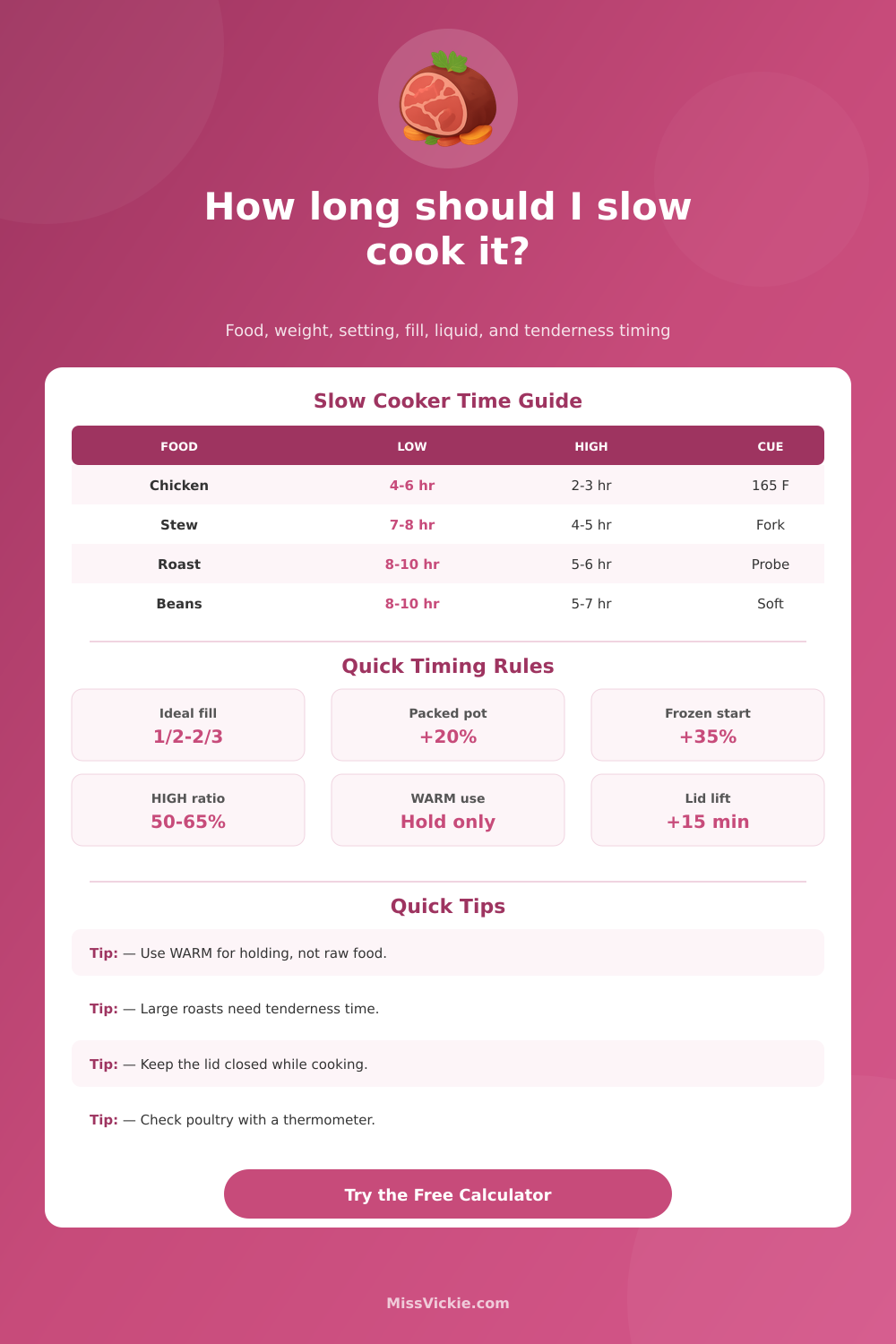
| Food Type | Typical LOW Time | Typical HIGH Time | Best Doneness Cue |
|---|---|---|---|
| Boneless chicken breast | 4 to 5.5 hours | 2 to 3 hours | 165°F, still juicy, not stringy |
| Chicken thighs or drumsticks | 5 to 7 hours | 2.5 to 4 hours | 165°F minimum and tender at the bone |
| Beef stew cubes | 7 to 8.5 hours | 4 to 5.5 hours | Fork slides into the largest cube |
| Chuck roast or pot roast | 8 to 10 hours | 5 to 6.5 hours | Probe tender through the thick center |
| Pork shoulder or butt | 9 to 11 hours | 5.5 to 7 hours | Shreds easily with light pressure |
| Soaked dry beans | 8 to 10 hours | 5 to 7 hours | Fully soft center with no chalky bite |
| Setting | Best Use | Timing Behavior | Watch Point |
|---|---|---|---|
| LOW | Large cuts, stew meat, beans, all-day meals | Most reliable tenderness curve | Start checking near the last 15 percent of the estimate |
| HIGH | Smaller batches, soups, chicken, weeknight meals | Usually 50 to 65 percent of LOW time | Lean meat can overcook if held after done |
| WARM | Holding fully cooked food or gentle reheating | Not a raw-food cooking setting | Use food-safe holding practices and avoid long quality holds |
| LOW then WARM | Meal ready before serving time | Cook first, then hold briefly | Texture softens during the hold |
| Fill Level | Timing Effect | Liquid Effect | Practical Adjustment |
|---|---|---|---|
| Under half full | Edges may run hot and finish faster | Liquid can reduce faster in shallow recipes | Check early and avoid long HIGH cooking |
| Half to two-thirds full | Baseline for most recipe timing | Best balance of simmer and moisture | Use the calculator result as the main plan |
| Two-thirds to three-quarters full | Heavier load heats more slowly | More food mass buffers the simmer | Add a modest timing buffer |
| Nearly full or packed | Slowest ramp and most uneven heating | Steam and sauce circulation are restricted | Add time and verify the center carefully |
| Starting State | Timing Effect | Liquid Guidance | Best Check |
|---|---|---|---|
| Hot sauce or preheated liquid | Shortens the warm-up phase | Use normal recipe liquid | Start texture checks earlier |
| Refrigerator-cold ingredients | Normal home-cooking baseline | Make sure sauce reaches a steady simmer | Check the thickest piece or center mass |
| Frozen or partly frozen pieces | Lengthens the schedule and increases uncertainty | Avoid low-liquid recipes with frozen centers | Thaw when possible and verify temperature |
| Cooked leftovers on WARM | Holding or gentle reheating only | Add sauce or broth if texture is drying | Use safe reheat and holding temperatures |
Slow cooker brands and crock shapes vary. The calculator gives a planning estimate; use safe internal temperature, visible simmering, and tenderness checks before serving.
A slow cooker is used to cook foods over a long period of time. Slow cookers allow cooks to prepare meal without having to supervise the cookware continuously. However, the length of time that it takes for the slow cooker to perform the cooking of the food are not always the same.
For instance, a three-pound chicken breast will require a different amount of cooking time then a three-pound pork shoulder. Additionally, if the cook changes the settings of the slow cooker, the time will change as well. Therefore, cooks must understand these different factor that can change the cooking process within the slow cooker to effectively prepare meals using that cooking utensil.
What Affects Slow Cooker Cooking Time
The settings for a slow cooker are usually LOW and HIGH. Each of these settings, however, are not merely different settings for the same cooking process. The LOW cooking setting is used to allow time for the collagen within the meat to relax, as well as to allow the vegetables to cook to the center of the vegetable, without the outer edges of the vegetable becoming too soft.
In contrast, the HIGH cooking setting will shorten the cooking time for the food within the slow cooker; however, it is more likely that lean meat will become dry when using this setting. Thus, cooks must understand the texture that they would like there food to have, as this will impact the cooking time required to prepare the food. The weight and the shape of the food that is to be cooked within the slow cooker will impact the cooking time.
For instance, foods that has a greater weight will require more time to reach the center of the food to the necessary temperature. Additionally, foods in the form of cubes will cook faster than foods that are in the form of roasts, even if the weights of each of the food items is the same. Additionally, food in the form of stew cubes will lose more of its juices than meat in the form of a whole roast, due to the fact that the juices will not be trapped within the meat.
The amount of food that is placed into the slow cooker, as well as the amount of liquid within that slow cooker, will impact the cooking time of the food. For instance, if the slow cooker is only one-third full with the food to be cooked, that food will lose more moisture than if the slow cooker was filled to capacity. Additionally, if the slow cooker is only one-third full, it will lose moisture due to the exposure of the food to the air.
Furthermore, if the slow cooker is nearly filled with the food to be cooked, the food will heat more slow than if the slow cooker was full. Additionally, if the slow cooker is nearly full, the slow cooker will require more time to heat the center of the food to the necessary temperature. Furthermore, the amount of liquid within the slow cooker is important to the cooking process.
The liquid will help to cook the collagen in the food to gelatin. Additionally, if there is too little liquid within the slow cooker, the edges of the food will cook before the center of the food is cooked. However, if there is too much liquid within the slow cooker, the sauce that is cooked will not be thick enough to coat the meat.
The starting temperature of the food that is placed into the slow cooker will also affect the cooking time of the food. For instance, if the food that is placed into the slow cooker started at the temperature of the refrigerated food, it will take the slow cooker longer to reach cooking completion than if the food started at room temperature. Additionally, if the food that is placed into the slow cooker is frozen, the cooking time will take place over a longer period of time because the slow cooker will take longer to melt the ice within the food than to heat the center of the food to the necessary temperature.
Thus cooks must be accurate with the starting temperature of the food to ensure that the cooking time is accurately calculate. Finally, small changes in the cooking process can alter the cooking time. For instance, if the cook lifts the lid of the slow cooker, the slow cooker will lose some of the heat that it is emitting.
Additionally, the amount of heat that each slow cooker emits can change. For instance, older slow cookers may cook the food to less heat than newer slow cookers. Finally, as the cooking time nears the estimated length of cooking for the food, the food should be tested with a thermometer.
Using a thermometer will allow cooks to understand if the food is finished cooking, and whether or not it will take more time to reach the proper doneness.