🍗 MissVickie chicken yield math
Raw to Cooked Chicken Weight Calculator
Estimate finished edible chicken from raw weight by cut, cooking method, bone and skin status, trimming, moisture loss, rest drain, serving size, and target servings.
Each preset loads a real cooking situation with cut, method, raw weight, bone and skin setup, moisture change, and serving target already filled in.
Yield Breakdown
Lean meat with little bone loss, but it dries faster under direct heat.
Package yield drops because rib bones and skin are not usually served.
More fat and connective tissue keep the cooked yield forgiving.
Higher edible yield than wings because the bone share is smaller.
Good party cut, but each piece carries a central bone and skin loss.
High bone and skin share makes cooked edible meat lower per raw pound.
Yield blends breast, thigh, drumstick, wing, carcass, and skin.
No bone loss, but pan rendering and draining can change final weight.
| Chicken cut | Raw bone or skin share | Typical cooked edible yield | Best calculator setting | Yield note |
|---|---|---|---|---|
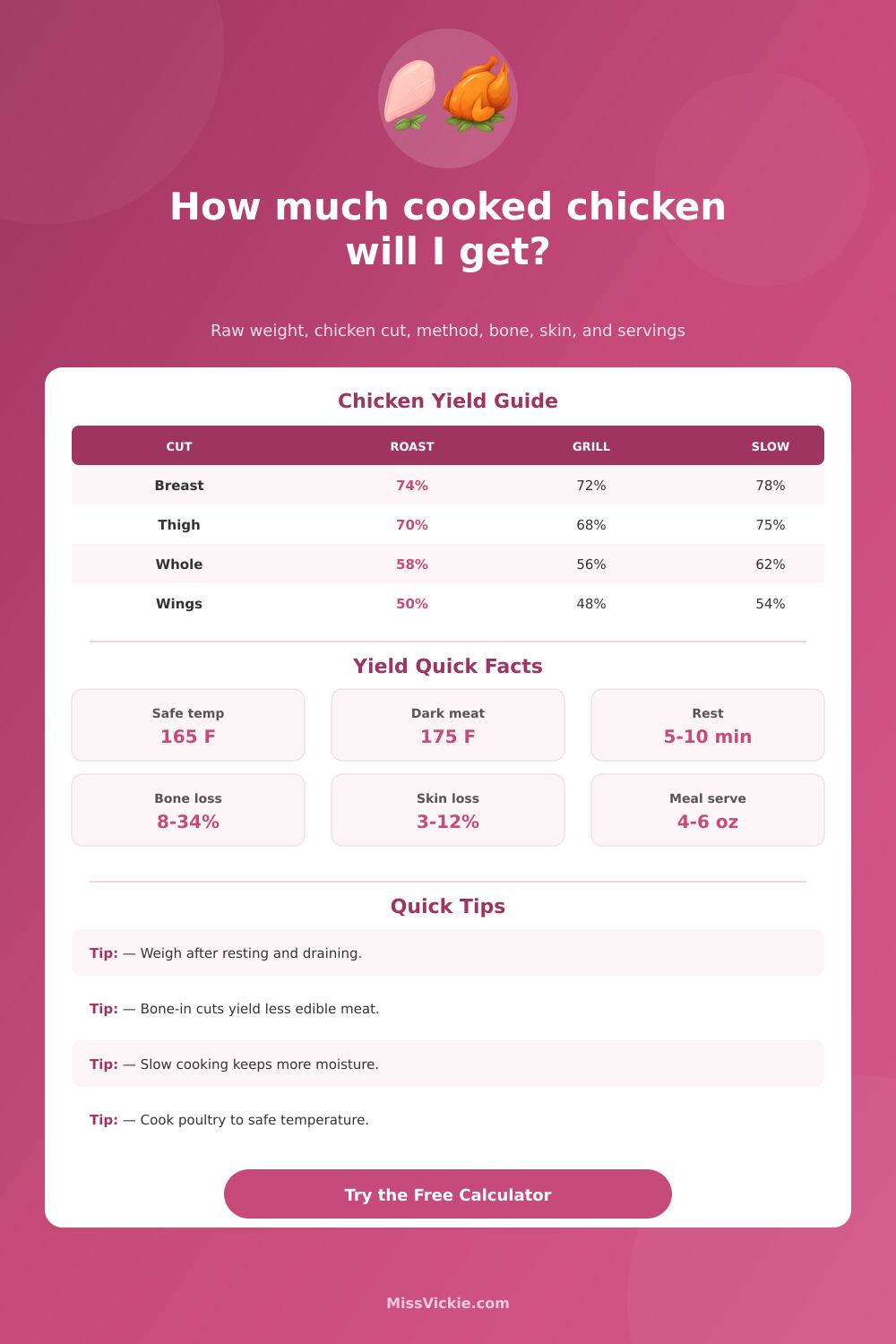
| Boneless skinless breast | 0 to 3% | 70 to 78% | Boneless skinless | Leanest common cut, so moisture loss drives most of the shrink. |
| Bone-in split breast | 22 to 32% | 56 to 66% | Bone-in skin-on | Bone and skin lower edible meat even when the breast stays juicy. |
| Boneless thighs | 0 to 5% | 69 to 77% | Boneless skinless or skin-on | Dark meat tolerates higher finish temperatures without severe drying. |
| Bone-in thighs | 18 to 28% | 58 to 68% | Bone-in skin-on | Higher collagen keeps the cooked meat moist after longer cooking. |
| Drumsticks | 26 to 36% | 55 to 64% | Bone-in skin-on | Good estimate for baked, grilled, or air-fried family trays. |
| Wings | 38 to 48% | 44 to 54% | Bone-in skin-on | Small pieces lose water quickly and carry a lot of bone per pound. |
| Whole chicken | 28 to 36% | 55 to 63% | Whole bird mix | Yield includes carved meat after carcass, wing tips, and excess skin. |
| Ground chicken | 0% | 72 to 82% | Boneless skinless | Drain loss and fat level matter more than cut structure. |
| Cooking method | Moisture loss bias | Best cuts | Yield behavior | Calculator hint |
|---|---|---|---|---|
| Oven roast or bake | Base | Whole bird, breasts, thighs | Balanced browning and moderate shrink. | Use 0% moisture adjustment first. |
| Grill | +3 to +7% | Thighs, drumsticks, wings | Direct heat and flare-ups increase surface drying. | Add moisture loss for hot grills. |
| Pan sear or saute | +2 to +6% | Boneless pieces, ground chicken | Small pieces lose water fast, especially when crowded then drained. | Increase rest and drain for ground meat. |
| Air fryer | +4 to +8% | Wings, tenders, thighs | Fast airflow crisps skin and reduces retained moisture. | Use smaller raw batches for accuracy. |
| Poach or simmer | -5 to -9% | Breast, tenders, salad chicken | Gentle liquid heat keeps more weight in the meat. | Use negative moisture adjustment if brined. |
| Slow cooker braise | -2 to -6% | Thighs, whole pieces, pulled meat | Meat stays wet, but shredding and draining still remove liquid. | Rest and drain loss may be higher. |
| Pressure cooker | -1 to -5% | Thighs, breasts, pulled chicken | Moist heat limits evaporation but liquid remains in the pot. | Count only drained edible meat. |
| Smoke or low barbecue | +4 to +10% | Whole bird, thighs, drumsticks | Long airflow can dry skin and exposed surfaces. | Use dark meat safety target for tenderness. |
| Food safety check | Target | Use for | Yield effect | Note |
|---|---|---|---|---|
| Standard poultry finish | 165 F | Breast, tenders, ground chicken | Base shrink | Check the thickest part with a food thermometer. |
| Dark meat tender finish | 175 F | Thighs, legs, drumsticks | Small extra shrink | Dark meat often tastes better when cooked beyond the minimum. |
| Shreddable pulled chicken | 185 F | Slow cooker, pressure cooker, smoked thighs | More collagen breakdown | Expect easier shredding and more drained juices. |
| Hot-hold service | 165 F plus hold | Buffets, meal prep pans | Extra moisture loss | Holding uncovered can lower final weight noticeably. |
| Target servings | Light serving | Meal serving | Hearty serving | Common use |
|---|---|---|---|---|
| 4 people | 1 lb cooked | 1.25 lb cooked | 1.5 lb cooked | Weeknight dinner or salad topping. |
| 8 people | 2 lb cooked | 2.5 lb cooked | 3 lb cooked | Tacos, pasta, rice bowls, or casseroles. |
| 16 people | 4 lb cooked | 5 lb cooked | 6 lb cooked | Potluck trays and meal prep proteins. |
| 30 people | 7.5 lb cooked | 9.4 lb cooked | 11.3 lb cooked | Buffet pans, barbecue, or sandwich service. |
When you are planning to prepare a meal that includes chicken, you must determine how much raw chicken you must purchase in order to ensure that you have enough cooked chicken to serve all of the individuals that you plan to feed. You cant simply use the weight of the raw chicken that is listed on the package because some of that weight will be lost during the cooking process of the chicken. The weight of the chicken will decrease as a result of the evaporation of the water from the chicken, the rendering of the fat from the chicken, and the removal of the bones and skin from the raw chicken.
Understanding how and why the chicken will lose this weight allows you to purchase the correct amount of raw chicken for your meal. Not all cuts of chicken will lose the same amount of weight. For instance, you will lose a different amount of weight from a boneless chicken breast as compared to a bone-in chicken thigh.
How to Buy the Right Amount of Raw Chicken
The lean white meat will lose more moisture from the chicken than the dark meat will. The dark meat will contain more fat and connective tissue than the white meat, and it will hold onto its liquid for longer. A calculator that estimate the amount of chicken that will be available after cooking can account for these variations in the cuts of chicken.
The methods that you use to cook your chicken will also alter the weight of the chicken that you have after cooking. For instance, oven roasting will cause some shrinkage of the raw chicken, but grilling or air frying the chicken will cause the loss of more of its moisture. Poached and slow-cooked chicken will remain in its liquid form, so the weight of the chicken will be similar to the initial weight of the raw chicken.
However, pressure cooking will allow the liquid to remain within the chicken, though some of it will be lost to draining the pot. You can account for these different methods by adjusting the estimate of the amount of raw chicken that is required to provide the amount of cooked chicken that you require for your meal. The amount of the raw chicken that you trim prior to cooking will alter the weight of the raw chicken that you purchase.
Many chickens contains the extra fat and skin that will not be used in the prepared meal. By removing this fat and skin prior to cooking the chicken, you will reduce the initial weight of the raw chicken that you must purchase. Additionally, some of the liquid will drain from the chicken after it is cooked; by allowing the chickens to rest and drain of its liquid, you will again reduce the amount of raw chicken that you will have once it is cooked.
This drain loss can be accounted for in the calculator of the amount of raw chicken that you should purchase. The temperature to which you heat your chicken will also alter the weight of the cooked chicken. Chicken must be cooked to a minimum of 165 F to ensure food safety, especially for the white meat portion of the chicken.
However, the dark meat can be cooked to a higher temperature as it is thought that higher temperatures tastes better in the dark meat. The higher the temperature to which you cook your chicken, the more the collagen in the chicken will break down. The more collagen that breaks down, the more liquid that will drain from the chicken.
Therefore, if you plan to use the chicken for tacos or barbecue, you may want to cook it to a higher temperature; however, you will have less raw chicken than if you cooked it to 165 F. The calculator can account for this factor to determine the weight of raw chicken that you should purchase for your meal. Finally, the variables of your kitchen will also impact the weight of raw chicken that you will have after cooking. For instance, different ovens have different temperatures, and different-sized chicken pieces will cook at different rates.
Additionally, placing chicken into a pan will allow the chicken to steam, while air frying the chicken will allow the chicken to dry out. These variables can again be accounted for with a variable moisture factor in the calculator that will help to estimate the amount of raw chicken that you should purchase for your meal. Another factor to consider is the portion size of the cooked chicken that you would like to serve each individual.
Four ounces of cooked chicken is a common portion size for salads, but six ounces is provided as a portion size for main courses. The calculator will ask for the weight of each portion of chicken that you desire to serve; with this information, the calculator will determine how many servings that one package of chicken will provide. Additionally, the calculator will tell how much raw chicken that you need to purchase to serve a specific number of guests to your dinner table.
This information will allow you to avoid purchasing too little or too much raw chicken for your meal. It is common for cooks to make the mistake of purchasing chicken based off solely upon the weight of raw chicken that is requested of the recipe. When the chicken is cooked, however, they often discover that they do not have enough cooked chicken for their meals.
Other cooks may purchase too much chicken, and end up with leftovers that are too dry to eat afterwards. It is a habit that is valuable to learn to think backwards from the meal that you wish to prepare. You can first determine how much cooked chicken that each person should receive.
Then, you can calculate how much raw chicken that would provide after losses of weight from the chicken. This same logic can be used to determine the amount of raw chicken that you would need to purchase if you were preparing a large meal for a number of guests. While the percentage of yield from raw to cooked chicken will remain the same if you cook larger quantities of chicken, cooking more chicken will allow you to account for potential inconsistencies in the kitchen.
For instance, if you are preparing a meal for twenty people, you may desire to purchase an extra half pound of raw chicken for every ten servings that you wish to prepare. The tool that calculates the raw chicken that you should purchase can account for these scenarios. The value of this tool is in the ability of the tool to match the weight of the cooked chicken that you actualy prepared.
If the weight of your cooked chicken is less than that which was calculated by the tool, then you should adjust the loss of moisture or drain loss of the chicken. If, on the other hand, you have prepared too much chicken to eat, you should adjust the trim loss of the chicken or the cooking methods that you use in the kitchen. With the adjustments to the tool according to your cooking experiences, the tool will become a reliable tool in your preparation of meals.