Juice Yield Calculator
Estimate how much fresh juice you will get from fruit or vegetables using produce type, count or weight, juicer method, pulp level, trim loss, and target servings.
🧃Quick presets
⚙Yield inputs
Estimated juice yield
Your fresh juice estimate will appear here.
🍎Produce comparison grid
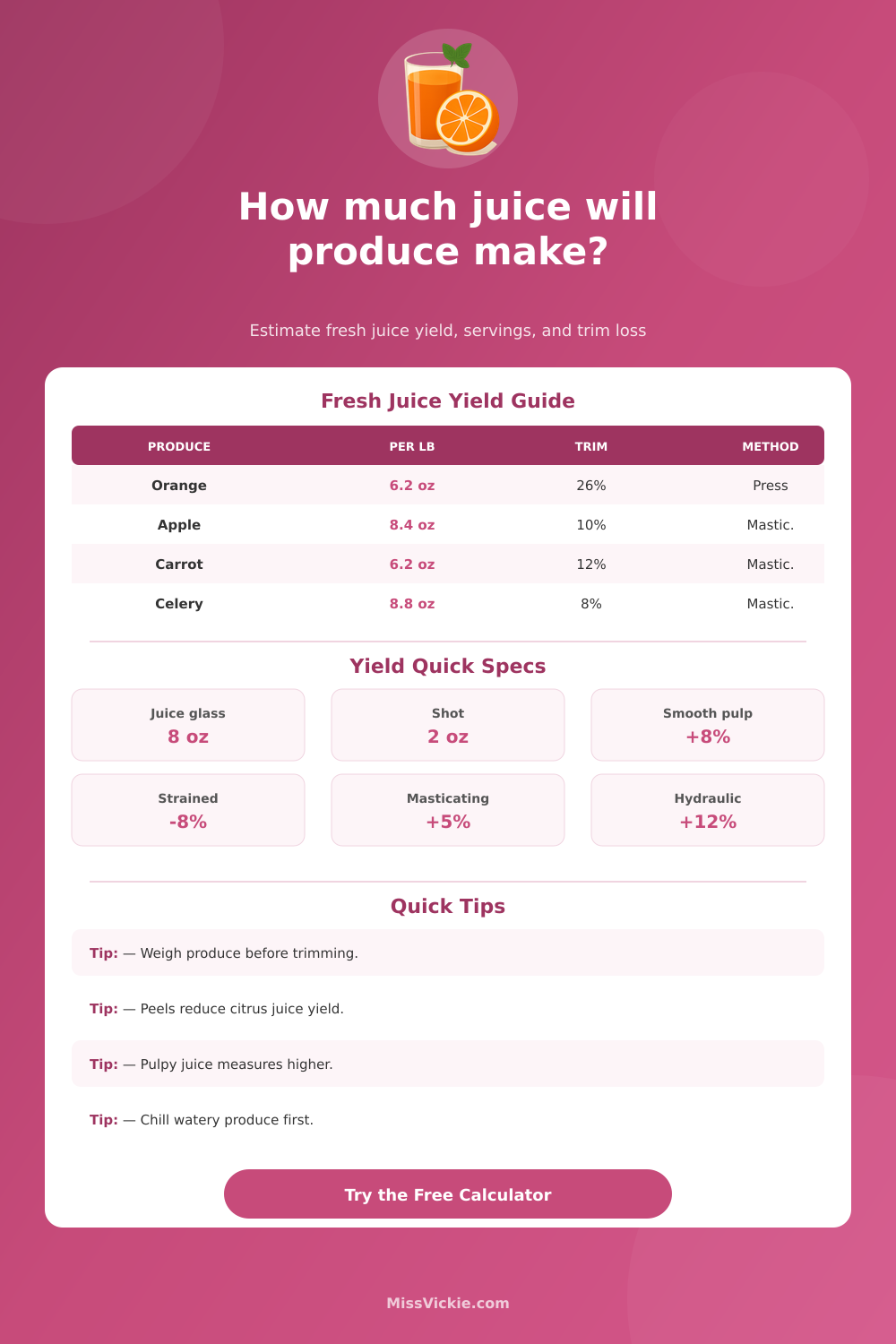
These quick cards compare typical juice yield from 1 lb of whole produce after average peel, core, rind, or stem loss.
📊Yield reference tables
| Produce | Average unit | Default trim | Base yield from edible weight | Approx juice from 1 lb whole |
|---|---|---|---|---|
| Orange | 185 g each | 26% | 50 ml per 100 g | 183 ml / 6.2 fl oz |
| Lemon | 95 g each | 22% | 42 ml per 100 g | 149 ml / 5.1 fl oz |
| Lime | 67 g each | 20% | 38 ml per 100 g | 138 ml / 4.7 fl oz |
| Grapefruit | 246 g each | 32% | 52 ml per 100 g | 160 ml / 5.4 fl oz |
| Apple | 182 g each | 10% | 58 ml per 100 g | 237 ml / 8.0 fl oz |
| Carrot | 72 g each | 12% | 44 ml per 100 g | 176 ml / 6.0 fl oz |
| Celery | 40 g stalk | 8% | 62 ml per 100 g | 259 ml / 8.8 fl oz |
| Pineapple | 900 g each | 42% | 55 ml per 100 g | 145 ml / 4.9 fl oz |
| Watermelon | 4.5 kg small | 48% | 70 ml per 100 g | 165 ml / 5.6 fl oz |
| Leafy greens | 250 g bunch | 18% | 30 ml per 100 g | 112 ml / 3.8 fl oz |
| Juicer method | Yield factor | Best produce | Notes |
|---|---|---|---|
| Masticating slow juicer | 105% | Apples, carrots, celery, greens | Slow crushing extracts more liquid from fibrous produce. |
| Centrifugal juicer | 95% | Apples, carrots, celery | Fast and convenient, but pulp often stays wetter. |
| Citrus press | 100% | Oranges, lemons, limes, grapefruit | Best when peel and pith are excluded from the starting edible weight. |
| Blender then strain | 88% | Watermelon, pineapple, citrus | Some juice stays trapped in pulp unless pressed hard. |
| Hydraulic press | 112% | Apples, greens, pineapple | Highest extraction when produce is crushed before pressing. |
| Trim level | Use when | Typical loss | Yield effect |
|---|---|---|---|
| Light trim | Apples, carrots, celery | 5% to 12% | Most starting weight becomes edible produce. |
| Moderate peel | Oranges, lemons, limes | 18% to 28% | Good juice yield, but peel weight is meaningful. |
| Thick rind | Grapefruit, pineapple, melon | 32% to 50% | Buy more whole produce to reach the same serving target. |
| Heavy cleanup | Wilted greens or over-trimmed fruit | 50% to 70% | Use only when discard is unusually high. |
| Serving plan | Serving size | Total juice needed | Good use |
|---|---|---|---|
| Tasting shot for 8 | 2 fl oz / 60 ml | 16 fl oz / 475 ml | Strong ginger, lemon, or wheatgrass blends. |
| Breakfast for 4 | 8 fl oz / 237 ml | 32 fl oz / 950 ml | Orange, apple, carrot, or celery juice. |
| Large glass for 6 | 12 fl oz / 355 ml | 72 fl oz / 2.13 L | Party pitchers and brunch service. |
| Meal prep bottles | 10 fl oz / 296 ml | 50 fl oz / 1.48 L | Five ready-to-chill juice bottles. |
Yield values are practical kitchen estimates. Actual juice depends on produce variety, freshness, blade or auger condition, cut size, and how firmly pulp is pressed.
💡Juice yield tips
Making juice at home can be dificult because the amount of liquid that different produces yields is often difficult to predict. If you purchase some produce and place it into a juicer, the amount of juice that the produce will yield may not be the amount that you were hoping for. The amount of juice that the produce will yield depends on several different variable that can be accounted for before beginning the juicing process.
By understanding these variables, you can better plan your shopping for the produce that you will needed. The amount of juice that the produce will yield can vary due to the fact that the produce is a biological product. An orange that one season produced may contain more juice than an other orange that was produced during a different season.
How to Tell How Much Juice You Will Get
The same can be said for the amount of juice that a given apple will produce if the apple was stored in a drawer for a period of time as opposed to one that was recently pick from a tree. These variables is not accounted for on the produce labels, so you must use a calculator to determine the amount of juice that the produce will yield. This tool will calculate the amount of juice that you can expect from your produce if you input the type of produce that you will be juicing.
Another variable is the trim loss of the produce. If you weigh the produce prior to juicing, you can enter a trim percentage into the calculator to determine the amount of the produce that will actually pass through the juicer. This will provide a different and more accurate measurement then the weight of the produce that is listed on the grocery bag.
The same can be said for produce like leafy greens, wherein the stem and leaves of the produce account for a portion of the weight. By accounting for trim loss, you can better determine the amount of juice that your produce will yield. The type of juicer that you use to juice your produce can change the amount of juice that is yielded.
Slow masticating juicer tend to produce more juice from fibrous vegetables when compared to centrifugal juicers. Centrifugal juicers are generally faster at juicing produce, but may leave more of the liquid residue within the produce. Citrus juicers work differently than the other types of juicers, as they are used to juice halved fruit, but are not used to juice produce like apples or carrots.
By entering different types of juicers into the tool, you can determine which machine you should use. Another variable that may impact the amount of juice that the produce yields is the amount of pulp that is contained within the juice. If you juice the produce in a manner that leaves the pulp within the juice, more juice will be produced than if you removed the pulp before juicing the produce.
Additionally, the juicing of more ripe produce will yield more juice than that which is not as ripe. These variables can explain the differences in the juice that is produced within different batches of produce. These variables are noted within the tool to provide you with an understanding of the reasons for the fluctuations in the amount of juice that may be produced.
The reference tables that are available within the tool provide information regarding the amount of juice that will be produced from a pound of produce. The tables also note the impact that different juicing machines and trim loss can have upon the total amount of juice that can be produced. While the numbers within the reference tables do not need to be memorized, they can be of use when you are attempting to produce a large batch of juice.
Due to the variables within the kitchen, such as the sharpness of the blade on a juicer or whether the produce has been frozen prior to juicing, the amount of juice that will be produced can change. Additionally, the amount of pressure that you use to press the pulp will change the amount of juice that is produced. Because of these variables, the calculator is only a starting point for juicing recipes.
In addition to calculating the amount of juice that will be produced, the calculator allows you to plan your shopping trips. By entering the number of servings that you wish to produce, you can determine how many oranges you will need to purchase. Additionally, if you enter the number of servings, you can also determine how much additional produce you will need to purchase if you wish to produce juice for another day.
By planning according to servings, you will not find yourself without juice to enjoy during the meal. By thinking about the variables that impact the amount of juice that can be produced prior to juicing the produce, juicing can become a repeatable process. You can use the tool and process to determine which fruits will contain the most juice relative to the amount of space that they take up within your refrigerator.
Additionally, you can use the tool to determine which juicing methods will work best for the types of produce that you purchase, and how much trim loss can be accounted for prior to juicing the produce. Once you are familiar with the different variables, you can utilize the tool only when you change your plan for juicing.