Vinegar to Water Ratio Coffee Maker Converter
Convert reservoir size into vinegar, water, descaling solution strength, cycle volume, rinse water, and timing for drip, pod, espresso, thermal, and commercial coffee makers.
Load a realistic reservoir, vinegar strength, machine type, hardness level, and rinse plan, then adjust the vinegar to water ratio for your own coffee maker.
Ratio Breakdown
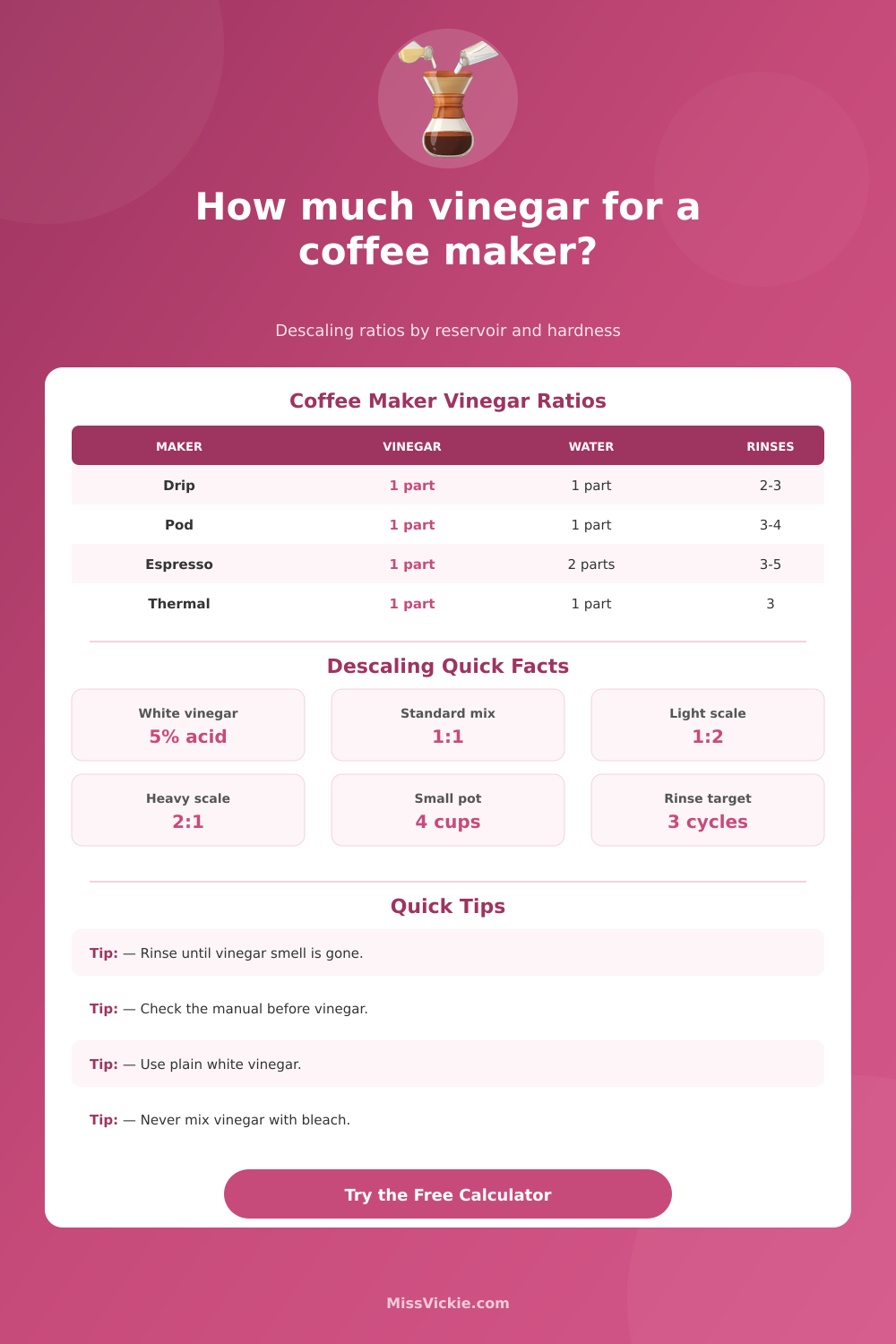
These quick cards use standard 5% white vinegar, a normal drip-style descaling cycle, and a 1:1 working mix before hardness and machine adjustments.
| Reservoir Size | Light Scale 1:2 | Standard 1:1 | Heavy Scale 2:1 | Fresh-Water Rinse |
|---|---|---|---|---|
| 4 cups / 32 fl oz / 950 ml | 1.3 cups vinegar + 2.7 cups water | 2 cups vinegar + 2 cups water | 2.7 cups vinegar + 1.3 cups water | 8 to 12 cups total |
| 6 cups / 48 fl oz / 1.4 L | 2 cups vinegar + 4 cups water | 3 cups vinegar + 3 cups water | 4 cups vinegar + 2 cups water | 12 to 18 cups total |
| 8 cups / 64 fl oz / 1.9 L | 2.7 cups vinegar + 5.3 cups water | 4 cups vinegar + 4 cups water | 5.3 cups vinegar + 2.7 cups water | 16 to 24 cups total |
| 10 cups / 80 fl oz / 2.4 L | 3.3 cups vinegar + 6.7 cups water | 5 cups vinegar + 5 cups water | 6.7 cups vinegar + 3.3 cups water | 20 to 30 cups total |
| 12 cups / 96 fl oz / 2.8 L | 4 cups vinegar + 8 cups water | 6 cups vinegar + 6 cups water | 8 cups vinegar + 4 cups water | 24 to 36 cups total |
| Vinegar Type | Typical Acidity | Standard Target Mix | When to Use | Calculator Adjustment |
|---|---|---|---|---|
| White vinegar | 5% | 1 part vinegar to 1 part water | Most drip and pod coffee makers | Baseline strength |
| Cleaning vinegar | 6% | 5 parts vinegar to 7 parts water | Harder scale with less total vinegar | Uses less vinegar for same acid target |
| 10% concentrate | 10% | 1 part vinegar to 3 parts water | Only when diluted carefully | Caps vinegar share for safer dilution |
| Apple cider vinegar | 5% | 1 part vinegar to 1 part water | Backup option if odor is acceptable | Same acid math, stronger smell note |
| Rice vinegar | 4.3% | 3 parts vinegar to 2 parts water | Mild emergency substitute | Needs more vinegar to match strength |
| Condition | Acid Target | White Vinegar Ratio | Soak Choice | Rinse Plan |
|---|---|---|---|---|
| Soft water, monthly upkeep | 1.6% to 2.0% | 1 part vinegar to 2 parts water | No pause needed | 2 full reservoirs |
| Moderate water, normal scale | 2.3% to 2.7% | 1 part vinegar to 1 part water | Run a normal descale cycle | 3 full reservoirs |
| Hard water, visible deposits | 2.8% to 3.2% | 3 parts vinegar to 2 parts water | Pause halfway for 20 minutes | 3 to 4 full reservoirs |
| Very hard water, slow flow | 3.2% to 3.6% | 2 parts vinegar to 1 part water | Pause-and-soak cycle | 4 to 5 full reservoirs |
| Machine Type | Minimum Rinses | Better Rinses | Odor Check | Why It Matters |
|---|---|---|---|---|
| Automatic drip | 2 tanks | 3 tanks | Smell carafe steam | Removes vinegar from showerhead and carafe path |
| Single-serve pod | 3 tanks | 4 tanks | Run without pod | Small lines can hold sour odor longer |
| Home espresso | 3 tanks | 5 tanks | Flush wand and group | Narrow passages need more fresh water |
| Thermal carafe brewer | 3 tanks | 4 tanks | Check lid gasket | Sealed lids hold vinegar aroma |
| Office brewer | 3 tanks | 5 tanks | Discard first brew | Larger plumbing volume keeps solution behind |
Machine style changes how much of the reservoir should be filled, how strong the solution should be, and how many fresh-water rinses feel clean.
Full tank works well for most 8 to 12 cup home machines.
Use several small brew pulses and add an extra rinse cycle.
Milder vinegar mix protects narrow paths; check the manual first.
Plan more rinse water because lids and gaskets hold aroma.
Keep vinegar out of the grinder and clean the brew path only.
Larger tanks and hard-water use often need stronger solution.
Mineral buildup within coffee maker can lead to flat tasting coffee and slow water flow from the coffee maker. Mineral buildup occurs within the lines and the heating element of the coffee maker. A mixture of vinegar and water will help to loosen the mineral buildup within the coffee maker.
However, the amount of vinegar and the amount of water that is used must be correct. The correct amount of vinegar and water depends upon the size of the coffee maker’s reservoir, the acidity level of the vinegar, and the hardness of the water that is used within the coffee maker. Should the user use the incorrect amount of vinegar and water, the mineral buildup may remain within the coffee makers lines, or the vinegar and water mixture may be wasted due to having to rinse the coffee maker with fresh water prior to brewing coffee.
How to Clean a Coffee Maker with Vinegar and Water
The calculator that is provided will handle the mathematical calculations necessary to determine the amount of vinegar and water that should be mixed together. The information that must be entered into the calculator includes the size of the reservoir of the coffee maker, the type of coffee maker that is to be descaled, the acidity of the vinegar, and the hardness of the water that is used within the coffee maker. Based off this information, the calculator will calculate the amount of vinegar and water that will need to be mixed together for one cycle of descaling the coffee maker.
Additionally, the calculator will calculate the number of reservoirs (of fresh water) that will be necessary to rinse the coffee maker after the descaling cycle. Rinsing the coffee maker with fresh water after descaling is necessary in order to remove any vinegar that may otherwise flavor the brewed coffee for multiple brewing cycles. Different types of coffee makers may require different approaches to descaling coffee makers due to the different structures of coffee makers of each type.
For instance, drip coffee makers may allow for the use of a one-to-one mixture of vinegar and water. Single-serve pod coffee makers may require that the descaling process take longer to rinse the coffee maker due to the narrower passage within the coffee maker. Finally, espresso coffee makers may experience mineral buildup within their boilers and group heads due to the high temperatures at which the coffee makers operate.
Each of these types of coffee makers may have different settings within the calculator to account for their different structures so that the same recipe for the vinegar and water mixture isnt used within each type of coffee maker. The hardness of the water that is used within the coffee maker may impact the descaling process of the coffee maker. For instance, coffee makers that use water that contains few minerals (soft water) will experience less mineral buildup within the coffee maker than coffee makers that use hard water, which contains more minerals.
Therefore, the amount of vinegar that is used with soft water may be less than the amount of vinegar that is used within coffee makers that use hard water. The strength of the vinegar that is used may vary depending upon the type of vinegar. For instance, white vinegar may contain 5% acidity, which is the default setting for the vinegar strength within the calculator.
Other common vinegars that may be used to descale coffee makers include cleaning vinegar that contains 6% acidity, 10% vinegar concentrate that is very strong and should never be added to coffee makers without first diluting it with water, and apple-cider or rice vinegar that may have a stronger odor that may require more rinsing cycles to remove after brewing coffee. The coffee maker user can select each of these types of vinegar within the calculator. One of the last steps in the process of descaling coffee makers is rinsing the coffee maker with fresh water.
Rinsing the coffee maker will separate a coffee maker that has been descaled from a coffee maker that may still have an odor of vinegar within its lines. The calculator will calculate the number of rinse cycles by multiplying the size of the coffee maker’s reservoir by the number of rinse cycles that is required by the type of coffee maker that is being descaled. Additionally, if the setting for the hardness of the water is hard within the coffee maker, an extra number of rinse cycles will be accounted for in the calculation performed by the calculator.
The coffee maker should be rinsed until the steam and brewed coffee no longer contain the scent of vinegar. Coffee makers that brew drip coffee may require three full tanks of water to rinse the coffee maker, but espresso coffee makers may require five tanks of fresh water to effectively rinse the coffee maker. Some coffee maker users may choose to skip the rinse cycle or may choose to perform insufficient rinsing steps after descaling the coffee maker.
If coffee makers are not rinsed properly after descaling, the coffee that is brewed by those coffee makers will have a sour taste to the coffee. Additionally, commercial descaling packets are available for coffee makers, however, these packets may cost more money than vinegar yet require the same number of rinsing cycles to effectively remove the minerals that have built up within coffee makers over time. Thus, vinegar may be a cheaper method of descaling coffee makers if the proper amount of vinegar with the appropriate strength is used within coffee makers.
The size of the reservoir of the coffee maker may be more important than the amount of coffee that is brewed by the coffee maker. For instance, a coffee maker that is rated at a twelve cup capacity may only brew ten cups of coffee at a time. Yet, the reservoir of the coffee maker can still hold twelve cups of liquid within the coffee maker.
When descaling coffee makers, the reservoir of the coffee maker should be filled with the vinegar and water mixture so that each line within the coffee maker is rinsed with the descaling solution. The coffee maker users should use the size of the reservoir of the coffee maker instead of the number of cups of coffee that may be brewed by the coffee maker in a cycle. Coffee makers may be descaled at regular intervals based upon the choice of the coffee maker user.
For instance, it is possible to perform maintenance on the coffee maker each month to prevent the formation of mineral buildup within the coffee maker. In contrast, if six months or more pass between each descaling cycle, then a stronger vinegar solution may be required to effectively remove the mineral buildup within the coffee maker. The settings within the calculator allow the coffee maker user to adjust the type of coffee maker, the strength of the vinegar, the hardness of the water, the number of rinse cycles, and the cycle that will be performed to descale the coffee maker.
To effectively use the calculator, the coffee maker user should enter the details of their coffee maker and the water that is used within the coffee maker. After entering these variables, the coffee maker user should run the cycle that is calculated by the descaling calculator and rinse the coffee maker until the vinegar smell is completely gone.