Bread Machine Loaf Size Converter
Resize bread machine recipes by original loaf size, target loaf size, flour weight, hydration, pan capacity, yeast type, salt level, and cycle style.
Pick a real bread machine situation, then fine-tune the flour, hydration, yeast, salt, and pan capacity before calculating the scaled loaf.
Loaf Conversion Breakdown
| Ingredient | Target grams | Imperial cue | Baker percent |
|---|
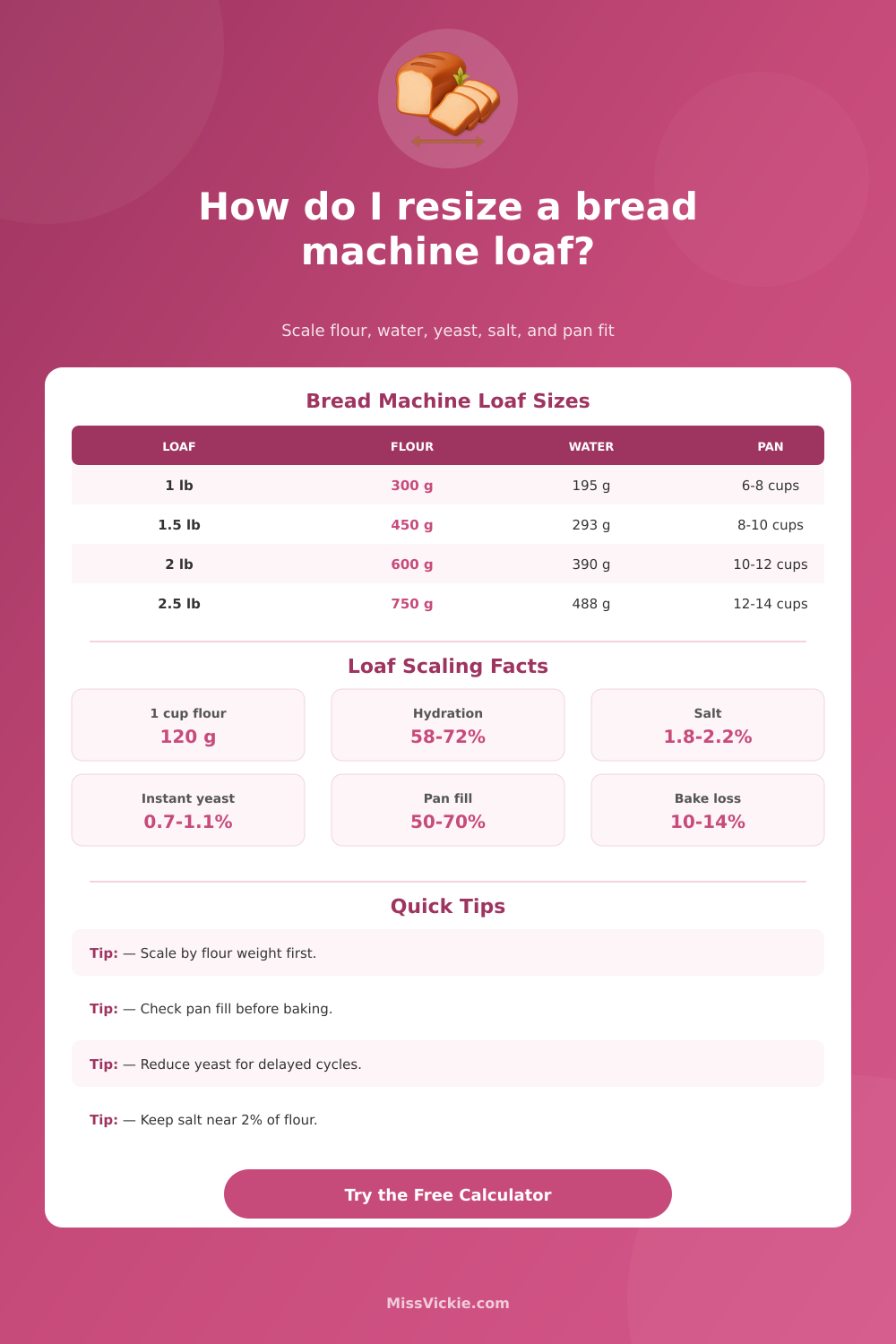
About 300 g flour, 560 g dough, and a 6 to 8 cup pan.
About 450 g flour, 840 g dough, and an 8 to 10 cup pan.
About 600 g flour, 1120 g dough, and a 10 to 12 cup pan.
About 750 g flour, 1400 g dough, and a 12 to 14 cup pan.
| Loaf size | Typical flour | Estimated dough | Best pan capacity |
|---|---|---|---|
| Mini 0.75 lb | 225 to 250 g | 420 to 470 g | 5 to 6.5 cups |
| 1 lb loaf | 280 to 330 g | 520 to 620 g | 6 to 8 cups |
| 1.5 lb loaf | 420 to 480 g | 780 to 900 g | 8 to 10 cups |
| 2 lb loaf | 560 to 640 g | 1040 to 1200 g | 10 to 12 cups |
| 2.5 lb loaf | 700 to 800 g | 1300 to 1500 g | 12 to 14 cups |
| Pan capacity check | Fill level | What it means | Adjustment |
|---|---|---|---|
| Under 40% | Low | Short loaf, dry sides possible | Use smaller pan or larger target size |
| 40% to 50% | Modest | Safe but may bake squat | Use light crust or check early |
| 50% to 70% | Ideal | Good bread machine expansion room | Keep the recipe close |
| 70% to 78% | Full | Watch high-rising doughs | Reduce flour 5% or yeast 10% |
| Over 78% | Overflow risk | Dough may touch the lid | Downsize recipe before baking |
| Bread style | Hydration range | Sugar and fat | Machine note |
|---|---|---|---|
| Basic white | 60% to 66% | Low to moderate | Reliable on basic cycle |
| Soft sandwich | 62% to 68% | Milk, sugar, and fat help softness | Good medium crust loaf |
| Whole wheat | 68% to 78% | Small fat helps texture | Use whole wheat cycle if available |
| Sweet enriched | 58% to 64% | Higher sugar and fat slow yeast | Sweet cycle prevents overbrowning |
| Gluten-free | 88% to 105% | Often batter-like | Use gluten-free setting |
| Ingredient | Typical baker percent | For 450 g flour | Scaling warning |
|---|---|---|---|
| Water or milk | 58% to 75% | 260 to 338 g | Change slowly by 10 g at a time |
| Salt | 1.8% to 2.2% | 8 to 10 g | Do not scale by spoon heaps |
| Instant yeast | 0.7% to 1.1% | 3.2 to 5 g | Use less for delay timer |
| Sugar | 2% to 12% | 9 to 54 g | High sugar slows fermentation |
| Fat or oil | 2% to 8% | 9 to 36 g | Too much can make a low dome |
A bread machine loaf size converter is a tool that allows people to adjust the size of a bread recipe to match the capability of the specific bread machine that they own. Many bread recipes is written for a bread machine that will produce a 1.5-pound loaf of bread, but individuals may own a different model of bread machine that can produce a 2-pound loaf, for instance. Without being able to adjust the amount of water, yeast, and salt that is required to bake a loaf of bread of the appropriate size, its impossible to successfully bake bread with a bread machine that is of a different size then the recipe describes.
A bread machine loaf size converter allows for these variables to be adjusted automatically, so that each recipe can be made to fit the specific bread machine and desired loaf size of an individual. Bread machine loaf size converters typically begin by asking for the weight of the flour that will be used in the recipe. Flour is the primary ingredient in a batch of bread, and all of the other ingredient are measured in relation to the weight of the flour.
How to Use a Bread Machine Loaf Size Converter
If the initial recipe’s flour weight is used as the starting point for the bread machine loaf size converter, and if the converter knows the ratio of the initial recipe to the target loaf size that is desired, it can automatically calculate the amount of each ingredient that should be used in the new batch of bread. One of the factors that needs to be considered in a bread recipe is the hydration level. Hydration levels refers to the amount of water in the recipe in comparison to the weight of the flour that is to be used.
Different types of bread contain different hydration levels due to the way in which the flour reacts to the water. For instance, bread that contains whole wheat flour require a higher hydration level due to the presence of the bran in that type of flour, while sweet bread recipes often contain less hydration than bread recipes that use only white flour. The bread machine loaf size converter will maintain the hydration percentages of the original recipe, but will adjust the amount of water that must be used for the changed loaf size.
The amount of yeast that is required to make bread also need to be adjusted with changes in loaf size. The amount of yeast will impact both the rate at which the dough rises during baking, as well as the flavor of the resulting loaf of bread. The bread machine loaf size converter will adjust the amount of yeast that is calculated according to the cycle that is to be used to bake the bread.
For instance, cycles that incorporate a delay timer will require less yeast than cycles that require the dough to rise rapid. Like the amount of yeast, the amount of salt that is used in recipes cannot be ignored. Salt is required to make dough, as it helps to strengthen the gluten in the dough.
Additionally, the salt slows the rate at which the dough ferment. Most bread recipes contain between 1.8 and 2.2 percent of the weight of the flour in salt. The bread machine loaf size converter will maintain the percentage of salt in the recipe automatically.
Another factor in the creation of bread is the size of the pan in which the bread is to be baked. Even if the other ingredients are properly measured for the size of the pan in which the bread will be baked, the bread machine loaf size converter can also calculate in what extent the pan will become filled with dough when baked. Ideally, the dough should fill the pan to 50-70% of the pans capacity.
Fill levels that are below 40% of the pan’s capacity may result in a loaf of bread that is too short in size and too dry in texture. Fill levels that are too high, at 78% of the pan’s capacity or higher, may cause the bread to overflow the pan. Tables can be created that show the different weights of flour that are typically used in recipes of different sizes, as well as the capacity of the pan of common models of bread machines.
These tables are not a replacement for the measurements of ingredients that is to be used when baking bread. However, these tables can help people to determine if the desired loaf size is realistic with the bread machine that they own. Although bread machine loaf size converters are accurate in the measurements of each ingredient in a recipe, there are some variables in the kitchen that the bread machine is unable to consider.
For instance, the amount of humidity in the kitchen can impact the amount of water that the flour absorbs during the baking process. Additionally, the protein level in the flour may change the amount of liquid that the dough can absorb. Finally, any ingredients that are added to the dough other than those listed in the recipe will increase the total weight of the bread and cause it to fill the pan at a faster rate than is calculated by the bread machine loaf size converter.
As such, people should of use the bread machine loaf size converter as a starting point for the ingredients for the batch of bread. One of the most common mistakes in baking bread in a bread machine is changing only the flour and the water in a recipe, but leaving the amount of yeast and salt to the original amounts that were stated in the recipe. Using only this amount of yeast can cause the baked bread to be too dense and may lead to the bread collapsing after it is baked.
Additionally, people may ignore the suggested fill level for the pan. Even if the amount of ingredients is correctly measured, if the loaf of bread will be too large for the pan, baking the bread will result in overflow. These types of mistake can be avoided by using the bread machine loaf size converter.
To use a bread machine loaf size converter, individuals will have to first select the type of bread that will be made, the weight of the flour that will be used in the recipe, the size of the loaf of bread that will be made with that recipe, and the target size for the loaf. The bread machine loaf size converter will provide the weight of water, salt, and yeast that should be used in the recipe to make the indicated amount of bread. Additionally, the bread machine will also calculate the amount of the pan that will be filled with the dough once baked.
Using these parameters, an individual can decide if the bread recipe is reasonable as suggested by the bread machine loaf size converter. With the use of the bread machine loaf size converter, individuals will be able to learn the different ways that different types of bread can behave in the bread machine.