Slow Cooker Low to High Converter
Convert a LOW slow cooker recipe to HIGH with recipe time, food type, batch size, liquid level, cooker fill, starting temperature, and tenderness target adjustments.
Load a common slow cooker recipe, then tune the size, liquid, fill level, and tenderness goal for your pot.
Timing Breakdown
Slow climb, gentler simmer, best for collagen, beans, and unattended recipes.
Faster heat-up at the element, but the food still cooks in a moist simmering environment.
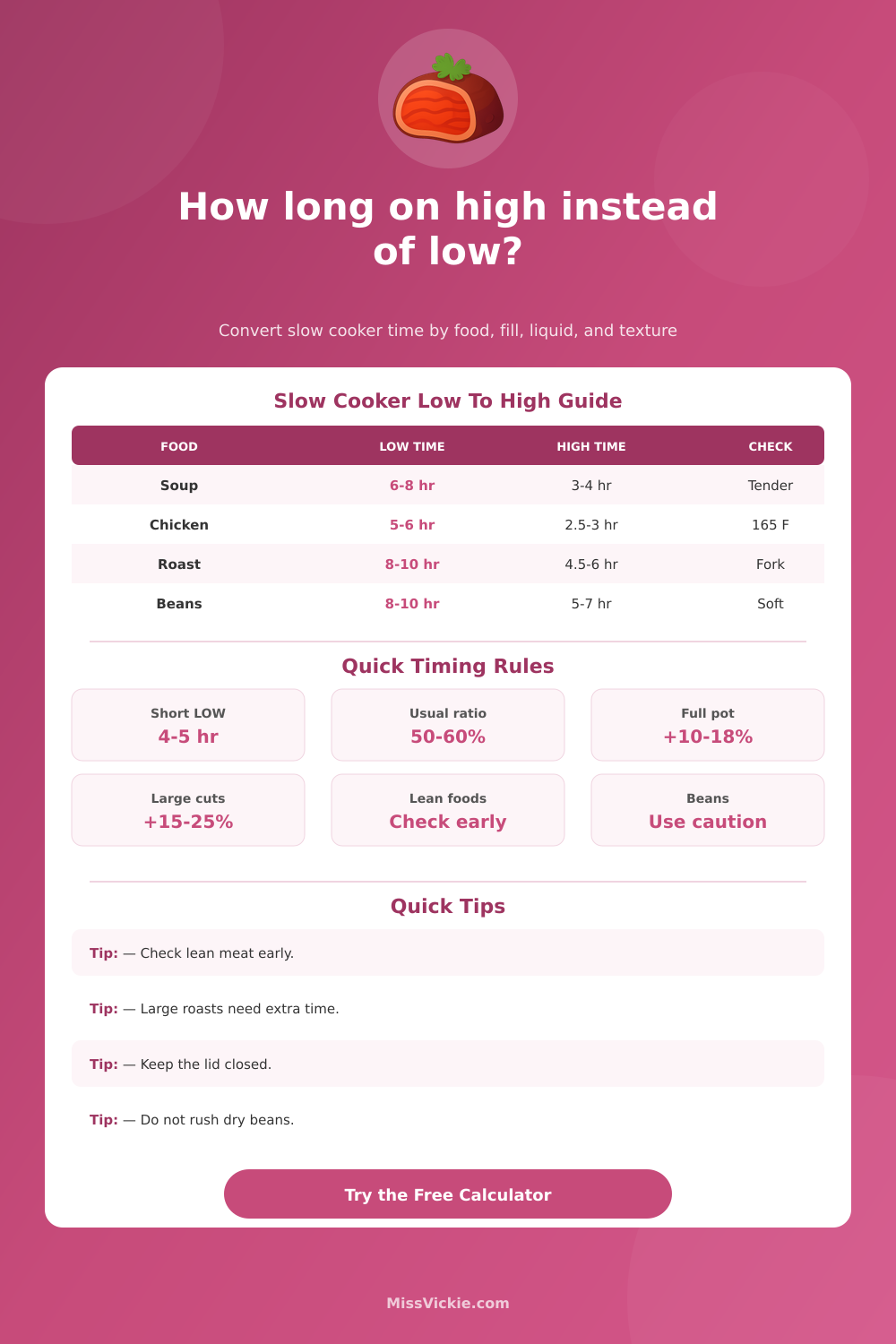
Most LOW recipes convert to a little more than half the time on HIGH.
Chicken breast, fish, and desserts need earlier checks than roasts or soups.
| Original LOW Time | Basic HIGH Estimate | Best For | Check Strategy |
|---|---|---|---|
| 3 to 4 hours on LOW | 1.75 to 2.5 hours on HIGH | Thin chicken, dips, desserts, small vegetable sides | Start checking early because small recipes can overcook quickly |
| 5 to 6 hours on LOW | 2.5 to 3.5 hours on HIGH | Chicken pieces, meatballs, chili, soft vegetables | Check for safe temperature and sauce simmering near the lower end |
| 7 to 8 hours on LOW | 3.75 to 5 hours on HIGH | Stews, soups, small roasts, braised thighs | Use tenderness checks once the center is hot and bubbling |
| 9 to 10 hours on LOW | 4.75 to 6.5 hours on HIGH | Chuck roast, pork shoulder, beans, dense root vegetables | Expect extra time for large cuts and shred-apart texture |
| 11 to 12 hours on LOW | 6 to 8 hours on HIGH | Very large roasts, bean pots, heavily loaded cookers | Do not compress too aggressively; texture needs time after simmering |
| Food Type | HIGH Conversion Behavior | Safety or Doneness Cue | Texture Note |
|---|---|---|---|
| Soups and thin stews | Often close to half of the LOW time | Steady simmer and tender vegetables | Liquid transfers heat evenly, so avoid unnecessary lid lifting |
| Boneless chicken breast | Shorter conversion with earlier check | 165 F in the thickest piece | Can dry out on HIGH if held too long after reaching temperature |
| Chicken thighs or legs | Handles HIGH better than lean breast meat | 165 F minimum, often better higher for tenderness | Dark meat stays juicier and tolerates a wider finish window |
| Beef stew cubes | Needs extra time past simmer for tenderness | Fork slides in with little resistance | Small cubes convert faster than a whole roast |
| Large roast or pork shoulder | Compress cautiously; add time for the dense center | Probe tender or shreddable depending on recipe | Collagen softening depends on time as well as temperature |
| Beans | Least reliable as a rushed conversion | Fully soft center, never crunchy | Use soaked beans and keep them at a steady simmer |
| Cooker Fill Level | Timing Effect | Liquid Effect | Best Practice |
|---|---|---|---|
| Under half full | Can finish faster and run hotter at the edges | Liquid may reduce faster in shallow recipes | Check early and avoid long holding on HIGH |
| Half to two-thirds full | Most recipe timing is written for this range | Liquid level stays more predictable | Use this as the baseline conversion zone |
| Two-thirds to three-quarters full | Add a modest timing buffer | More mass takes longer to heat through | Stir only if the recipe allows it, then close the lid quickly |
| Nearly full or packed | Add the largest timing buffer | Dense food can block heat circulation | Leave headspace and verify the center is hot before serving |
| Recipe Goal | Choose This Target | Add Time When | Check With |
|---|---|---|---|
| Just cooked and sliceable | Firm slices or just tender | Pieces are thick, cold, or bone-in | Thermometer plus clean slicing texture |
| Standard dinner texture | Standard recipe tenderness | Pot is above two-thirds full | Fork test and sauce bubbling around edges |
| Soft stew texture | Very soft stew texture | Root vegetables or stew meat still resist the fork | Fork pressure through the largest piece |
| Shredded meat | Shred-apart or spoon-tender | Converting a pork shoulder, chuck roast, or large roast | Probe tenderness and easy pulling, not clock time alone |
Slow cooker brands vary. Treat the result as a planning estimate and use visual simmering, thermometer readings, and tenderness checks for the final decision.
The timing of a slow cooker can be difficultly to manage if you desire to change the cooking speed of the meal. Slow cookers that require eight hour of cooking, for example, may be desired to be prepared in a shorter period of time. While it is possible to change a slow cooker from a low setting to a high setting, there are some factors that must be consider prior to making this change.
These factors include the type of food to be cooked, the amount of food that will be placed in the slow cooker, the fill level of the slow cooker, and the texture of the food that is desire when the meal is prepared. The low setting of a slow cooker maintain the temperature of the food between 190 and 200 degrees. At this setting, the food slowly simmer.
When to Use High or Low on a Slow Cooker
The high setting, in contrast, uses a hotter element to the slow cooker. The high setting allow the food to reach the simmer setting for the slow cooker in a shorter period of time. Once the food has reach the proper temperature, however, the food cooks in the same way regardless of whether the slow cooker is set to the high or the low setting.
The length of time that it takes for the center of the food to reach the proper temperature is the major factor in whether large piece of meat or a slow cooker that is loaded with food will require longer cooking times to reach the proper temperature. The more mass that must be heated, the more longer that it will take for the food to reach the center temperature that is required for food safety and flavor. Many recipes suggests that the high setting of a slow cooker will take half of the time required for the low setting.
This is true for recipes that include thin stews and soups, wherein the heat evenly distribute throughout the food. For recipes that include large chunks of meat or root vegetables, however, this rule may not be follow. The collagen in large pieces of meat will require additional time to soften even if the outside of the meat reach the proper temperature for food safety.
If too much time is saved for the meat to reach the high setting of the slow cooker, then the meat will be safe to eat but will be chewily. Thus, cooks must decide if desired food safety is the goal for the recipe or if the goal is the meat becoming tender enough to pull apart. The level of liquid in the slow cooker will impact the length of time that it takes for the food to cook.
Cooks that place food into a slow cooker that is only half full will find that the food cook in a shorter period of time than if the slow cooker is nearly full. However, if the slow cooker is half full, the food may become dry. If a slow cooker is nearly full, it will take longer to reach the simmer setting of the food and will retain more heat.
Adding broth to a slow cooker will help to steady the temperature of the food but if too much broth is added, the cooking time for components of the recipe will be lengthened. The ingredient that are used in the recipe have an impact upon the cooking time of the recipe. Ingredients that are cold from the refrigerator or contain frozen ingredient will take longer to warm to the proper temperature for the slow cooker.
Additionally, if the slow cooker is opened during the cooking period, the cooking time will be reset. Slow cookers should remain covered with the lid so that the calculated cooking time is maintained. The type of food that is to be cooked allow for some error in the calculated cooking time for the slow cooker.
Foods like lean chicken breast will become dry if the chicken breast reaches 165 degrees, so it must be monitor to ensure that it does not cook beyond the calculated time. Dark chicken meat will remain juicy for a longer period of time. Beans require a simmer for their inner portion to soften.
Cutting the cooking time too short for beans will result in beans that remain firm to the touch. Desserts that cook slowly must also be considered because cooking them for too long will result in curdling of the cooked dessert. While a slow cooker time converter may be helpful in planning a meal, cooks should always use the first time that the recipe suggests that the food is tasted.
At this first tasting, cooks should verify that the sauce simmer and that the center of the food reaches 165 degrees. After tasting the food, cooks should evaluate the texture of the food. If a fork easily pass through the largest portion of the cooked meat, the collagen has broken down and the recipe is complete.
While a thermometer can be used to verify that the food reaches 165 degrees, a fork or probe determine if the food reaches the desired texture. Many cook make two mistakes when using slow cookers. The first mistake is to believe that using the high setting will reduce the cooking time to half of that required for the low setting.
The second mistake is to believe that the food is cooked when it reaches 165 degrees. These mistakes occur because slow cookers has two major jobs: to cook foods slowly to the proper temperature and to hold the food in a moist environment for the proper length of time to develop the texture of the food. A slow cooker calculator can assist cooks in understanding these two steps and the factor that influence each step; a calculator considers the size of the food, the fill level in the slow cooker, and the desired texture.
Slow cookers may behave differently depending upon the brand and age of the slow cooker. Additionally, the slow cooker may behave differently based upon the temperature of the environment in which it is placed or the temperature of the ingredient that are placed into the slow cooker. Therefore, cooks should always taste the food with a fork or thermometer before serving.
Slow cooker time calculators provide cooks with an estimate of cooking time, but cooks must monitor the food to ensure it is cooked to the desired extent. The converter may be most helpful for cooks who are adapting recipes to high setting cooking that had previously been cooked at low settings.