Slow Cooker to Oven Converter
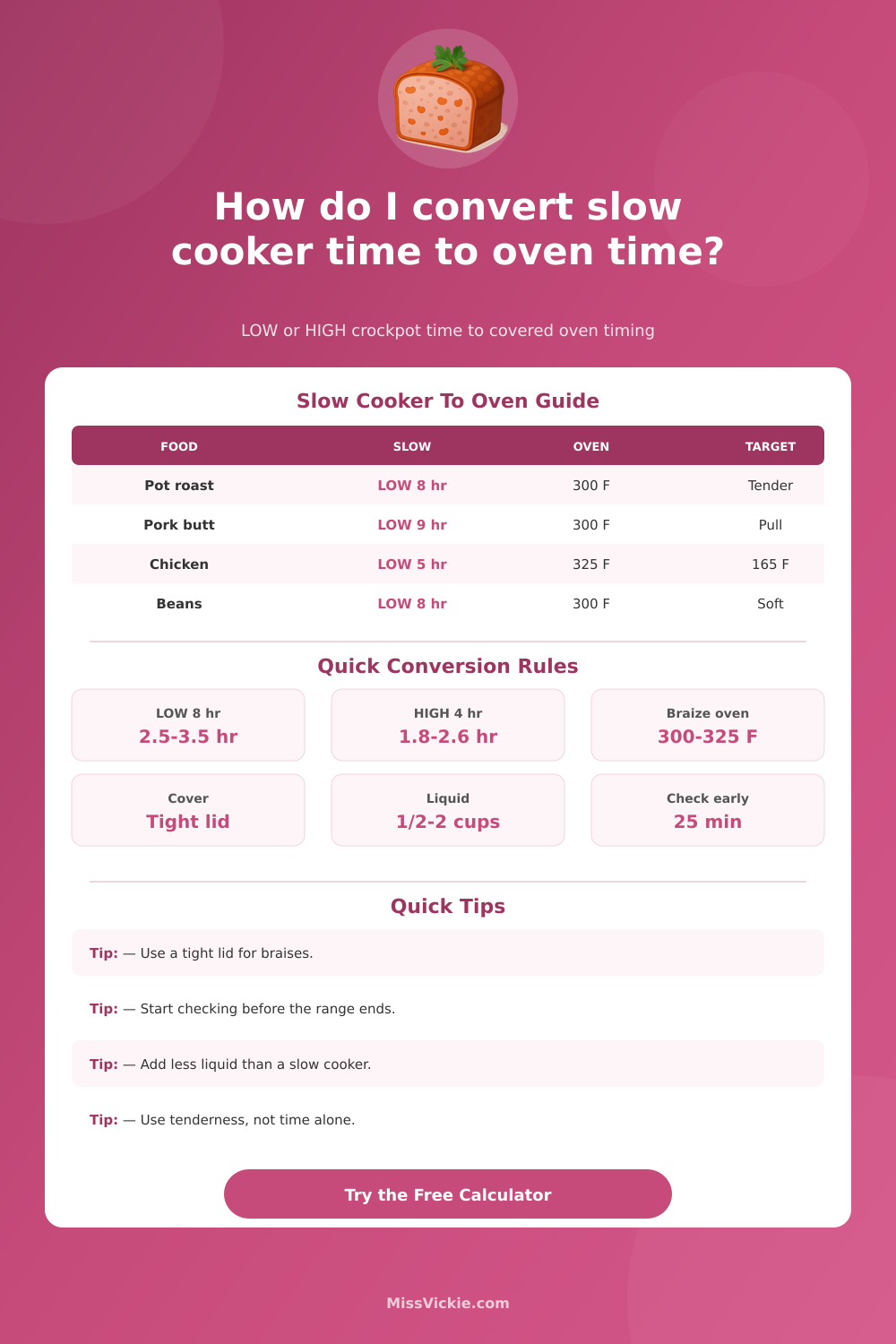
Convert LOW or HIGH slow cooker recipes to covered oven timing with food type, oven temperature, pan cover, liquid level, weight, start temperature, and tenderness target.
Load a common crockpot recipe, then adjust the slow cooker setting, original time, oven temperature, liquid, cover style, and tenderness target.
Conversion Breakdown
Best for collagen-rich cuts that need time more than aggressive heat.
Converts to a shorter oven braise but still needs a covered pan.
A heavy tight-lidded pot holds moisture and steady heat like a crock.
Useful for browning only; long slow-cooker conversions dry out quickly.
| Original Slow Cooker Plan | Covered Oven Starting Point | Best Pan Setup | When To Check |
|---|---|---|---|
| LOW 6 hours | About 1 hour 45 minutes to 2 hours 30 minutes at 300°F | Tight lid with a little liquid | Check texture after 90 minutes |
| LOW 8 hours | About 2 hours 30 minutes to 3 hours 30 minutes at 300°F | Dutch oven or foil-sealed dish | Start checking 25 minutes early |
| LOW 10 hours | About 3 hours to 4 hours 15 minutes at 285°F to 300°F | Heavy covered pot, moderate liquid | Check liquid level midway |
| HIGH 3 to 4 hours | About 1 hour 45 minutes to 2 hours 45 minutes at 325°F | Tight cover, shallower food layer | Check internal temperature early |
| Warm hold after cooking | Do not treat warm time as full cooking time | Use oven only to reheat or finish | Verify food safety temperature |
| Food Type | Usual Slow Cooker Goal | Covered Oven Range | Doneness Reference |
|---|---|---|---|
| Beef pot roast or chuck | LOW 8 to 10 hours until fork-tender | 285°F to 325°F covered braise | Usually tender around 195°F to 205°F |
| Pork shoulder | LOW 8 to 10 hours for pulling | 285°F to 325°F with lid | Pull-apart texture near 198°F to 205°F |
| Chicken thighs or legs | LOW 4 to 6 hours | 300°F to 350°F covered, uncover to brown | At least 165°F; dark meat stays juicy higher |
| Chicken breast | LOW 3 to 5 hours | 300°F to 325°F covered gently | 165°F minimum, avoid long overcooking |
| Stew, chili, or beans | LOW 6 to 9 hours for soft texture | 300°F to 325°F with enough liquid | Simmering edges and tender pieces |
| Root vegetables | LOW 4 to 6 hours | 325°F to 375°F covered or partly covered | Knife slides through centers easily |
| Oven Setup | Time Effect | Liquid Effect | Best Use |
|---|---|---|---|
| Dutch oven with tight lid | Slightly faster and most even | Use less liquid than a slow cooker | Roasts, ribs, pork shoulder, stews |
| Tightly sealed foil dish | Close to a covered pot | Add a little extra to prevent dry edges | Casseroles, chicken, saucy meatballs |
| Loose foil or vented lid | Moderately slower | Expect more evaporation | Foods that need slight browning |
| Uncovered pan | Slow cooker match is poor | Liquid evaporates quickly | Only for final browning or reducing sauce |
| High stew liquid | Heat moves through sauce | May dilute seasoning less than crockpot | Beans, chili, soups, stew chunks |
| Weight or Fill | Oven Conversion Impact | Check Window | Tenderness Note |
|---|---|---|---|
| 1 to 2 pounds | Short range, easy to overcook lean foods | Check 20 to 30 minutes early | Chicken breast and meatballs finish quickly |
| 3 to 5 pounds | Standard family-size braise curve | Check after about 75 percent of estimate | Most pot roasts and pork shoulders fit here |
| 6 to 8 pounds | Longer warm-up and more carryover | Check liquid midway and near the end | Deep pots need gentle heat and time |
| Crowded casserole | Center heats slower than the edges | Stir if the recipe allows | Best for chili, beans, and stew rather than roasts |
| Pull-apart target | Needs extra time after safe temperature | Probe for little resistance | Temperature plus texture matters most |
If slow cooker recipes take more time than you have available to cook the food, you can move the food from a slow cooker to an oven to speed up the cooking process. However, moving the food from slow cooker to an oven is difficult due to the fact that slow cookers and ovens performs differently. Slow cookers are design to retain moisture within the pot and to maintain a slow and steady heat.
Ovens, on the other hand, lose moisture and heat the food much faster than an slow cooker. Because of these different methods of heating the food, it is necessary to use a slow cooker to oven time conversion calculator to compensate for the difference between the two appliance. The calculator will require that you input several factor related to the food that you are cooking in order to provide an accurate estimation of the time that it will take for the food to be cooked in the oven.
How to Convert Slow Cooker Time to Oven Time
The user must describe factors that include the type of food, the setting that was used in the slow cooker, the length of time that the food spent cooking in the slow cooker, the oven temperature, the weight of the food, and the type of cover and liquid that will be use to cover the food while it is cooking in the oven. Each of these factor can affect the time it takes for the heat to reach the center of the food. When the heat reach the center of the food, the proteins in the food will have denatured and the collagen and starches will have softened and gelatinized.
Each of these factor can have an impact upon the cooking time, therefore, changing any of the factors will change the amount of time that it will take for the food to be cooked. The setting used on the slow cooker will impact the cooking process of the food. For instance, if the food was cooked on the low setting for eight hour, that is different than slow cooking the same type of food on the high setting for four hour.
Low settings provide the food with longer period of time to cook while remaining below the boiling point of water, which is a benefit when breaking down the connective tissue within the meat. High settings allow for the food to reach the boiling point of water more quick, thus, allowing for the protein to denature at a faster rate. The time conversion calculator account for these different settings.
The weight of the food will impact the time it takes for the food to cook in the oven. For instance, cooking a three-pound piece of roasting meat will take longer than roasting a six-pound cut of meat. This is due to the fact that it takes longer for heat to conduct through a larger piece of meat to the deepest fiber of that meat.
Therefore, the time conversion tool accounts for the weight of the food. The cover that is used for the food will impact the outcome of the cooking process. For instance, a lid that is place upon a Dutch oven will retain the same amount of moisture as the lid that is used on a slow cooker.
However, if the cover is loose or if the pan is uncovered, the moisture will evaporate from the food. If moisture is lost from the food, the food will dry out. Therefore, if the cover is to be tight, the time will be decreased; if the cover is to be loose, the time will be increased.
Additionally, the tool will suggest a starting amount of liquid for the food; ovens lose moisture at a higher rate than slow cookers. The texture of the food is another factor that many people tend to ignore when converting cooking times from a slow cooker to an oven. While it is necessary that the food reach an internal temperature that will eliminate any risk of food borne illness, it is additionally important that the food reach an appropriate texture.
If the meat’s texture is to be tender enough that it can be easily torn apart with a fork, the meat will require an amount of time beyond that needed to reach safe temperature for the meat to allow for the collagen to convert to gelatin. If, however, the texture of the meat is to be moist enough to be sliced, then the cooking process can be ended at an earlier time. Therefore, the time conversion tool accounts for the target texture that is to be achieved with the food.
Finally, there are a few variables in your kitchen that may impact how long it will take for the food to be cooked in the oven and that cannot be account for in the calculator. For instance, the thickness of the pan may be different than the thickness of the pan that is assumed in the time conversion tool. Additionally, the oven may reach different temperature than those that are set on the oven timer for the same length of time.
Finally, the temperature of the food may be either cold from being in the refrigerator or it may be at room temperature. These variables may not impact the cooking of the food, but it is recommended that you begin to check the food a little earlier than the middle of the time range that is calculated. The same logic can be applied to cooking beans or root vegetables.
Beans need to remain covered to prevent the skin from splitting. Additionally, the root vegetables will cook slower if they are to be cooked in a crowded pot. The time conversion tool accounts for these different situations by altering the setting of the tool according to the type of food and how full the pot is to be.
Because neither an oven nor a slow cooker is an exact appliance for cooking, you should not place too much faith in the time calculation created by the tool. For instance, ovens will cycle on and off in order to maintain the set temperature. Additionally, it takes different length of time for the oven to reach the set temperature when the oven door is opened than when it is closed.
Slow cookers will retain the heat when the lid is opened, but ovens will lose heat when the lid is opened. Therefore, the time conversion tool includes a time period for initially cooking the food and then allowing for the food to be checked to ensure that it is not too early in the cooking process to be checked. It is also important to avoid adding the same amount of liquid that was used in the slow cooker to the food.
If the food is simmering in the oven, the liquid will evaporate at a higher rate. For this reason, it is better to start the food with less liquid than to start the food with a large amount of liquid and then continue cooking until the liquid has almost all evaporated. The goal is to create the same texture as achieved in the slow cooker by using an oven as an alternative cooking appliance.
By providing all of the necessary information about the food to be cooked, the tool will calculate a range of time that will be close enough to the actual time that the food will be done cooking. Finally, a few additional considerations for those who are cooking in there kitchen: if the amount of liquid is too great, the food will be at risk of boiling over when placed into the oven. Additionally, a more accurate measurement of the amount of liquid will ensure that the food is safe from food poisoning caused by inadequate cooking.
Finally, it is recommended that each of the parameter be carefully considered; cooking food to the appropriate level of doneness is important to the health of each individual.