Gas to Electric Oven Converter
Convert gas marks, Fahrenheit, and Celsius into electric conventional or convection settings with practical adjustments for food type, rack position, pan material, and original bake time.
Load a common gas-oven recipe, then adjust the oven type, pan, rack, and food style for your own kitchen.
Conversion Breakdown
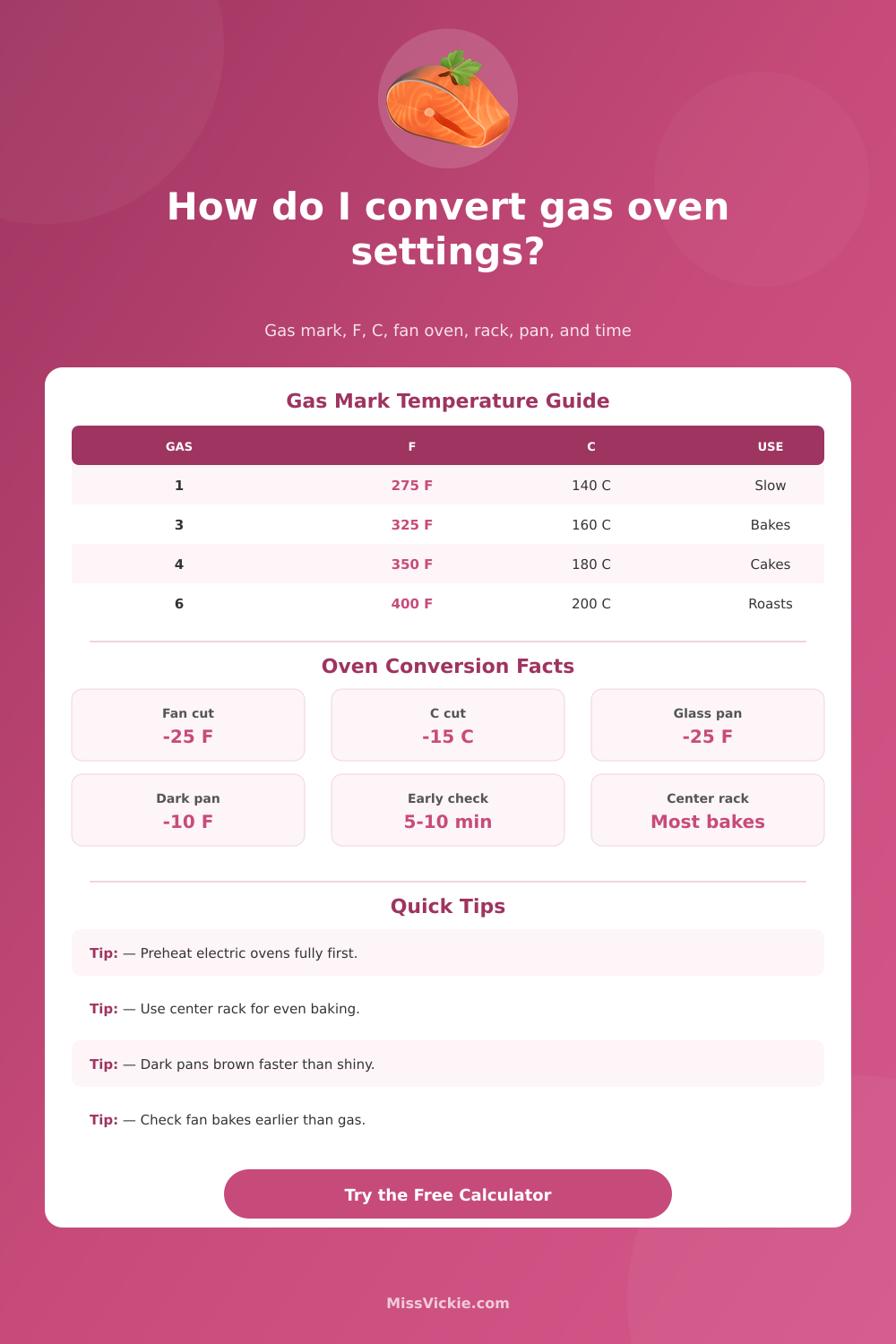
| Gas Mark | Electric Conventional | Electric Fan / Convection | Best Cooking Range |
|---|---|---|---|
| 1/4 | 225°F / 110°C | 200°F / 95°C | Very slow drying, meringue, gentle warming |
| 1/2 | 250°F / 120°C | 225°F / 105°C | Slow braises, delicate custards, long warming |
| 1 | 275°F / 140°C | 250°F / 125°C | Low-and-slow roasts, fruit cakes, casseroles |
| 2 | 300°F / 150°C | 275°F / 135°C | Slow baking, covered dishes, gentle breads |
| 3 | 325°F / 160°C | 300°F / 150°C | Rich cakes, brownies, covered casseroles |
| 4 | 350°F / 180°C | 325°F / 165°C | Everyday cakes, cookies, pies, tray bakes |
| 5 | 375°F / 190°C | 350°F / 175°C | Biscuits, pastries, roasted vegetables |
| 6 | 400°F / 200°C | 375°F / 190°C | Roasts, potatoes, crisp-edged bakes |
| 7 | 425°F / 220°C | 400°F / 205°C | Pizza, scones, browning, hot roasting |
| 8 | 450°F / 230°C | 425°F / 220°C | Flatbreads, pizza, high-heat searing |
| 9 | 475°F / 240°C | 450°F / 230°C | Very hot roasting, pizza, oven spring |
| 10 | 500°F / 260°C | 475°F / 245°C | Maximum heat, stone baking, fast browning |
Best match for a standard gas recipe when heat is steady and preheated.
Moving air cooks faster, so lower heat and check earlier.
Smaller cavities run hot near elements and brown quickly.
Strong airflow suits crisp foods, but delicate cakes need caution.
| Food Type | Temperature Bias | Time Bias | Best Electric Oven Note |
|---|---|---|---|
| Cakes and quick cakes | Keep moderate | Check 12% early | Middle rack protects structure and avoids doming. |
| Cookies and sheet sweets | May use fan | Check 15% early | Rotate pans if edges brown before centers set. |
| Bread and rolls | Keep recipe heat | Check 8% early | Use lower-middle rack for strong bottom heat. |
| Meat roasts and poultry | Fan works well | Check 10% early | Use thermometer for final doneness, not time alone. |
| Casseroles and lasagna | Moderate heat | Add 5% if deep | Cover early, uncover near the end for browning. |
| Pizza and flatbread | Hotter is better | Check 15% early | Preheat stone or steel longer than the oven beep. |
| Custards and cheesecake | Lower heat | Check gently | Avoid strong fan because edges can overcook. |
| Frozen foods | Fan friendly | Check 18% early | Spread in one layer for crisp airflow. |
| Pan Material | Temperature Adjustment | Time Adjustment | Why It Changes the Bake |
|---|---|---|---|
| Light shiny metal | No change | No change | Reflects heat and matches many recipe test pans. |
| Dark metal | Lower 10°F | Check 5% early | Absorbs more radiant heat and browns edges faster. |
| Glass or ceramic | Lower 25°F | Add 5% after lowering | Heats slowly but holds heat strongly once hot. |
| Cast iron | Lower 10°F | Add 3% for thick foods | Stores heat and can darken crusts quickly. |
| Nonstick coated pan | Lower 10°F | Check 5% early | Darker finish often browns more than bare aluminum. |
| Silicone mold | Add 10°F | Add 8% time | Insulates food and slows browning. |
| Stone or steel | No oven cut | Check early | Needs long preheat and gives strong bottom heat. |
| Rack Position | Heat Effect | Best Foods | Conversion Caution |
|---|---|---|---|
| Top rack | Strong top browning | Finishing casseroles, gratins, melting cheese | Reduce temperature for sugary foods. |
| Upper-middle rack | More color on top | Cookies, biscuits, pastry tops | Check thin foods early in fan mode. |
| Middle rack | Most even heat | Cakes, quick breads, brownies, pies | Best default when leaving a gas oven. |
| Lower-middle rack | More bottom heat | Bread, pizza, pies, roasted meats | Watch dark pans and glass dishes. |
| Bottom rack | Strong bottom browning | Pizza stones, crisp crusts, covered braises | Avoid delicate cakes unless recipe says so. |
When switching from using a gas oven to an electric oven, some adjustments will be necessary. The reason that these adjustment will be necessary is due to the difference in how gas and electric oven move heat. Because gas oven have to cycle on and off to maintain the target oven temperature, the air within the oven is not evenly heated.
Even when electric oven reach the target oven temperature, the heat within electric ovens is more even than that of the gas oven. The difference in browning of food is one of the differences between the two types of ovens; electric ovens brown the surface of food more aggressively than do gas ovens. Because of these differences in how each oven type moves heat, the results of a recipe created for a gas oven may not be achieved with the same ease within an electric oven.
Switching from a Gas Oven to an Electric Oven
An oven converter tool is a device that will help a person to adjust each recipe according to the change from a gas oven to an electric oven. The oven converter tool will take the original temperature of the recipe for a gas oven and apply adjustments according to the type of oven (electric), the type of food to be cooked, the material of the pan that will be used, and the position of the rack within the oven on which the food will be placed. The oven converter tool will provide a target oven temperature for the recipe and a time window during which the recipe should be checked for doneness.
The oven converter tool provides the time window for checking the food because checking the food early with an electric oven is important to avoid the rapid browning of the edges of the food. The position of the rack within the oven can impact the browning of food; different rack positions allow for different amounts of browning to occur on the top and bottom of the food. The middle rack within the oven provide the most even distribution of heat within the oven; therefore, oven converter tools will default to this rack position for foods such as cakes and casseroles.
If the user moves the rack to a higher position within the oven, the top of the food will brown more quickly. However, if the rack is moved to a higher position within the oven, there is the potential for the top of a loaf of bread, for instance, to brown before the center of the loaf is fully baked. If the rack is moved to a lower position within the oven, the bottom of the food will brown more quickly.
However, if the rack is moved to a lower position, there is the potential for the base of food, such as pizza, to brown too much, especially if it is cooked on a glass dish. The oven converter tool accounts for these different positions of the rack within the oven. The material of the pan can impact the amount of heat that is conducted to the food being cooked.
The type of pan that can reflect heat is light metal pans. Recipes often state that the food will be tested on light metal pans. Dark pans absorb more heat from the oven than light metal pans; therefore, the edges of the pan will brown more quickly than if food were cooked on a light metal pan.
Food cooked on dark pans may need to be removed from the pan prior to the browning of the edges of the food. For pans made of glass or ceramic, the pan will heat up slowly, but food cooked on these pans will hold onto the heat once the pan reaches the cooking temperature. For these pans, the oven converter tool will lower the cooking temperature of the recipe and increase the time that the food needs to cook.
Finally, pans made of cast iron will store heat well within the pan. Therefore, the oven converter tool will account for the fact that food cooked on cast iron pans will have their crusts brown quickly. The type of food that will be prepared can impact the adjustments to the recipe according to the change in oven type.
Foods such as cakes and quick breads is very temperature sensitive. If the electric oven is even ten degrees hotter than the recipe suggests, the edges of the cake may set before the rest of the cake has time to rise. Food such as roasts and casseroles are more forgiving of temperature changes than cakes.
Additionally, roasts and casseroles typically require longer cooking times; if the food is not yet done after the time indicated in the recipe, the cooking time can always be increased. The oven converter tool takes into account the type of food that will be prepared to account for these difference. The adjustment to the time needed to cook the food is not a percentage of the original time required to cook the food; rather, the oven converter tool will multiply a number of factor together to arrive at the new cooking time.
The factors that are multiplied together are the type of oven, the type of pan that will be used, and the depth of the food that will be prepared. For instance, a thin sheet pan of cookies will cook 15% faster in a convection oven than an electric oven than the time indicated in the recipe written for a gas oven. However, a deep lasagna pan of food will take longer to cook, even at a lower cooking temperature.
The oven converter tool will provide the time adjustment that will indicate the time window during which the food should be checked for doneness. Every electric oven will behave differently. Each oven has its own unique characteristics.
For instance, some electric ovens will reach higher temperatures towards the back wall of the oven than towards the front of the oven. Additionally, electric ovens may have hot spots towards the bottom of the oven. While the oven converter tool will provide a starting point for adjusting recipes from gas ovens to electric ovens, the adjustments must be made according to the food that is being prepared.
If the edges of the food brown before the center of the food is fully baked, the person can lower the temperature of the electric oven by five or ten degrees for the next batch of food prepared. If the center of the food is pale while the edges of the food are browned, the rack on which the food will be prepared may be moved to a lower position within the electric oven, or the time during which the food is prepared may be increased. In addition to the adjustments to the cooking temperature, the habits of a person that use an electric oven instead of a gas oven will have to change somewhat.
Gas stoves often reach the target temperature quickly; however, the racks within the oven may take some of the same time to heat the food to the target temperature. Electric ovens may beep when the air within the oven reaches the target temperature; however, pans made of stone or cast iron may take some of the same time to heat the food to the target oven temperature. While the oven converter tool does not calculate the time for which the oven should be preheated, tables are provided within the oven converter tool that will remind the person that stone and steel pans will take more time to preheat than the oven itself.
The oven converter tool will prove to be valuable in the kitchen to a person that is switching cooking ranges from gas stoves to electric ovens. The oven converter tool will convert all of the different rules that a person must remember into one single decision. All that a person must do is enter the original gas mark of the recipe, choose the electric oven, the pan and rack position, and the oven converter tool will calculate the amount of heat that should be used within the electric oven and the length of time that the food should be cooked.
By using the oven converter tool, a person will save time and effort in calculating these values themselves. Additionally, using the oven converter tool will ensure that a person will not fail in the cooking of their recipe during the first attempt at the recipe with the electric oven. Though a person will eventually memorize the rules that apply to their electric oven, the oven converter tool will ensure that the first batch of food prepared according to the recipe is successful.