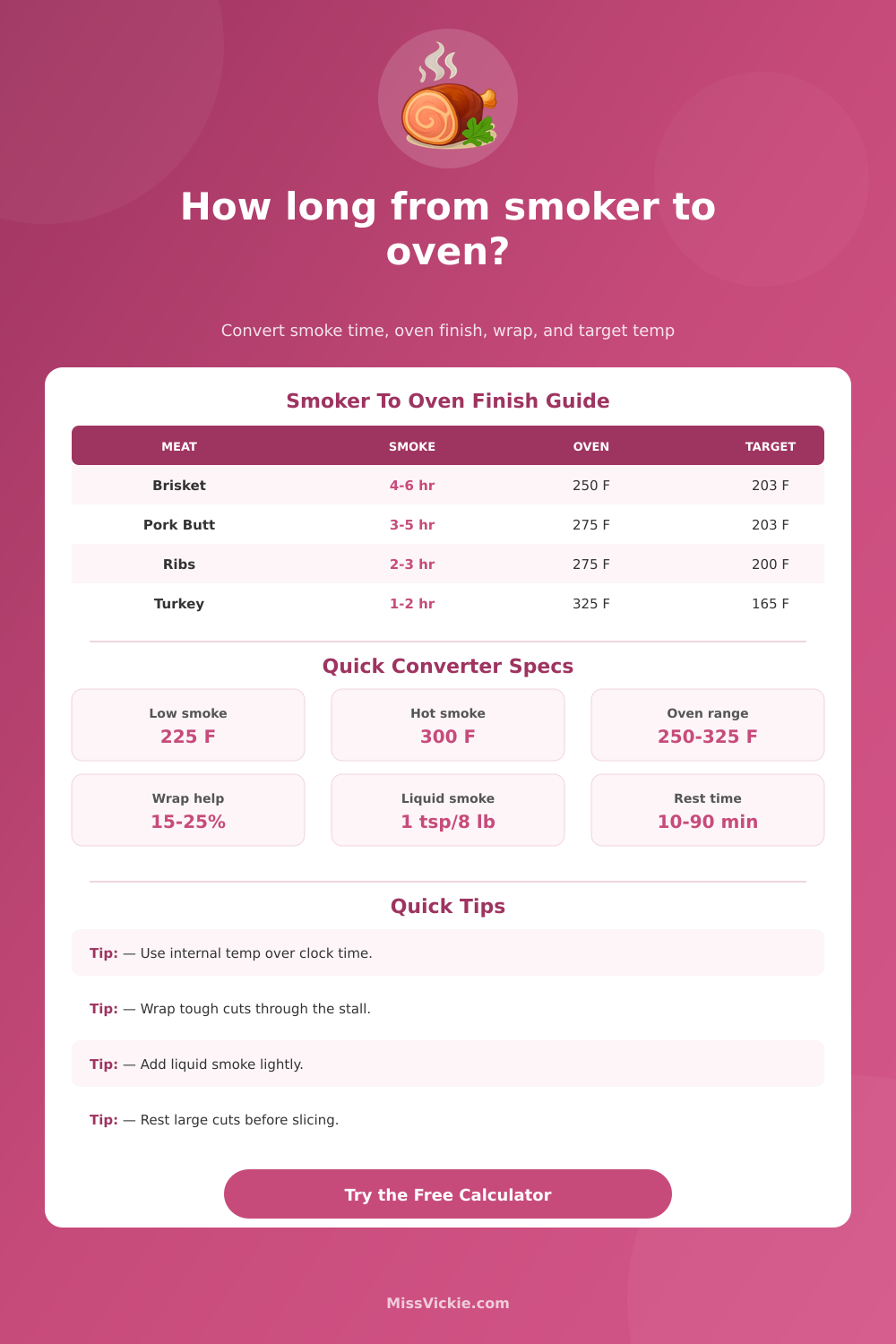
Smoke phase, stall wrap, oven finish, and target temperature math
Smoker to Oven Converter
Estimate when to move smoked meat to the oven, how long the oven finish may take, whether to wrap through the stall, and how much liquid smoke to use for an oven-only backup.
Load a common barbecue situation, then adjust weight, smoker temperature, oven temperature, smoke phase, stall status, and final target temperature.
Conversion Breakdown
Most smoke depth and bark texture, but requires steady smoker heat until the target internal temperature is reached.
Gets real smoke early, then uses the oven for stable heat, easier stall control, and predictable overnight finishing.
Useful when weather or fuel interrupts the smoker; use a light hand so the flavor stays rounded, not harsh.
Reliable for poultry, pork loin, and salmon, but it will not build the same smoke ring or bark as wood smoke.
These tables support the calculator assumptions. Always verify doneness with a food thermometer, especially for poultry and reheated meats.
| Meat Type | Typical Smoke Phase | Oven Finish Range | Common Target |
|---|---|---|---|
| Brisket flat | 3 to 5 hours at 225 to 275 F | 250 to 300 F covered or wrapped | 195 to 205 F for slicing tenderness |
| Whole packer brisket | 4 to 7 hours before the wrap | 250 to 300 F through the stall | 200 to 205 F when probe-tender |
| Pork butt | 3 to 5 hours for smoke color | 250 to 300 F wrapped | 198 to 205 F for pulling |
| Pork ribs | 2 to 3 hours before wrapping | 260 to 300 F until bend tender | 195 to 203 F for tender ribs |
| Poultry | 45 minutes to 2 hours | 300 to 350 F for skin and safety | 165 F minimum for poultry |
| Salmon | 30 to 90 minutes | 225 to 275 F gentle finish | 125 to 145 F by preference and safety |
| Transfer Internal Temp | What It Means | Wrap Choice | Oven Note |
|---|---|---|---|
| 110 to 135 F | Early smoke only, limited cooking progress | Usually unwrapped | Expect most of the cook to happen in the oven |
| 140 to 160 F | Smoke flavor is set and large cuts may be entering stall | Wrap tough cuts if bark is dark enough | Covered oven heat prevents drying during the stall |
| 160 to 180 F | Stall zone or post-stall transition for brisket and pork | Foil for speed, paper for bark | Finish time depends heavily on collagen-rich meat type |
| 180 F and above | Final tenderness window for barbecue cuts | Keep wrapped if juices need protection | Start checking texture often, not just temperature |
| Stall or Wrap Setting | Time Effect | Texture Effect | Best For |
|---|---|---|---|
| No stall yet, unwrapped | Slower finish on big cuts | Better bark but more surface drying | Early brisket, ribs, pork butt |
| Approaching stall | Slight delay expected | Bark can keep setting | Waiting for color before wrapping |
| In the stall, unwrapped | Longest oven estimate | Firm bark, slower collagen softening | Large beef or pork cuts |
| Wrapped in foil or paper | Usually 15 to 25 percent faster | Softer bark, juicier finish | Brisket, pork butt, beef ribs |
| Post-stall, unwrapped | Moderate finish speed | Can reset bark near the end | Finishing ribs or crisping edges |
| Smoke Flavor Plan | Liquid Smoke Guide | Where To Add It | Flavor Risk |
|---|---|---|---|
| Real smoke phase before oven | Usually none needed | Let bark and drippings carry flavor | Low if smoke was clean |
| Short smoke, oven does most work | Optional tiny splash in wrap liquid | Mix with broth, cider, or pan juices | Low to medium |
| Oven only, subtle liquid smoke | About 1 teaspoon per 8 pounds | Rub slurry or pan liquid | Low if diluted well |
| Oven only, balanced liquid smoke | About 1 teaspoon per 5 pounds | Brush lightly before covering | Medium if concentrated |
| Oven only, bold liquid smoke | About 1 teaspoon per 3 pounds | Use only for large rich cuts | High on lean meats |
A smoker-to-oven converter is a tool that will help you to move the meat from the smoker to an oven. You may have to move the meat from the smoker to the oven if the smoker’s temperature is dropping or if it is raining out. Beyond the temperature of the meat, there is other factors that will help to determine whether the meat should be moved from the smoker to the oven.
These factor include the amount of smoke that the meat has absorbed while smoking and the amount of collagen that is left to tighten in the meat while it is cooking. The smoker-to-oven converter will eliminate the guesswork in this process by using a series of variable to estimate the time that the meat will take to cook in the oven. To determine how long the meat will take to cook in the oven, the smoker-to-oven converter will ask for a few specific piece of information from the smoker.
When to Move Meat from Smoker to Oven
The smoker-to-oven converter will need to know for how many hours the meat has been smoking in the smoker. Furthermore, the tool will need to know the internal temperature of the meat. The smoker-to-oven converter will also need to know whether the meat is wrapped or not, as this will impact the cooking process.
Based off this information, the smoker-to-oven converter will calculate how long the oven will need to cook the meat to the target temperature. Furthermore, the smoker-to-oven converter will also provide information regarding the total plan for cooking the meat, which will help to inform the smoker whether or not to begin cooking the meat in the oven at this time. The weight of the meat is another important variable.
The weight of the meat will impact the cooking process because meat that is heavy will behave different than meat that is light in weight. The smoker-to-oven converter will automatically convert any weight measurement to pounds. The temperature of the smoker is another important variable in that a hotter temperature will cook the meat more fast than a lower smoker temperature.
A lower smoker temperature allows the meat to absorb more flavor from the smoker. Furthermore, oven temperature is another important variable, though it works differently from the smoker’s temperature. For instance, 275 degrees in the oven will cook brisket and pork butt, though 325 degrees is another temperature that may be used in situations like when cooking ribs quick or when cooking poultry so that the skin will tighten.
Another important variable is the concept of the “stall.” During the stall, the temperature of the meat will plateau; no temperature will rise. During this phase of cooking, cooks often lose track of time. However, if the meat is wrapped prior to cooking in the oven, this stall will not occur.
The smoker-to-oven converter will factor in whether the meat was wrapped early in the cooking process, after the bark has set, or whether it was not wrapped at all. If the meat is wrapped, it will finish cooking 20% more faster than if it is not wrapped. Another important variable is the use of liquid smoke.
Some cooks use liquid smoke as a means of replacing real smoke when they are unable to use a smoker due to the weather. The smoker-to-oven converter will calculate the amount of teaspoons of liquid smoke that is needed based upon the weight of the meat and the level of intensity of the liquid smoke that the cook chooses. Caution should be used in the addition of liquid smoke as using too much of it will impart a sharp flavor into the meat.
If the meat has been smoked with real smoke it will be possible to leave the liquid smoke out of the recipe. Rest time is another important variable in the cooking process, especially if using large cut of meat. The smoker-to-oven converter will factor in rest time into the total plan that is provided to the smoker.
Rest time cannot be skipped for large cuts of meat; it will result in the meat being dry when it is sliced. The smoker-to-oven converter will provide options for short rest time, standard rest time, or long rest time depending upon the type of meat that is being cooked. The tables that are provided on the smoker-to-oven converter provide information on the different type of smoke and the different range of oven temperatures.
These tables are not rules, but they are guidelines that can help to determine whether the smoker-to-oven converter’s estimate of cooking time is logical. For instance, if the smoker-to-oven converter calculates that the meat has been smoking for 4 hours and reached 140 degrees, it will indicate that the cooking time in the oven will be longer due to the collagen left in the meat. However, if the smoker-to-oven converter calculates that the meat has been smoking for 4 hours and reached 180 degrees and is wrapped, the estimated cooking time will be shorter.
The smoker-to-oven converter is a tool that can help smokers to maintain consistency regardless of the time of year that the smoker is used. For instance, during the summer months, the smoker can continue to cook the meat until it is tender to the touch. However, during the winter months, the smoker may be moved to the oven when the wind begins to pick up.
Thus, it does not replace the smoker’s judgment, but it does remove the need for the smoker to perform the computations on the paper. Safety is another primary concern regarding the smoker-to-oven converter. Poultry must reach a minimum safe temperature because exposing the meat to temperatures above the safe temperatures will result in the texture of the bird suffering.
Brisket and pork butt must reach temperatures above 180 degrees because the collagen in these meats will not become tender unless exposed to such temperatures. The smoker-to-oven converter will display the target temperature for the meat and flag it as safe or potentially too high for the meat that is selected. To use the smoker-to-oven converter, the smoker will have to provide information regarding the weight of the meat, the hours that the meat has been smoking, the internal temperature of the meat, and the choice of whether to wrap the meat in cooking.
The smoker-to-oven converter will output information regarding the length of time that the oven will run to cook the meat to the target temperature and the total length of time that the smoker-to-oven converter calculated that the meat will be cooked in total. Based off this time, the smoker can make a decision regarding whether to start cooking the meat in the oven or whether to continue smoking the meat for an additional period of time. Thus, the smoker-to-oven converter allows the smoker to make an informed decision instead of an hopeful one.