Servings, cup size, ingredient ratios, calories, and yield
Smoothie Ingredient Calculator
Scale a smoothie batch by servings, cup size, fruit and vegetable balance, protein add-ins, liquid base, frozen share, estimated calories, and blender yield.
🥤Smoothie presets
Pick a starting smoothie style, then adjust the ratio, fruit, greens, protein, liquid, frozen share, and serving size for your blender.
📝Batch inputs
Your Smoothie Batch
Adjust the inputs above to calculate a smoothie batch.
Ingredient breakdown
🧮Calculated ingredient amounts
⚖Ratio snapshot
📊Smoothie style comparison
Drinkable balance with enough fruit for sweetness and enough liquid to pour easily.
Uses more vegetable volume, mild fruit, and a steady liquid base for breakfast blends.
Reduces liquid slightly and gives more space to yogurt, powder, tofu, or cottage cheese.
Thick, spoonable blend with more frozen fruit and less liquid than a cup smoothie.
📘Ingredient ratio reference
| Style | Liquid | Fruit | Vegetable | Protein | Best use |
|---|---|---|---|---|---|
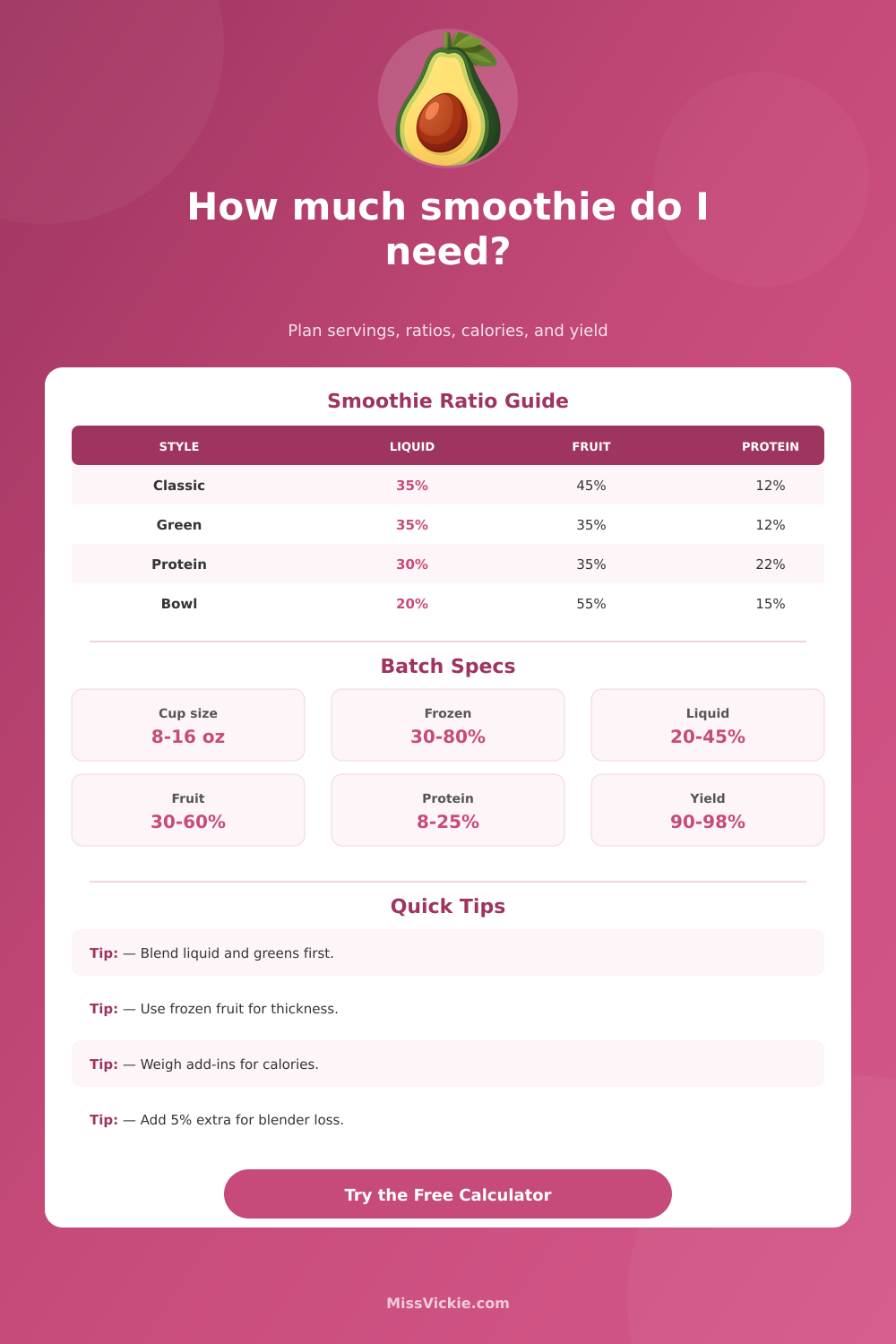
| Classic drinkable | 35% | 45% | 8% | 12% | Balanced everyday smoothies that pour cleanly into glasses or bottles. |
| Green breakfast | 35% | 35% | 18% | 12% | Spinach, cucumber, kale, or zucchini blends with moderate fruit sweetness. |
| High protein | 30% | 35% | 8% | 22% | Workout smoothies, breakfast replacements, and yogurt-forward batches. |
| Thick bowl | 20% | 55% | 10% | 15% | Spoonable bowls that need frozen fruit and minimal liquid. |
🧊Frozen and yield guide
| Frozen share | Texture | Blend yield | Liquid adjustment | Planning note |
|---|---|---|---|---|
| 0% to 25% | Fresh and loose | 96% to 98% | Start with the normal liquid ratio | Good for same-day smoothies and citrus-heavy blends. |
| 30% to 60% | Cold and creamy | 94% to 96% | Add 1 to 2 tbsp liquid per serving if needed | Best all-purpose range for fruit smoothies and meal prep packs. |
| 65% to 85% | Thick frozen | 90% to 94% | Add liquid slowly after the first blend | Works well for bowls, but small blenders may need pauses. |
| 90% to 100% | Spoonable | 88% to 92% | Use a tamper or scrape between pulses | Plan extra volume because more mixture stays in the jar. |
🍌Fruit, liquid, and protein data
| Ingredient | Typical amount | Calories | Protein | Kitchen use |
|---|---|---|---|---|
| Mixed berries | 1 cup, 140 g | 70 cal | 1 g | Lower-sugar fruit base with bright color and enough fiber. |
| Banana and berries | 1 cup, 150 g | 105 cal | 1 g | Creamier texture and sweeter flavor without much extra liquid. |
| Greek yogurt | 1/2 cup, 120 g | 90 cal | 16 g | Thick protein choice for breakfast and snack smoothies. |
| Protein powder | 1 scoop, 30 g | 120 cal | 24 g | High protein with little volume; blend with enough liquid. |
| Unsweetened almond milk | 1 cup, 240 ml | 35 cal | 1 g | Light liquid base when fruit and add-ins carry the calories. |
| Oat milk | 1 cup, 240 ml | 120 cal | 3 g | Creamier liquid base that raises calories and sweetness. |
🍽Common smoothie batch sizes
| Batch | Finished yield | Liquid base | Fruit | Protein add-in |
|---|---|---|---|---|
| Two small smoothies | 16 fl oz / 475 ml | 2/3 cup | 1 3/4 cups | 1/2 to 1 serving |
| Family breakfast | 48 fl oz / 1.4 L | 2 to 2 1/2 cups | 5 to 7 cups | 2 to 3 servings |
| Meal prep bottles | 72 fl oz / 2.1 L | 3 to 4 cups | 7 to 10 cups | 4 to 5 servings |
| Party pitcher | 128 fl oz / 3.8 L | 5 to 6 cups | 12 to 16 cups | 5 to 8 servings |
💡Smoothie planning tips
Making smoothies at home involves several logistical challenge. The most difficult of these challenges is calculating the correct amount of each ingredient that should go into a smoothie based on the number of servings that you want to make. You must decide how many servings of smoothie you want to make, and the size of the cups that you will use to serve the smoothie.
If you do not calculate the correct amount of each ingredient, you may find that you create a batch of smoothie that is either too small or too large for your container. If the batch is too large, and you allow the smoothie to sit in the refrigerator for too long, the flavor of the smoothie may become dull. The ingredients that a smoothie contain, and the ratio of those ingredients will determine how the smoothie will pour from the container, and the thickness of the smoothie.
How to Measure Smoothie Ingredients
Smoothies contain liquid ingredient, fruit, vegetables, and protein. The ratio of these ingredients will determine if the smoothie has a light pourability to it like water, or if it is thick like a milkshake. Smoothies that contain high percentage of frozen fruit will be thick, and will tend to cling to the sides of the blender container.
Thick smoothies tend to lose volume compared to smoothies that contain more liquid ingredients. Additionally, the more protein that you add to a smoothie, the less liquid that will be required to drink the smoothie, however, the amount of space that will be available for the sweetness of the fruit that is contained within the smoothie will decrease. The smoothie calculator can help you to overcome these challenge.
The smoothie calculator will perform the mathematical calculation for you, as you select your desired smoothie style, your liquid base, the percentage of frozen fruit that you would like to use, the number of serving that you would like to make, and the thickness that you would like your smoothie to have. Using the smoothie calculator will prevent you from having to manually calculate how much of each ingredient you need to add to your smoothie to ensure that each cup will be filled to the appropriate amount. When using the smoothie calculator, you must account for the fact that most home blenders will lose some of the volume of the smoothie.
You will lose between two and ten percent of the total volume of the smoothie due to the formation of foam while blending the ingredients, and due to the amount of residue that stick to the sides of the blender. The thicker the smoothie, the more volume that will be lost due to the smoothie being spoonable rather than pourable. Thin smoothies contain less frozen fruit than thick smoothies, and will, therefore, lose less volume during blending.
Knowing the amount of yield that a smoothie will produce will help to prevent error in filling your bottles or bowls with the smoothie. Some of the ingredients that you add to smoothies to increase the volume of the smoothie without significantly increasing the number of calorie that are consumed with the smoothie include spinach and cucumber. These vegetables are counted as produce within the smoothie recipe.
Therefore, the amount of space that is allocated for these ingredients will automatically reduce the amount of space that is available for the fruit and protein component of the smoothie. This automatic adjustment of the smoothie calculator will ensure that the ratios of the smoothie remain realistic, and that there is enough space for each ingredient so that one ingredient does not overpower the others. The percentage of frozen fruit in the smoothie will affect the texture of the smoothie and the final volume of the smoothie.
If the percentage of frozen fruit is below thirty percent, the smoothie may separate in the glass. If the percentage of frozen fruit is above seventy percent, it may be difficult to blend the smoothie and you will have to add extra liquid while blending the smoothie. Using a percentage of frozen fruit in the middle of the scale will create a cold smoothie with the proper thickness without having to scrape the blender jar constant.
Add-ins for protein will affect the smoothie in relation to the volume and thickness of the smoothie. Adding items like Greek yogurt or cottage cheese will increase the volume of the smoothie along with the protein content. Using items that add little volume to the smoothie, such as protein powder or seeds, will not change the volume of the smoothie as much.
However, if using protein powder you may have to add extra liquid to the smoothie to ensure it does not become a paste. The calculator for the smoothie can scale the volume of protein based on the type of ingredient so the smoothie does not become too thick for drink. Using a liquid will affect the calories and thickness of the smoothie.
Using almond milk will make the smoothie lighter in calories while using milk like oat milk or kefir will add more calories, body and sweetness to the smoothie. The smoothie calculator will include the calories and protein content of the liquid for your smoothie. This is helpful for those who must limit the calories in their smoothie and want to increase the protein content.
Planning the batch size will allow individuals to choose the number of servings that will be included and the size of the cup for each serving. A batch size of four servings of an eight ounce cup will yield a different result than four servings of a sixteen ounce cup. Using the smoothie calculator will show the finished volume of the smoothie in ounces and milliliters.
This will show how many cups of smoothie will be made so individuals can ensure that their smoothie will fit in their container. Common mistake made in blending smoothies include treating all ingredients as if they are the same volume. A cup of spinach will have a different volume to berries.
Two tablespoon of nut butter will contain more calories than two tablespoons of cocoa powder. The weight and calorie information for smoothie ingredients can be found in the reference table for ingredients included in the smoothie calculator. This makes it possible for individuals to make adjustment to the smoothie if they would like to incorporate such an ingredient.
The intention of using the smoothie calculator is for individuals to have consistency in their smoothie preparation. By understanding the effect that certain ingredient will have on the smoothie, individuals can adjust the percentage of frozen fruit or the type of liquid used without changing the quality of the smoothie. Additionally, the calculator makes it so individuals dont have to utilize arithmetic to determine the ingredients needed to create the smoothie desired by the individual.