Ingredient Ratio Calculator
Scale cooking and baking formulas by base ingredient, baker percentage, finished batch size, serving count, hydration, fat, sugar, salt, add-ins, and planned overage.
Start with a real formula style, then fine-tune the ratios for your dough, batter, dressing, sauce, brine, granola, or batch-prep recipe.
Ratio Breakdown
| Ingredient Group | Baker % | Weight | Kitchen Measure |
|---|
Base plus water, salt, yeast, and little or no fat.
More fat, sugar, egg, and liquid for tender cakes.
Oil-centered ratios with acid, water, salt, and flavor solids.
Oat base with oil, syrup, salt, nuts, and fruit add-ins.
| Formula Type | Base Ingredient | Liquid Range | Fat / Sugar Range |
|---|---|---|---|
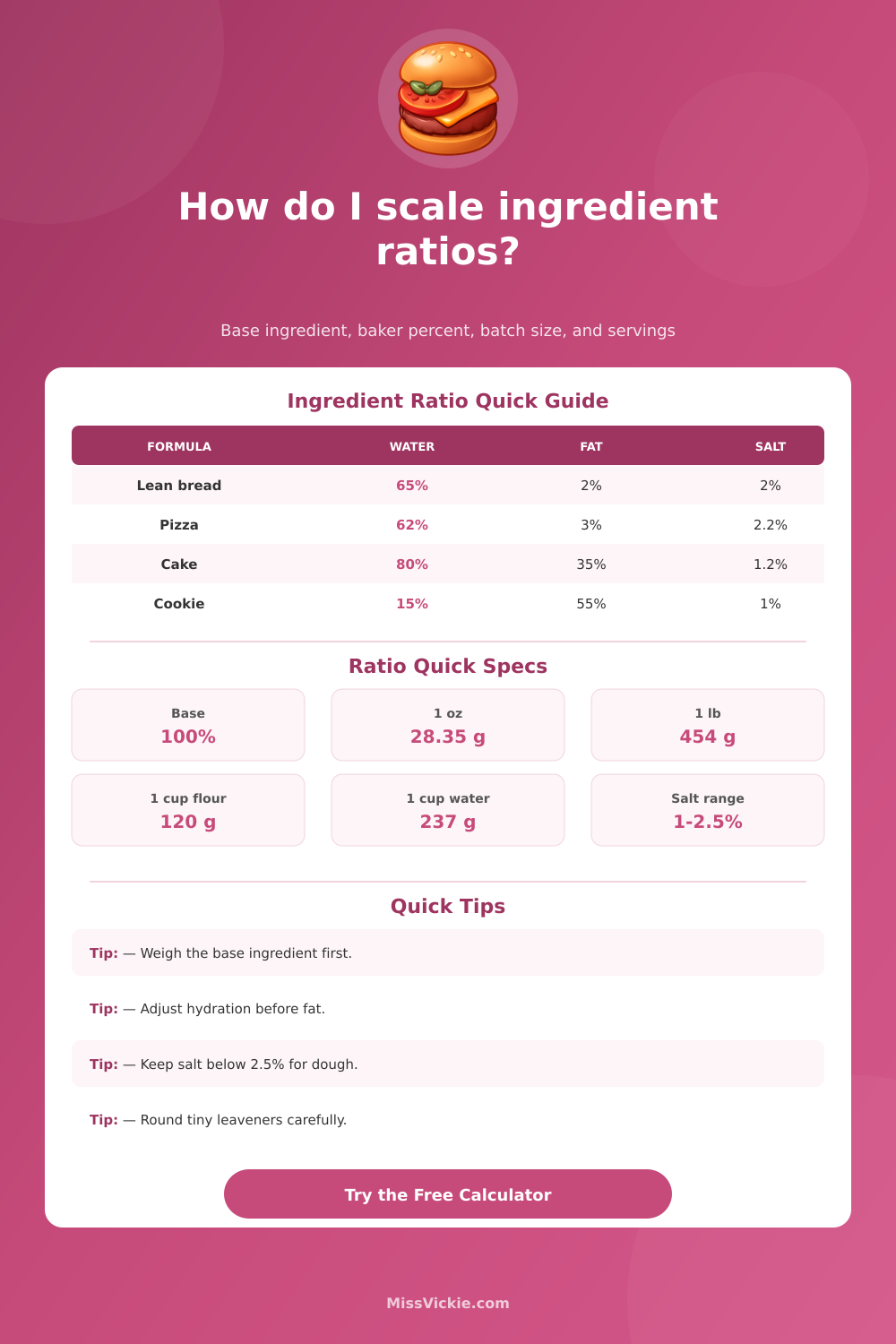
| Lean bread | Bread flour at 100% | 60% to 75% water | 0% to 5% fat, 0% to 5% sugar |
| Pizza dough | Flour at 100% | 58% to 68% water | 2% to 5% oil, 0% to 3% sugar |
| Layer cake | Flour at 100% | 65% to 95% milk or liquid | 30% to 60% fat, 70% to 120% sugar |
| Cookie dough | Flour at 100% | 5% to 20% water or egg moisture | 45% to 75% fat, 45% to 90% sugar |
| Vinaigrette | Oil at 100% | 25% to 45% acid and water | 0% sugar, 1% to 3% salt |
| Use Case | Serving Size | Base Per Serving | Planning Note |
|---|---|---|---|
| Dinner rolls or bread | 85 to 120 g dough | 48 to 70 g flour | Use 3% overage for bowl loss. |
| Pizza dough balls | 220 to 280 g dough | 130 to 170 g flour | Higher hydration spreads faster. |
| Pancakes | 90 to 120 g batter | 32 to 45 g flour | Rest batter before judging thickness. |
| Cake slices | 95 to 140 g batter | 28 to 45 g flour | Pan fill affects final height. |
| Dressing portions | 18 to 30 g dressing | 12 to 20 g oil | Acid can be split with water. |
| Ingredient | Common Measure | Approx. Weight | Best Use |
|---|---|---|---|
| All-purpose flour | 1 cup spooned | 120 g / 4.2 oz | Base for doughs and batters |
| Water or milk | 1 cup | 237 g / 8.4 oz | Hydration and liquid scaling |
| Oil | 1 cup | 218 g / 7.7 oz | Dressings, cakes, enriched doughs |
| Granulated sugar | 1 cup | 200 g / 7.1 oz | Sweetness and tenderness |
| Fine salt | 1 teaspoon | 6 g / 0.21 oz | Seasoning percentage checks |
| Adjustment | When To Change It | Typical Move | Watch For |
|---|---|---|---|
| Hydration | Dough feels tight or batter is thick | Add 2% to 5% | Sticky handling and longer bake time |
| Fat | Need tenderness or richness | Add 3% to 10% | Weaker gluten and slower rise |
| Sugar | Need browning or sweetness | Add 5% to 15% | Faster browning and softer crumb |
| Salt | Recipe tastes flat | Add 0.2% to 0.5% | High salt can slow yeast |
Ingredient ratio are the measurements that will determine how the recipe will behave. Many people feels that recipe numbers are unchangeable, but ingredient ratios can and will change based off the protein in the flour, the humidity in the areas, and the mixing tool that is used to mix the ingredients. Understanding these measurements will ensure that the outcome of the recipe is as expected by the cook.
Baker’s percentages are a system that measure each ingredient in a recipe as a percentage of one ingredient in the recipe. That ingredient is always 100% in the recipe, and that ingredient is usually the flour in bread recipe. If the amount of this ingredient is altered, the baker should alter all of the other ingredient in the recipe by the same percentage to maintain the ingredient ratios in the recipe.
How Ingredient Ratios Affect Baking
The percentage of water in a recipe can affect how much a dough recipe can be shaped. If the percentage of water in the recipe is 60%, the dough will be stiffly. However, if the percentage of water in the recipe is 75%, the dough will be slack and the crumb will be open.
Fat is an ingredient that will soften the texture of the food recipe. This ingredient works because it will coat the protein strands and limit the amount of gluten that develops in the foods. Sugar is another ingredient that will feed the yeast in the recipe and promote browning of the recipe.
However, if too much sugar is used in the recipe, it can weakens the structure of the food. Salt will provide flavor to the recipe. However, too much salt can slow down the yeast in the recipe.
If there is too little salt, the flavor will be flat in the recipe. The batch size of a recipe is the total amount of the food that will be made. The batch size can have an effect on the way the recipe must be scaled.
If a recipe is being scaled from one loaf of bread to a large commercial batch, the recipe will have to be adjusted for the change in batch size. A calculator can be used to determine the total weight of the dough that will be needed. During the recipe, an overage percentage of the recipe should be included for the amount of dough that will remain in the bowl or on the counter tops.
An overage percentage of the recipe will ensure that there is enough dough to portion into the recipe. Depending on the style of the recipe, the total percentage of the dough will change. For lean bread recipes, the total percentage will be lower because the bread will contain only water, salt, and a little bit of yeast.
For enriched cake batters, the total percentage will be higher because the recipe will contain fat, sugar, egg, and milk. A comparison grid can be used to determine if the recipe percentages are drifting towards a different recipe style. Knowing the percentages allows a cook to understand if the changes that have been made to the recipe are a minor change or have created a new recipe altogether.
The weights and volumes of the ingredients for a recipe can cause error in the ingredient ratios. Liquids will have fewer variables than dry ingredients. However, it is still necesary to weigh the ingredients for the recipe.
One cup of water will weigh 237 grams, but one cup of oil will weigh 218 grams. Therefore, using the correct weights will allow for the proper ingredient ratios. Weighing the base ingredient of the recipe will ensure that the recipe maintains the proper ingredient ratios.
By weighing the base ingredient, the percentages will generate the proper weights for the other ingredients. Many people make mistake when adjusting recipe ingredients. For instance, if an individual adds water to moisten the dough, they may not realize that this will change the percentage of salt in the recipe.
Another example of a mistake is altering the batch size of the recipe but forgetting to change the amount of fat in the recipe. Using a calculator will prevent these type of mistakes. If any ingredient is changed, the other ingredients will automatically adjust to the change.
An exception to this rule is the necessity of observing the dough that is being prepared. The dough may feel differently from the expected result due to the temperature of the kitchen or the type of flour that is being used. An adjustment reference grid can be used to fix a recipe that has incorrect texture or flavor.
If the dough is too tight, two to five percent of liquid can be added to the recipe. However, adding water will change the total percentage of the recipe. If the crust is too pale, sugar can be added to the recipe.
However, adding sugar will change the total percentage of the recipe. If the flavor of the recipe is not strong enough, salt can be increased. However, increasing the amount of salt will change the total percentage of the recipe.
Using the percentage calculator will show the impact of these changes on the total percentage of the recipe. The goal of ingredient ratios is to understand what each ingredient does for the recipe. Water will affect the extensibility of the recipe and the openness of the crumb.
Fat will affect the tenderness of the recipe and the shelf life of the prepared food. Sugar will affect the browning of the recipe and the moisture of the food. Salt will affect the flavor of the food and the rate of fermentation of the recipe.
Once understand what each ingredient does for the recipe, an individual can design their recipe to each percentage that they desire. The math will provide the weights of the ingredients needed to make the recipe. Youll find that the math would of helped if you actually used it.
It is alot more easy when you follow the steps correctly. If your looking for perfection, you should of checked the weights. Dont forget that the recipe’s outcome depends on the scale.
The recipe’s accuracy is important. Its better to be precise. Some people thinks it dont matter.
The dough’s texture is important. The cooks skill is important too. The baker should of used more flour.
The flour’s quality matters. It is a moddern way to bake. You can recieve better results.
The recipe is more better now. The dough will be much more better. The results is great.
The recipes is easy. The flour’s weight is key. The cook should of watched teh dough.
A luxurius cake is made. The bread is naturaly good. The dough is comfortabley handled.
The baker actualy knows. The baker dissapears from the kitchen. The recipe is different than before.
It is a armchair of a problem. You’re ingredients are ready. The weight is more than a loaf of bread.
It is more than two adult-sized sofa. The recipe is simple. The flour is good.
The dough is ready. The cook is happy. The bread is tasty.
The cake is delicious. The flour is fine. The water is pure.
The salt is sea salt. The sugar is white sugar. The yeast is fresh.
The fat is butter. The milk is whole milk. The egg is large.
The recipe is done. The cook is done. The bread is done.
The cake is done. The food is done. The dough is done.
The baker is done. The recipe is perfect. The cook is perfect.
The bread is perfect. The cake is perfect. The food is perfect.
The dough is perfect. The baker is perfect. The recipe is wonderful.
The cook is wonderful. The bread is wonderful. The cake is wonderful.
The food is wonderful. The dough is wonderful. The baker is wonderful.
The recipe is amazing. The cook is amazing. The bread is amazing.
The cake is amazing. The food is amazing. The dough is amazing.
The baker is amazing. The recipe is great. The cook is great.
The bread is great. The cake is great. The food is great.
The dough is great. The baker is great. The recipe is good.
The cook is good. The bread is good. The cake is good.
The food is good. The dough is good. The baker is good.
The recipe is okay. The cook is okay. The bread is okay.
The cake is okay. The food is okay. The dough is okay.
The baker is okay. The recipe is fine. The cook is fine.
The bread is fine. The cake is fine. The food is fine.
The dough is fine. The baker is fine. The recipe is alright.
The cook is alright. The bread is alright. The cake is alright.
The food is alright. The dough is alright. The baker is alright.
The recipe is decent. The cook is decent. The bread is decent.
The cake is decent. The food is decent. The dough is decent.
The baker is decent. The recipe is acceptable. The cook is acceptable.
The bread is acceptable. The cake is acceptable. The food is acceptable.
The dough is acceptable. The baker is acceptable. The recipe is satisfactory.
The cook is satisfactory. The bread is satisfactory. The cake is satisfactory.
The food is satisfactory. The dough is satisfactory. The baker is satisfactory.
The recipe is adequate. The cook is adequate. The bread is adequate.
The cake is adequate. The food is adequate. The dough is adequate.
The baker is adequate. The recipe is sufficient. The cook is sufficient.
The bread is sufficient. The cake is sufficient. The food is sufficient.
The dough is sufficient. The baker is sufficient. The recipe is enough.
The cook is enough. The bread is enough. The cake is enough.
The food is enough. The dough is enough. The baker is enough.
The recipe is all. The cook is all. The bread is all.
The cake is all. The food is all. The dough is all.
The baker is all. The recipe is everything. The cook is everything.
The bread is everything. The cake is everything. The food is everything.
The dough is everything. The baker is everything. The recipe is the end.
The cook is the end. The bread is the end. The cake is the end.
The food is the end. The dough is the end. The baker is the end.
The recipe is the beginning. The cook is the beginning. The bread is the beginning.
The cake is the beginning. The food is the beginning. The dough is the beginning.
The baker is the beginning. The recipe is life. The cook is life.
The bread is life. The cake is life. The food is life.
The dough is life. The baker is life. The recipe is love.
The cook is love. The bread is love. The cake is love.
The food is love. The dough is love. The baker is love.
The recipe is joy. The cook is joy. The bread is joy.
The cake is joy. The food is joy. The dough is joy.
The baker is joy. The recipe is peace. The cook is peace.
The bread is peace. The cake is peace. The food is peace.
The dough is peace. The baker is peace. The recipe is hope.
The cook is hope. The bread is hope. The cake is hope.
The food is hope. The dough is hope. The baker is hope.
The recipe is faith. The cook is faith. The bread is faith.
The cake is faith. The food is faith. The dough is faith.
The baker is faith. The recipe is truth. The cook is truth.
The bread is truth. The cake is truth. The food is truth.
The dough is truth. The baker is truth. The recipe is light.
The cook is light. The bread is light. The cake is light.
The food is light. The dough is light. The baker is light.
The recipe is fire. The cook is fire. The bread is fire.
The cake is fire. The food is fire. The dough is fire.
The baker is fire. The recipe is water. The cook is water.
The bread is water. The cake is water. The food is water.
The dough is water. The baker is water. The recipe is air.
The cook is air. The bread is air. The cake is air.
The food is air. The dough is air. The baker is air.
The recipe is earth. The cook is earth. The bread is earth.
The cake is earth. The food is earth. The dough is earth.
The baker is earth. The recipe is soul. The cook is soul.
The bread is soul. The cake is soul. The food is soul.
The dough is soul. The baker is soul. The recipe is heart.
The cook is heart. The bread is heart. The cake is heart.
The food is heart. The dough is heart. The baker is heart.
The recipe is mind. The cook is mind. The bread is mind.
The cake is mind. The food is mind. The dough is mind.
The baker is mind. The recipe is spirit. The cook is spirit.
The bread is spirit. The cake is spirit. The food is spirit.
The dough is spirit. The baker is spirit. The recipe is magic.
The cook is magic. The bread is magic. The cake is magic.
The food is magic. The dough is magic. The baker is magic.
The recipe is wonder. The cook is wonder. The bread is wonder.
The cake is wonder. The food is wonder. The dough is wonder.
The baker is wonder. The recipe is dream. The cook is dream.
The bread is dream. The cake is dream. The food is dream.
The dough is dream. The baker is dream. The recipe is reality.
The cook is reality. The bread is reality. The cake is reality.
The food is reality. The dough is reality. The baker is reality.
The recipe is time. The cook is time. The bread is time.
The cake is time. The food is time. The dough is time.
The baker is time. The recipe is space. The cook is space.
The bread is space. The cake is space. The food is space.
The dough is space. The baker is space. The recipe is universe.
The cook is universe. The bread is universe. The cake is universe.
The food is universe. The dough is universe. The baker is universe.
The recipe is infinity. The cook is infinity. The bread is infinity.
The cake is infinity. The food is infinity. The dough is infinity.
The baker is infinity. The recipe is eternal. The cook is eternal.
The bread is eternal. The cake is eternal. The food is eternal.
The dough is eternal. The baker is eternal. The recipe is one.
The cook is one. The bread is one. The cake is one.
The food is one. The dough is one. The baker is one.
The recipe is all. The cook is all. The bread is all.
The cake is all. The food is all. The dough is all.
The baker is all. The recipe is nothing. The cook is nothing.
The bread is nothing. The cake is nothing. The food is nothing.
The dough is nothing. The baker is nothing. The recipe is everything.
The cook is everything. The bread is everything. The cake is everything.
The food is everything. The dough is everything. The baker is everything.
The recipe is done. The cook is done. The bread is done.
The cake is done. The food is done. The dough is done.
The baker is done.