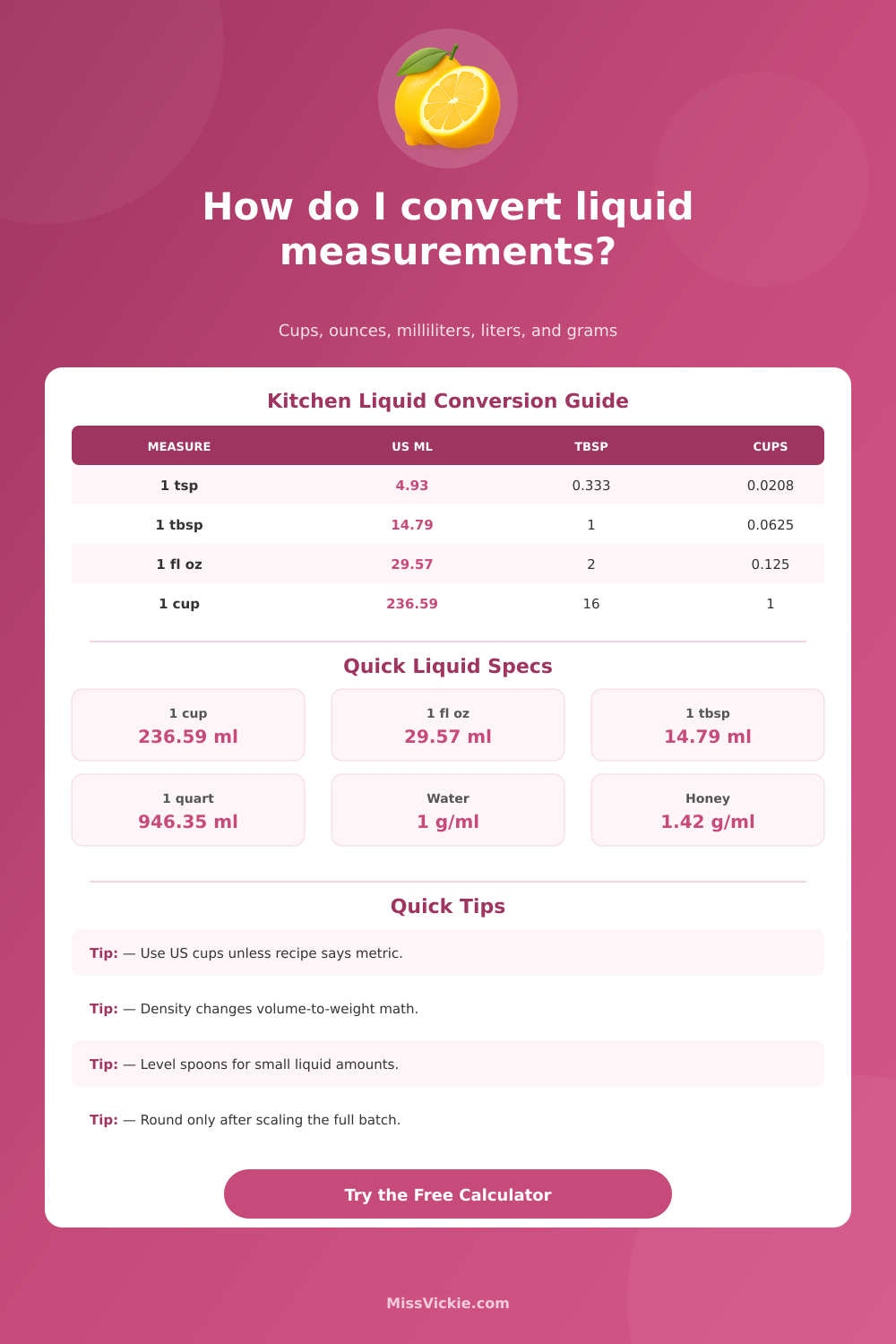
Kitchen liquid volume, weight, and batch math
Liquid Measurement Conversion Calculator
Convert liquid ingredients between teaspoons, tablespoons, fluid ounces, cups, pints, quarts, gallons, milliliters, liters, grams, and ounces while accounting for density, scaling, and batch overage.
Pick a common kitchen situation to load real liquid types, units, scaling, rounding, and container splits before calculating.
Full Conversion Breakdown
The volume conversions are fixed, but weight changes by ingredient density. These values are practical kitchen averages for room-temperature liquids.
1 cup is about 237 g or 8.35 oz.
1 cup is about 244 g or 8.60 oz.
1 cup is about 218 g or 7.68 oz.
1 cup is about 336 g or 11.85 oz.
1 cup is about 315 g or 11.11 oz.
1 cup is about 216 g or 7.60 oz.
1 cup is about 239 g or 8.43 oz.
1 cup is about 343 g or 12.10 oz.
| US Measure | Milliliters | Fluid Ounces | Cups | Common Kitchen Use |
|---|---|---|---|---|
| 1 teaspoon | 4.92892 ml | 0.1667 fl oz | 0.0208 cup | Extracts, acids, flavorings |
| 1 tablespoon | 14.7868 ml | 0.5 fl oz | 0.0625 cup | Oil, vinegar, syrups |
| 1 fluid ounce | 29.5735 ml | 1 fl oz | 0.125 cup | Cocktails, sauces, cream |
| 1 cup | 236.588 ml | 8 fl oz | 1 cup | Baking liquids, stock, milk |
| 1 pint | 473.176 ml | 16 fl oz | 2 cups | Cream, broth, ice cream base |
| 1 quart | 946.353 ml | 32 fl oz | 4 cups | Soup, brine, punch, stock |
| 1 gallon | 3785.41 ml | 128 fl oz | 16 cups | Large brines, beverage batches |
| Metric Amount | US Teaspoons | US Tablespoons | US Cups | Best Measuring Tool |
|---|---|---|---|---|
| 5 ml | 1.01 tsp | 0.34 tbsp | 0.021 cup | Measuring spoon |
| 15 ml | 3.04 tsp | 1.01 tbsp | 0.063 cup | Tablespoon measure |
| 30 ml | 6.09 tsp | 2.03 tbsp | 0.127 cup | Small liquid cup |
| 100 ml | 20.29 tsp | 6.76 tbsp | 0.423 cup | Metric jug |
| 250 ml | 50.72 tsp | 16.91 tbsp | 1.057 cups | Metric measuring cup |
| 500 ml | 101.44 tsp | 33.81 tbsp | 2.113 cups | Large jug |
| 1 liter | 202.88 tsp | 67.63 tbsp | 4.227 cups | Pitcher or scale |
| Liquid | Density | 1 Cup Weight | 1 Tablespoon Weight | Kitchen Note |
|---|---|---|---|---|
| Water or thin stock | 1.00 g/ml | 237 g / 8.35 oz | 14.8 g / 0.52 oz | Closest to metric one-to-one |
| Whole milk | 1.03 g/ml | 244 g / 8.60 oz | 15.2 g / 0.54 oz | Slightly heavier than water |
| Heavy cream | 0.994 g/ml | 235 g / 8.30 oz | 14.7 g / 0.52 oz | Varies with fat percentage |
| Vegetable oil | 0.92 g/ml | 218 g / 7.68 oz | 13.6 g / 0.48 oz | Lighter than water by volume |
| Honey | 1.42 g/ml | 336 g / 11.85 oz | 21.0 g / 0.74 oz | Warm slightly for cleaner pouring |
| Maple syrup | 1.33 g/ml | 315 g / 11.11 oz | 19.7 g / 0.69 oz | Grade and sugar content vary |
| Melted butter | 0.911 g/ml | 216 g / 7.60 oz | 13.5 g / 0.47 oz | Cool slightly before measuring |
| Molasses | 1.45 g/ml | 343 g / 12.10 oz | 21.4 g / 0.76 oz | Very dense and clings to cups |
| Starting Liquid | Scale Factor | Before Overage | With 5% Overage | Useful Split |
|---|---|---|---|---|
| 1 cup milk | 2x | 473 ml / 2 cups | 497 ml / 2.1 cups | 4 portions of 124 ml |
| 2 tbsp oil | 3x | 88.7 ml / 6 tbsp | 93.2 ml / 6.3 tbsp | 3 portions of 31 ml |
| 1 quart stock | 1.5x | 1.42 L / 6 cups | 1.49 L / 6.3 cups | 6 bowls of 248 ml |
| 1 gallon brine | 0.5x | 1.89 L / 8 cups | 1.99 L / 8.4 cups | 2 jars of 994 ml |
| 3 cups honey | 1.25x | 887 ml / 3.75 cups | 932 ml / 3.94 cups | 12 bakes of 77.6 ml |
| 500 ml vinegar | 4x | 2 L / 8.45 cups | 2.1 L / 8.88 cups | 7 jars of 300 ml |
To succesfully complete a recipe, it is important to be able to convert the different unit of measurement that are listed in the recipe. Recipes often use a variety of units to describe the amount of liquid that are to be used in the recipe, such as cup and milliliters. The unit of measurement that is used in a recipe may be different than the unit of measurement that can be display on the measuring tools that are to be used in the kitchen.
Thus, each of these measurement must be converted to ensure the success of the recipe. While it may appear that this type of measurement is difficult due to the math that is required to perform each of these conversions, it is actualy this diversity of units of measurement for liquids that is complicated by the fact that there are different system of measurement created for different purposes. Liquids can be measured in two different way: volume or weight.
How to Measure and Convert Liquids in Recipes
Each of these unit does not necessarily have the same weight for the same amount of liquid. For instance, one cup of water will weigh the same as one cup of water measured in gram, but one cup of honey will contain more weight than a cup of water because honey is a more dens liquid than water. Thus, the density of a liquid will indicate both the weight and the amount of space that liquid will occupy.
Because honey is much more denser than vegetable oil, the two liquids cant be directly interchanged in a recipe. When scaling a recipe, it is important to account for the fact that some of the liquid that is measured will be lost during the cooking process. When doubling a recipe that calls for two quarts of stock, for instance, it is likely that the amount of liquid will be less than the measured amount due to the evaporation of some of the liquid, as well as to the amount of liquid that can become stuck to the side of the pot.
An overage option of adding five to ten percent extra liquid to a recipe is often used to compensate for these lost liquid. Some liquids are better measured than others according to the volume or the weight of the liquid. Liquids that are thin, like stocks and vinegar, dont need to be measure by weight.
However, liquids that are thick or sticky, like syrups or melted butter, are better measured by weight because this will result in less liquid wasted while measuring the ingredient. By using the density of the ingredient to convert the volume to gram, the cook can then measure the liquid by weight using a scale. The sizes of the containers into which the liquids are to be portioned is also another important variable in measuring liquids.
If the cook portions the amount of vinegar into a variety of jar, for instance, each of the container must be of the correct size. Using containers that are too large for the volume of the liquid may result in the liquid spoiling. Using containers that are too small for the volume of the liquid may require the liquid to be portioned into the containers multiple times.
Thus, it is important to ensure that the containers of liquid are of the correct size to receive the amount of liquid. Many errors in the kitchen may result from the consideration of all liquids as if they was the same and could be measured in the same way. A tablespoon of oil will occupy the same amount of space in a measuring spoon as a tablespoon of molasses, but the two liquids will behave differently due to the difference in the density of each of the liquid.
Additionally, some countries use different measurement for units like a cup or pint than others do. Thus, ensuring that you refer to a reference table will allow you to make certain that all of the unit are measured correctly. Another factor in the measurement of liquids is the temperature at which the liquids are measured.
Viscosity, which is a measurement of the resistance of a liquid to move or flow, can change with the temperature of the liquid. For instance, the viscosity of cold honey will be higher than warm honey, which will allow the cold honey to exit the spoon at a slow rate. Oil will thicken in the cooler temperature of the kitchen.
Thus, the change in viscosity can impact the accuracy of the measurement of the liquid according to volume. To avoid errors in measuring liquids, it is helpful to decide on the unit of measurement that will be used for the entire recipe prior to beginning to measure the liquids. If the recipe uses measurement of milliliters, for instance, it is best to use those units of measurement for every step of the recipe.
However, if the liquids to be measured are better measured in weight, the recipe can be converted to weight measurement prior to beginning to measure the ingredient. By making a decision on the unit of measurement that is to be used, the cook can ensure that they understand the amount of liquid that is to be used in the recipe and that they will follow the recipe as it is written. You should of checked the recipe’s instructions carefully.