How Much Salad Per Person Calculator
Plan salad by guest count, salad type, entree or side role, trimmed greens yield, dressing ratio, toppings, appetite, leftovers, and waste factor.
🥗Salad presets
Choose a starting point for a real meal, party, buffet, or meal prep setup, then fine tune the portion and yield fields.
📝Salad planning inputs
Your salad plan
The calculator starts with finished salad portions, then estimates trimmed greens, raw greens to buy, dressing volume, toppings, leftovers, holding buffer, and waste.
Calculation breakdown
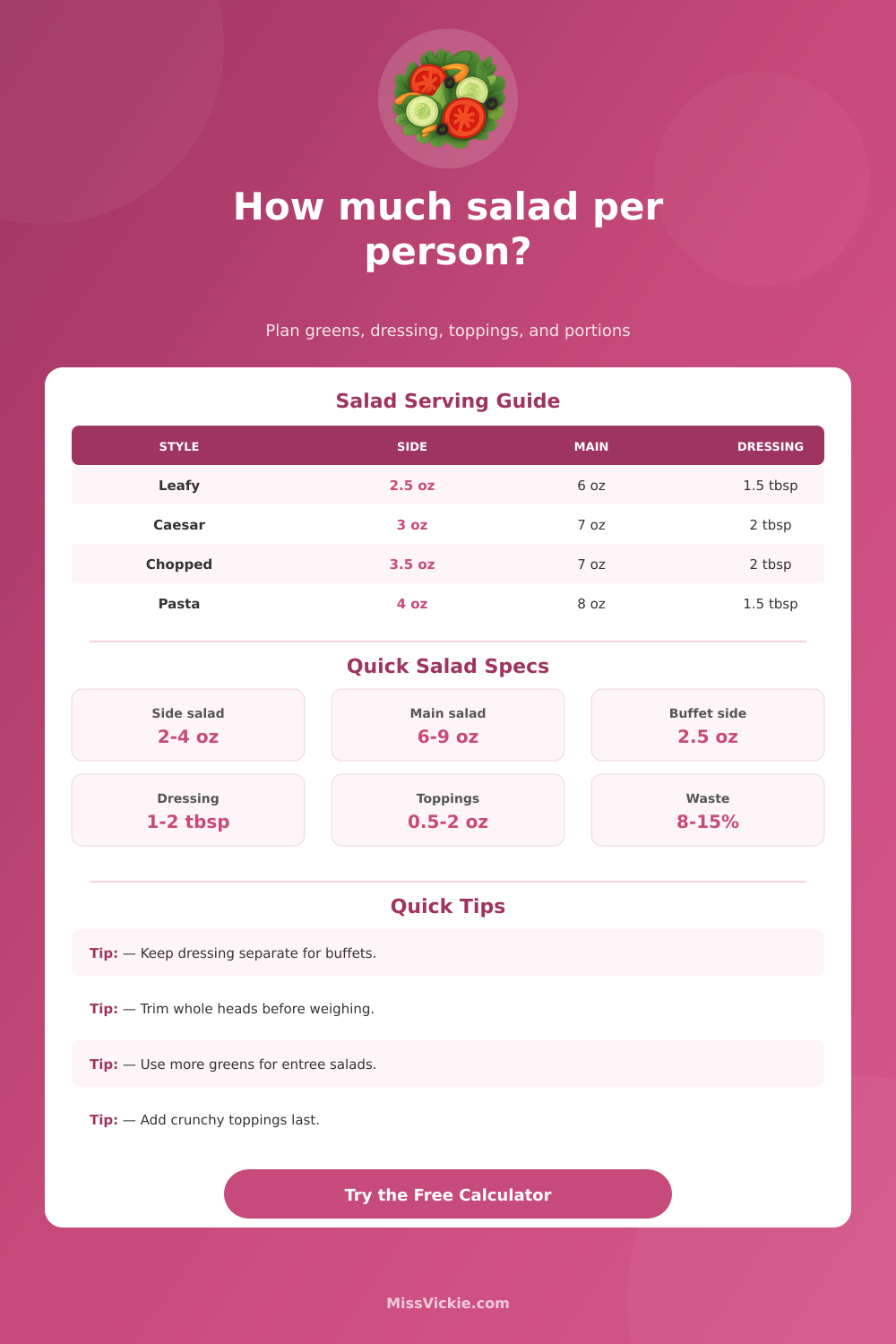
📌Fast salad rules of thumb
🥬Salad type comparison grid
Mixed greens, spinach, or romaine served beside a main dish. Plan more raw volume because greens are light and compress after dressing.
Romaine, dressing, croutons, and cheese make a compact but heavier side salad. It scales well for family dinners and buffets.
Vegetables, greens, cheese, and beans pack tightly, so the bowl looks smaller than a fluffy leafy salad at the same weight.
Pasta, potato, grain, slaw, and fruit salads are denser. Use smaller visual bowls but heavier finished portions.
🍲Serving size reference
| Serving scenario | Finished salad per person | Best salad types | Planning note |
|---|---|---|---|
| Starter course before dinner | 2 to 3 oz / 55 to 85 g | Mixed greens, spinach, Caesar | Keep dressing light so it does not feel heavy before the main course. |
| Side salad with a plated meal | 2.5 to 4 oz / 70 to 115 g | Leafy, Caesar, chopped, slaw | Use the higher end when the main dish is simple or light. |
| Buffet or potluck side | 2 to 3.5 oz / 55 to 100 g | Caesar, slaw, pasta, potato, grain | Guests sample many dishes, so portions are smaller but waste buffer matters more. |
| Cookout side salad | 3 to 5 oz / 85 to 140 g | Coleslaw, pasta, potato, chopped | Dense salads hold better outdoors than delicate dressed greens. |
| Light lunch salad | 5 to 7 oz / 140 to 200 g | Chopped, spinach, grain, fruit | Add more toppings or protein if the salad is the main lunch item. |
| Entree salad bowl | 7 to 10 oz / 200 to 285 g | Chopped, Caesar, grain, protein salad | Plan enough toppings and dressing so the bowl eats like a meal. |
⚖Greens yield and raw purchase guide
| Greens source | Usable yield | Raw amount for 1 lb usable | Best use |
|---|---|---|---|
| Bagged washed greens | 96% to 99% | 1.02 lb / 465 g | Fast side salads and events where trim waste must stay low. |
| Baby spinach | 88% to 94% | 1.09 lb / 495 g | Spinach salads, fruit-nut salads, and light lunch bowls. |
| Romaine hearts | 68% to 75% | 1.39 lb / 630 g | Caesar salads and chopped romaine bowls. |
| Leaf lettuce heads | 60% to 70% | 1.54 lb / 700 g | Fluffy mixed side salads where volume matters. |
| Iceberg or cabbage heads | 75% to 82% | 1.28 lb / 580 g | Slaw, wedge salad, shredded lettuce, and crunchy chopped salads. |
| Kale bunches, stems removed | 55% to 65% | 1.67 lb / 760 g | Massaged kale salads and hearty make-ahead greens. |
Whole heads look economical, but cores, stems, bruised outer leaves, and washing loss can remove one quarter or more of the weight before the salad bowl is built.
For large groups, bagged greens reduce trim uncertainty. They also make it easier to keep backup greens chilled and undressed for refills.
🧺Common group quantities
| Group size | Leafy side salad | Entree salad bowls | Dense side salad | Dressing estimate |
|---|---|---|---|---|
| 4 guests | 10 to 14 oz finished | 1.8 to 2.5 lb finished | 1 to 1.25 lb finished | 1/4 to 1/2 cup |
| 8 guests | 1.25 to 1.75 lb finished | 3.5 to 5 lb finished | 2 to 2.5 lb finished | 1/2 to 1 cup |
| 12 guests | 1.9 to 2.6 lb finished | 5.25 to 7.5 lb finished | 3 to 3.75 lb finished | 3/4 to 1.5 cups |
| 25 guests | 4 to 5.5 lb finished | 11 to 15.5 lb finished | 6.25 to 8 lb finished | 1.5 to 3 cups |
| 50 guests | 8 to 11 lb finished | 22 to 31 lb finished | 12.5 to 16 lb finished | 3 to 6 cups |
| 75 guests | 12 to 16.5 lb finished | 33 to 47 lb finished | 19 to 24 lb finished | 4.5 to 9 cups |
🥄Dressing and topping ratios
| Salad build | Dressing per person | Toppings per person | How it behaves |
|---|---|---|---|
| Delicate mixed greens | 1 to 1.25 tbsp | 0.25 to 0.75 oz | Too much dressing collapses the volume, so toss lightly and serve quickly. |
| Classic Caesar | 1.5 to 2 tbsp | 0.75 to 1.25 oz | Romaine can take a richer coating, especially with croutons and Parmesan. |
| Chopped vegetable salad | 1.5 to 2 tbsp | 1 to 2 oz | Small cuts distribute dressing evenly and hold well for lunch service. |
| Coleslaw or cabbage salad | 1.5 to 2.5 tbsp | 0.25 to 1 oz | Cabbage releases moisture after salting, so reserve some dressing for final adjustment. |
| Pasta, potato, or grain salad | 1 to 1.75 tbsp | 1 to 2.5 oz | Dense bases absorb dressing while chilling and may need a small refresh before serving. |
| Entree salad bowl | 2 to 3 tbsp | 2 to 5 oz | Protein, cheese, grains, and crunchy toppings drive the weight more than greens do. |
💡Two salad planning tips
When calculating an amount of salad that is needed for a group of people, there are many different factor that must be accounted for. The amount of salad that a person will eat will change according to the situation in which the salad is consume. For example, if the salad is to be the main course for a meal, the amount of salad that people will consume will be greater than if the salad are to be a side dish.
In the opposite example, if the salad is to be a side dish, the amount of salad that will be consumed is less then if the salad is to be the main course for an individual’s meal. Other factors to consider are how the cook is to serve the salad and how much weight will be lost during the preparation of the salad. The calculator provide a mathematical means of determining the total weight of the salad that will be needed for a gathering.
How Much Salad You Need for a Group
The calculator utilizes three different variable to determine the baseline weight of the salad that will be needed. The number of guests that will attend the event, the type of salad that will be provided, and how the salad will be served are the three variables that the calculator utilize. For instance, the type of salad will impact the weight and volume of the salad that is prepared.
Additionally, the way that the salad is to be served can also have an impact upon the weight of the salad that is prepared; buffets require more salad than those that are to be served as seated meal. Buffets require more salad to be prepared to account for the fact that salad greens will be required to be provided as refills to the guests, as well as the weight of the salad dressing that may remain at the bottom of the salad bowl after the guests have eaten. Another of the factors that must be accounted for in the calculation is the loss of weight of the salad during the cleaning of the greens.
For instance, if leafy greens that are whole heads of lettuce are to be purchase, the weight of the greens will be lost when the cook removes the stems and damaged leaves from the greens. The percentage of the salad that is lost during this process is known as the yield loss of the greens. The purchase of bagged greens will result in little yield loss.
However, the purchase of hearts of romaine or kale will result in a yield loss of thirty to forty percent of the total weight of the greens due to the need to discard the stems of the greens. The calculator will provide the weight of the salad that will be prepared, as well as the raw weight of the greens that will be needed to account for the yield loss. Additionally, the weights of the toppings that are to be include with the salad will impact the total weight of the greens that will be consumed by the guests.
Salads that contains many of the toppings will have a greater total weight than those that contain only greens. The calculator account for the type of toppings that are to be included with the salad. Additionally, the type of salad will impact the amount of dressing that is recommend for the salad.
For instance, the amount of dressing that is needed for a pasta salad will be different than the amount of dressing needed for a leafy greens salad. One reason for the difference in amount of dressing is that the pasta salad will require additional liquid to remain moist. Another reason is that the pasta salad will tend to absorb more of the salad dressing if it is prepared for longer period of time.
An additional consideration for the preparation of the salad is the provision for any waste that may occur with the salad. For instance, some individuals may only take a small amount of the salad from the serving, others may leave the salad dressing in the salad bowl. To account for these possible instances of waste, an initial buffer of eight to fifteen percent of the total weight of the salad is provided.
The individual that use the calculator can adjust this percentage; it is possible to provide extra salad to account for any that may be left over at the event, or to minimize the amount of salad that is left over. To use the calculator to determine the total weight of the salad that will be needed for the event, the user will first enter the initial information into the calculator. After the initial information is entered, different variables can be adjusted to determine the total weight of the salad that will be needed for the event.
For instance, the level of appetite that the guests will have can be adjusted. Additionally, the percentage of salad that is expected to be waste can be adjusted. By adjusting each of these variables, it is possible to find the range of the total weight of the salad that will be needed for the guests.
Within this range will be the total weight of the salad that should of been prepared to ensure that there is enough for all of the guests, while also ensuring that there is not too much of the salad prepared to the point of having excess salad left over after the event. The calculator cant be used without entering all the data first. Its important to be accurate.
Youll also find that modern salad types needs different amounts of dressing. One more thing, the salad’s weight depends on the ingredients. Don’t forget that.