Guests, entree or side bowls, meat, beans, toppings, yield, and leftovers
How Much Chili Per Person Calculator
Scale chili by crowd size, serving role, appetite, chili style, meat and bean ratio, topping load, cooked yield, simmer loss, buffet buffer, and planned leftovers.
Start with a common chili night, tailgate, potluck, or freezer plan, then adjust the serving size and ratio details.
Chili Batch Breakdown
| Chili Style | Typical Portion | Meat And Bean Lean | Cup Weight | Simmer Loss | Best Use |
|---|---|---|---|---|---|
| Classic beef and beans | 1.5 to 2 cups | Balanced meat, beans, tomato | 8.8 oz per cup | 10% to 14% | Family dinners, potlucks, and standard bowls. |
| Texas-style no-bean | 1.25 to 1.75 cups | Meat-heavy with thick sauce | 9.4 oz per cup | 14% to 18% | Smaller rich bowls with cornbread or chips. |
| Three-bean chili | 1.75 to 2.25 cups | Beans carry most of the volume | 8.5 oz per cup | 8% to 12% | Vegetarian tables and filling low-meat batches. |
| Turkey chili | 1.75 to 2 cups | Lean meat with moderate beans | 8.4 oz per cup | 8% to 12% | Weeknight dinners and lighter chili bars. |
| White chicken chili | 1.5 to 2 cups | Chicken, beans, broth, and dairy | 8.2 oz per cup | 6% to 10% | Creamy bowls where toppings are usually lighter. |
| Smoky brisket chili | 1.25 to 1.75 cups | Rich meat with lower bean volume | 9.6 oz per cup | 12% to 16% | Tailgates, cookoffs, and hearty smaller bowls. |
| Guests | Side Cup | Main Bowl | Hearty Bowl | With 20% Leftovers | Serving Note |
|---|---|---|---|---|---|
| 4 guests | 4 cups / 1 qt | 8 cups / 2 qt | 10 cups / 2.5 qt | 9.6 cups / 2.4 qt | A small Dutch oven is usually enough. |
| 8 guests | 8 cups / 2 qt | 16 cups / 4 qt | 20 cups / 5 qt | 19.2 cups / 4.8 qt | Use a 6 to 7 qt pot for stirring room. |
| 12 guests | 12 cups / 3 qt | 24 cups / 6 qt | 30 cups / 7.5 qt | 28.8 cups / 7.2 qt | A slow cooker may need two batches. |
| 25 guests | 25 cups / 6.3 qt | 50 cups / 12.5 qt | 62.5 cups / 15.6 qt | 60 cups / 15 qt | Hold chili in two warmers for cleaner service. |
| 50 guests | 50 cups / 12.5 qt | 100 cups / 25 qt | 125 cups / 31.3 qt | 120 cups / 30 qt | Split into labeled mild and spicy pans. |
| 100 guests | 100 cups / 25 qt | 200 cups / 50 qt | 250 cups / 62.5 qt | 240 cups / 60 qt | Plan refills in hotel pans or stockpots. |
| Ratio Style | Cooked Meat Share | Bean Share | Raw Meat Yield | Bean Shortcut | Planning Note |
|---|---|---|---|---|---|
| Mostly meat | 80% to 90% | 0% to 10% | 68% to 76% | Optional | Use smaller bowls because rich chili fills faster. |
| Classic balance | 50% to 60% | 25% to 35% | 70% to 78% | 1 can gives 1.5 cups | Good default for potlucks and family meals. |
| Bean-forward | 20% to 35% | 45% to 60% | 72% to 82% | Dry beans triple after cooking | Plan more topping crunch for texture contrast. |
| Vegetarian | 0% | 60% to 75% | Not needed | 1 lb dry gives 6 cups | Add vegetables and tomato base for volume. |
| White chicken | 45% to 55% | 20% to 30% | 76% to 84% | White beans hold shape | Lower simmer loss because broth stays looser. |
| Brisket chili | 65% to 80% | 0% to 20% | Already cooked | Optional | If meat is already cooked, set yield near 95%. |
| Topping Style | Per Bowl | Cheese | Onion Or Fresh | Crunch | Leftover Note |
|---|---|---|---|---|---|
| No toppings | 0 cups | None | None | None | Best when freezing most of the batch. |
| Simple cheese and onion | 0.18 cup | 0.6 oz | 0.25 oz | Optional crackers | Works for office lunches and family dinners. |
| Standard chili bar | 0.30 cup | 0.9 oz | 0.35 oz | 0.35 oz chips | Keep dairy toppings out of leftover containers. |
| Loaded bowls | 0.45 cup | 1.2 oz | 0.45 oz | 0.6 oz chips | Use wide bowls so toppings do not spill. |
| Frito pie style | 0.55 cup | 1.0 oz | 0.25 oz | 1.25 oz chips | Plan smaller chili portions because chips add bulk. |
Planning a pot of chili requires you to calculate the correct amount of chili that you need to feed the number of people who will eat the chili. Due to these varying number of people, it is often difficult to plan for a pot of chili. One batch of chili might be too small for the number of people who will eat the chili, but the same recipe might be too large for another number of people.
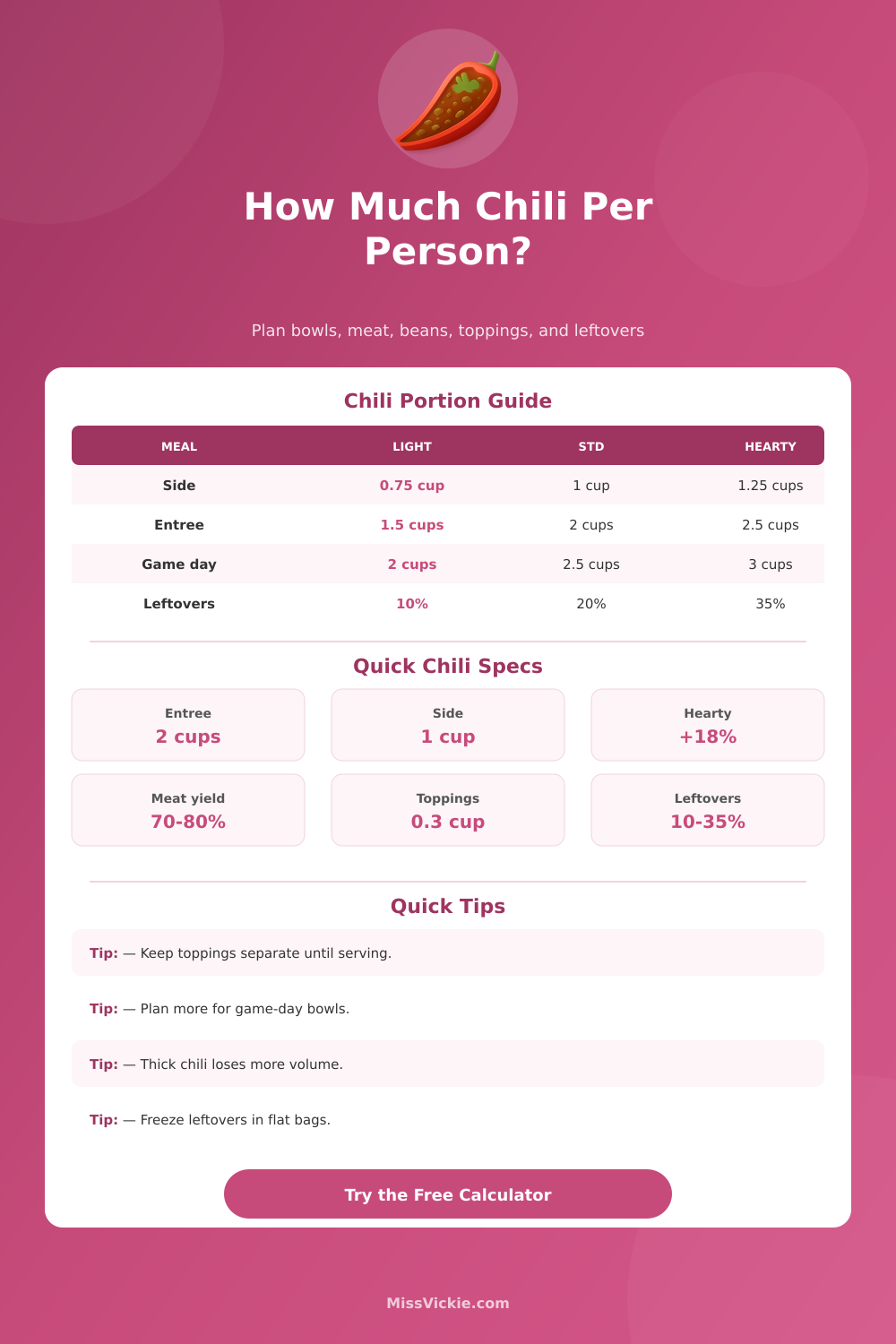
Before you begin to cook the chili, you must consider the portion size of the chili that will be served to each of the guests. The calculator will provide mathematical totals for you once you have entered the size of the group that will eat the chili and the role of the chili. For instance, if the chili will be the main meal for the group, then a different amount of chili will be required than if it was to be a topping for baked potatoes.
How to Plan the Right Amount of Chili
In addition to the role of the chili, the appetite level of the group, the style of chili that will be prepared, and the ratio of meat to beans that you will use in your chili will also influence the number of servings of chili. When planning a pot of chili, you must account for the chili yield and the amount of loss that will occur while simmer the chili. If you use ground beef for your chili, the ground beef will lose weight during the cooking process.
Additionally, if you simulate your chili to the point of thick chili, the chili will lose volume if the lid is off of the pot. Both of these factor will be accounted for in the chili recipe calculator. The field for cooked yield percentage will allow you to account for how much raw meat will need to be purchased for your chili.
If the percentage of raw meat that will be used in your chili is low, you will need to purchase more raw meat to prepare chili for your group. The simmer loss field will allow for the evaporation of the chili during the simmering process. This field will ensure that you have enough chili to serve to all of your guests when they arrives.
In addition to accounting for the loss of chili during simmering, you will need to account for the toppings that will be served with the chili. If you plan on having a chili bar with cheese, onions, and chili chips, the amount of chili that is needed will be less than if you plan on serving these toppings with the chili. The topping style field will account for the amount of chili that will be consumed with the toppings.
The buffer field will provide extra chili for those who eat second helping or spill their chili. Another decision that you must make before calculating the amount of chili that is needed for your group is the decision of whether you would like chili leftovers. Some people eat chili in the lunches of the weekdays, while others want chili that can be frozen in containers.
The percentage of chili that will be left over can be set in the calculator. The reference tables will help you to understand the different options for chili planning. For example, the reference tables will help you to understand how each of the appetite settings will affect the chili plan.
You can use these tables to determine how one changing variable will impact another in your chili plan. The way in which you serve the chili will impact the amount of chili that each person will eat. If you serve chili on a buffet line, each person will eat smaller scoops of chili.
However, if you are having a sit-down meal that includes cornbread, each person will be served larger portions of chili. Additionally, if some of the people who will eat the chili are children, the portion sizes will be smaller for each child than they would be for an adult. These appetite settings will account for these different serving options in the recipe calculator.
Lastly, the style of the chili will impact the mathematical preparations of the chili. For instance, Texas-style chili contains very few beans and is dense in texture so that a person will feel full with a smaller portion of chili. If you prepare vegetarian chili that contains many beans, a large portion of chili will be required.
White chicken chili contains broth that is light in color so that a smaller portion of chili will be needed. These different styles of chili will be accounted for in the recipe calculator. Many people make mistakes when planning a chili pot.
For instance, many people calculate the amount of ground beef that they will need when the beef is in its raw state, but the raw beef will shrink during the browning process of the chili. Additionally, many people do not account for the volume that the beans and vegetables will add to the chili after they are cooked. If these factors are not accounted for, there will be either too much chili or too little chili to serve all of the guest.
The reference tables can be used to compare the different scenarios for the chili that will be prepared. One table will indicate the amount of chili that is needed based on the role of the chili. Another table will demonstrate the ratio of the meat to the beans that are needed for each style of chili.
While these tables are not rules, they do provide a starting point for planning chili. By using the chili recipe calculator, you can easily determine the amount of raw meat that you will need to purchase and the number of cans of beans that you will need to open for your chili recipe.