Chip bags, protein, cheese, toppings, salsa, appetite, and buffet waste
Walking Taco Bar Calculator
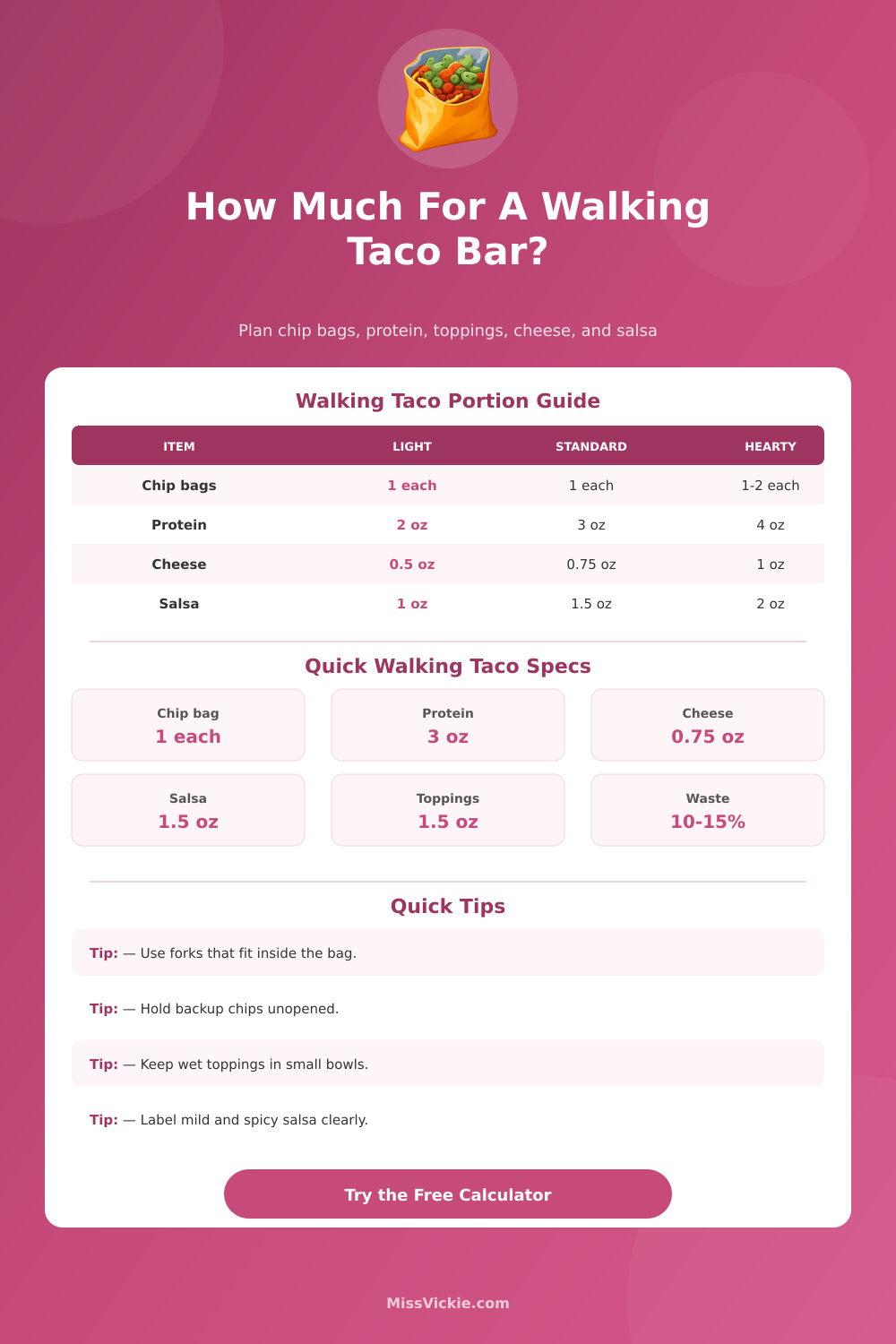
Plan a walking taco bar by guest count, single-serve bag size, scoop-cup serving style, protein type, topping load, cheese, salsa, appetite, vegetarian share, kids share, and refill waste.
Load a real party pattern, then adjust chip bag size, portions, topping intensity, and backup percentage for your crowd.
Walking Taco Bar Breakdown
| Serving Style | Chip Base | Protein Target | Topping Fit | Best Use |
|---|---|---|---|---|
| Mini snack bag | 0.75 oz chips | 1.5 to 2.25 oz cooked | Light cheese and salsa | Kids parties, sampling tables, and events with many sides. |
| Classic bag | 1 to 1.5 oz chips | 2.5 to 3.25 oz cooked | Standard cheese, lettuce, salsa | Most party walking taco bars. |
| Hungry bag | 2 oz chips | 3.5 to 4.5 oz cooked | Loaded toppings fit better | Sports teams, tailgates, and late-night meals. |
| Scoop cup | 1.5 oz bulk chips | 2.5 to 3.5 oz cooked | Neater for wet toppings | Office lunches and indoor buffets. |
| Nacho tray | 2.5 oz chips | 3.5 to 5 oz cooked | Room for queso and chili | Concession stands and seated events. |
| Topping Style | Cheese Per Serving | Salsa Per Serving | Dry Toppings | Wet Toppings |
|---|---|---|---|---|
| Simple concession | 0.5 oz | 1 oz | 0.4 oz lettuce or chips | 0.3 oz sour cream or sauce |
| Standard party | 0.75 oz | 1.5 oz | 0.75 oz lettuce, onion, tomato | 0.5 oz sour cream or queso |
| Loaded bar | 1 oz | 2 oz | 1 oz lettuce, onion, jalapeno | 0.75 oz crema, queso, beans |
| Fresh salsa bar | 0.5 oz | 2 oz | 0.9 oz slaw, cilantro, radish | 0.45 oz crema or avocado sauce |
| Kids cheese-forward | 1.1 oz | 0.75 oz | 0.35 oz lettuce or corn | 0.25 oz sour cream |
| Guests | Classic Bags | Cooked Protein | Cheese | Salsa | Station Note |
|---|---|---|---|---|---|
| 10 guests | 11 to 12 bags | 1.9 lb / 0.9 kg | 0.5 lb / 0.2 kg | 2 cups / 0.5 L | One warm pan is enough. |
| 25 guests | 28 to 30 bags | 4.7 lb / 2.1 kg | 1.3 lb / 0.6 kg | 4.7 cups / 1.1 L | Use two salsa bowls for flow. |
| 50 guests | 56 to 60 bags | 9.4 lb / 4.3 kg | 2.6 lb / 1.2 kg | 9.4 cups / 2.2 L | Stage unopened chip boxes nearby. |
| 75 guests | 84 to 90 bags | 14.1 lb / 6.4 kg | 4 lb / 1.8 kg | 14 cups / 3.3 L | Split toppings into two lines. |
| 100 guests | 112 to 120 bags | 18.8 lb / 8.5 kg | 5.3 lb / 2.4 kg | 18.8 cups / 4.4 L | Use labeled vegetarian protein. |
| Protein Style | Cooked Yield From Raw | Typical Serving | Raw For 25 Servings | Best Pairing |
|---|---|---|---|---|
| Seasoned ground beef | 70% to 75% | 3 oz cooked | 6.5 lb / 2.9 kg | Cheddar, lettuce, mild salsa |
| Beef and bean blend | 82% to 88% | 3.2 oz cooked | 5.8 lb / 2.6 kg | Corn chips, cheese, onion |
| Shredded chicken | 72% to 78% | 2.8 oz cooked | 5.8 lb / 2.6 kg | Salsa verde, slaw, crema |
| Turkey taco meat | 76% to 82% | 2.8 oz cooked | 5.5 lb / 2.5 kg | Pico, lettuce, pepper jack |
| Chili topping | 88% to 94% | 4 oz cooked | 6.9 lb / 3.1 kg | Cheese, onions, jalapenos |
| Bean and veggie filling | 88% to 95% | 3.2 oz cooked | 5.7 lb / 2.6 kg | Cabbage, corn salsa, lime |
A walking taco bar is a method of resolve a specific problem for parties that want to include a handheld meal that dont use a plate. A walking taco bar allows a person to hold the chip bag or cup that come with the tacos. Additionally, the host can add protein and toppings to this bag or cup.
The advantage of using a bag or cup to hold the tacos allow the guests to move and talk with others while eating. However, the host must provide the correct amount of food to ensure that the host does not have too much food or not enough for the guests. The amount of food that will be required can depend on several factors.
How to Plan a Walking Taco Bar
For instance, the number of chips that is required is a consistent number because that bag will be used to contain the tacos. However, the amount of protein, cheese, and salsa will vary depending on the guests who will eat the tacos. For example, children may require less protein but more cheese then adults.
Additionally, adults who is using the tacos as a dinner meal may require more toppings than children who only use them as a snack. A calculator can provide an estimate of how many of each item will be needed by considering the number of guests at the party, the age of the guests, the appetite level of the guests, and the amount of food that may be lost while preparing the tacos. Each of the different inputs into the calculator will alter the amount of each ingredient that is required of the host.
For example, the size of the chip bags will change the amount of other ingredients that can fit into the bag; single-serve bags provide more space for the toppings than mini bags. Additionally, the protein that will be used will change the amount of raw protein that is required; different proteins has different weights after they are cooked. Additionally, the amount of toppings that will be used will change the amount of ingredients that is required; a heavy topping load will require more ingredients than a lighter load of toppings.
Other factors that will affect the amount of ingredients that is required for the tacos includes the appetite level of the guests at the party. For example, if there will be a large number of sports fans at the party who will be eating the tacos, more food will be required than if there were only a few sports fans at the party. The number of children at the party will also alter the amount of food that will be required; more children means that less protein will be required.
Additionally, the number of vegetarians at the party will alter the amount of bean filling that is required; if the protein includes beans, then there will need to be enough bean filling for those who will not eat meat. The amount of food that could be lost while preparing the tacos is also a factor; for example, some of the protein may stick to the pan after being cooked. As such, there will need to be an extra number of bags of chips to provide for each guest; otherwise, there may not be enough for the last few guests to arrive at the party.
The reference tables provide information about the number of chips of each type that is required, the amount of cheese and salsa of each type that will be required for each load of toppings, and the amount of raw protein that will be required to provide the amount of protein of each type after it has been cooked. The organization of the walking taco bar line will also affect the type of food that is provided. For example, if the host adds protein, cheese, and toppings to the chip bags in that order, the wet ingredients will remain on the top of the chips.
This can be beneficial to the preparation of the tacos, as the chips will remain crisp by not soaking in the wet ingredients. Forks should also be provided that are short enough to remain within the bag to avoid getting the salsa on their clothing. The type of salsa that is provided should be labeled.
For example, if both mild and spicy salsa is prepared, the host should label the salsa so that guests who cant eat spice are not given the spicy salsa. Similarly, if vegetarian protein is prepared, it should also be labeled with a sign or a different colored spoon so that guests who eat only vegetarian foods are not provided with meat. The temperature of the protein is also important to the walking taco bar.
The protein should be hot when served to the guests. In order to provide hot protein for each guest, the cook should use a slow cooker or chafing dish, not in a regular pan. The calculator will determine how much protein will be provided, but the host will also need to determine the number of warmers for the protein.
One full size pan of warmers can heat protein that weigh eight to ten pounds. Some of the most common mistakes of walking taco bars are treating each guest as an adult with a large appetite. This can lead to providing too much protein and not enough cheese.
Another common mistake is opening all of the bags of chips that will be used as backups for the guests. Chips will lose their crunch if they are exposed to the air for too long. Thus, these backup bags of chips should remain in a sealed case until they are needed for the guests whose orders have run out of chips.
The calculator will provide a list of the items that should be purchased for the walking taco bar. The calculator will determine the number of bags of chips that should be purchased, the amount of raw meat that should be cooked, and the number of bowls of salsa that should be prepared. With this shopping list, the host can prepare the walking taco bar line.
By organizing the line correctly, the walking taco bar will have the proper amount of food for each guest, and there will be no extra food that will remain after the last guest has finished their taco.