Milk solids, moisture, curd loss, and aging math
Cheese Yield Calculator
Estimate how much finished cheese a batch of milk can make by volume, cheese style, fat and protein level, moisture target, curd loss, salt, efficiency, and aging shrinkage.
Each preset loads a practical cheesemaking batch with style-specific moisture, component recovery, curd handling loss, and aging loss already filled in.
Batch Breakdown
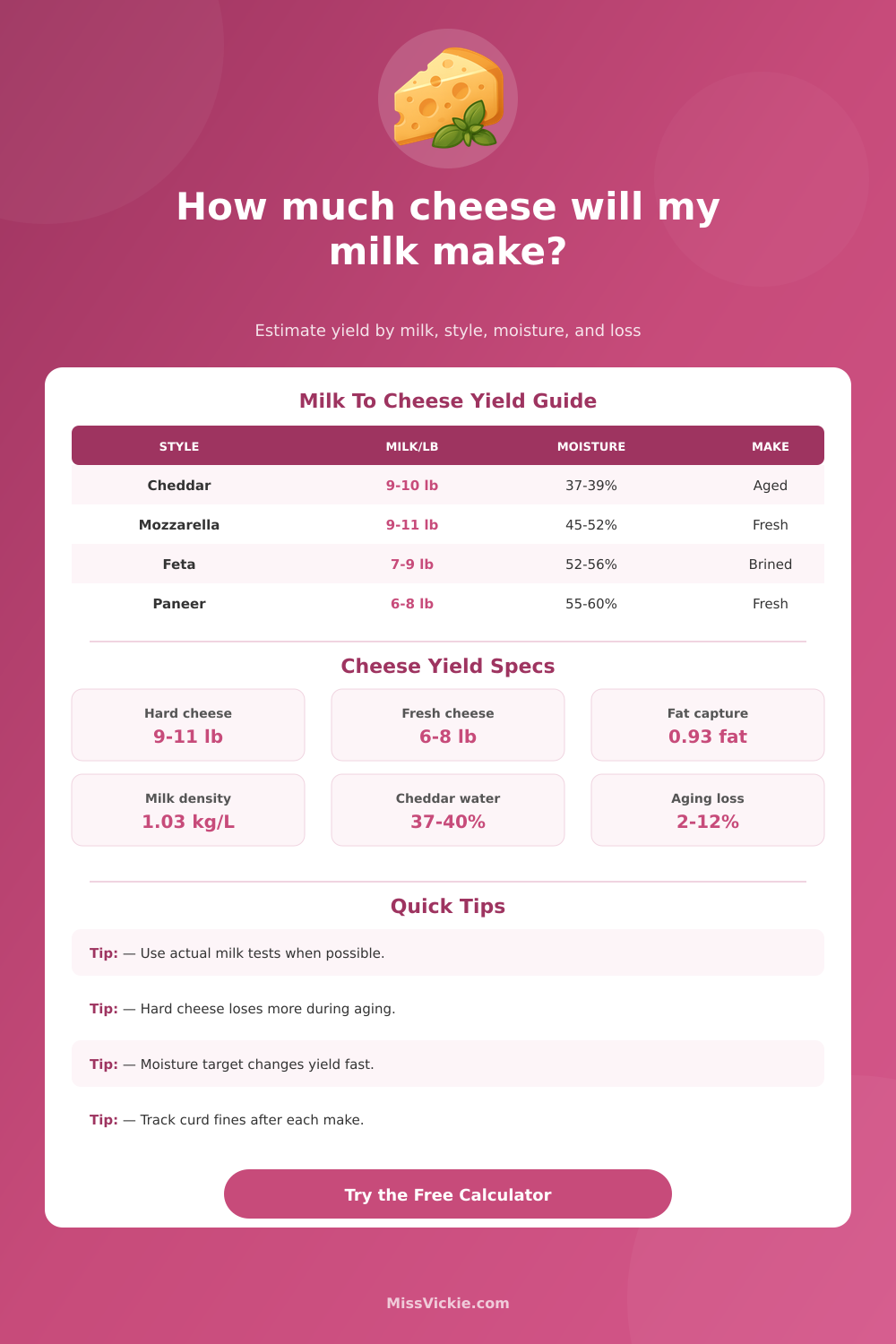
| Cheese style | Typical yield from 100 lb milk | Milk needed for 1 lb cheese | Typical moisture | Yield note |
|---|---|---|---|---|
| Cheddar or hard pressed cheese | 9.5 to 11 lb | 9 to 10.5 lb | 36 to 39% | Yield follows fat, casein, salt, and aging loss closely. |
| Mozzarella or pasta filata | 9 to 11.5 lb | 8.7 to 11 lb | 45 to 52% | Higher moisture raises fresh yield, but stretching can shed whey. |
| Feta or brined curd | 11 to 14 lb | 7 to 9 lb | 52 to 56% | Brine and moisture retention make yield higher than hard cheese. |
| Paneer or acid-set fresh cheese | 13 to 17 lb | 6 to 8 lb | 55 to 60% | Acid-set curds hold more moisture and some whey proteins. |
| Brie or camembert style | 11 to 13 lb | 7.5 to 9 lb | 48 to 54% | Soft ripened cheese starts wet and loses moisture during ripening. |
| Cottage cheese curd | 14 to 18 lb | 5.5 to 7 lb | 68 to 73% | Cream dressing can raise finished serving weight further. |
| Cream cheese style | 25 to 33 lb | 3 to 4 lb | 68 to 74% | High moisture and cream addition create a very high finished yield. |
| Swiss or alpine cheese | 8.5 to 10.5 lb | 9.5 to 12 lb | 38 to 41% | Cooked curd and aging loss make finished yield lower. |
| Milk profile | Fat % | Protein % | Casein share | Best yield use |
|---|---|---|---|---|
| Whole cow milk | 3.6 to 4.0 | 3.1 to 3.4 | 76 to 80% | Balanced benchmark for Cheddar, mozzarella, and fresh cheeses. |
| Jersey cow milk | 4.8 to 5.5 | 3.6 to 4.0 | 77 to 81% | Higher solids usually lift yield and richness. |
| Goat milk | 3.5 to 4.5 | 3.0 to 3.5 | 72 to 78% | Good for feta, chevre, bloomy rind, and lactic styles. |
| Sheep milk | 6.0 to 7.5 | 5.0 to 6.0 | 78 to 82% | Very high solids for Pecorino, feta, and dense fresh cheese. |
| Skim cow milk | 0.1 to 0.5 | 3.2 to 3.5 | 76 to 80% | Lower yield unless the target style is quark or low-fat curd. |
| Standardized vat milk | 3.0 to 3.5 | 3.2 to 3.6 | 77 to 80% | Used when repeatable fat-to-protein balance matters. |
Cheddar, alpine, and aged styles concentrate solids and lose moisture during pressing and aging.
Mozzarella yield depends on pH, stretch loss, moisture target, and curd handling.
Feta-style cheese retains more moisture before brining and usually has moderate aging loss.
Paneer-style curd captures moisture and some heat-denatured whey proteins.
Bloomy rind cheese begins with high moisture but loses weight as it ripens.
Quark, cream cheese, and drained lactic curds vary widely with draining time.
| Variable | Low range | Common range | High range | How it changes yield |
|---|---|---|---|---|
| Fat recovery into cheese | 88% | 91 to 94% | 95%+ | Higher recovery means less butterfat leaves in whey and fines. |
| Casein recovery into cheese | 92% | 95 to 97% | 98%+ | Clean coagulation and gentle handling protect casein yield. |
| Curd solids loss | 1% | 2 to 5% | 8%+ | Small curd fines and rough stirring quickly reduce recovered cheese. |
| Aging or drying loss | 0% | 2 to 8% | 12%+ | Hard, natural-rind, and long-aged cheese loses more water. |
| Moisture target | 35% | 38 to 55% | 70%+ | Moisture is often the biggest driver of fresh cheese weight. |
| Vat efficiency | 88% | 94 to 98% | 100%+ | Use this field to match the calculator to your actual make notes. |
Cheese production is the process of turning milk into cheese, and the weight of the resulting cheese depend on several specific factor. Even though you might think that you need alot of cheese from a lot of milk, the amount of cheese that will be produced will be less than the amount of milk you started with. This is because milk contain a large amount of water.
During the cheese production process, the water is removed from the milk and the solids of the milk are left behind. The solids of milk contains the fat and protein components of milk, both of which will eventually become cheese. In order to calculate the amount of cheese that will be produced from the milk, you must account for the fact that milk is mostly water but also contains fat and protein.
How Much Cheese You Get from Milk and What Affects Its Weight
The fat in milk creates the structure for the cheese. The protein in milk forms a structure that holds the fat and water within the cheese. Because different animal produce milk with different levels of fat and protein, you can have two batches of milk that appear to be the same but contain a different amount of solid.
Therefore, you must account for the fat percentage in the milk, the protein percentage in the milk, and the casein percentage in the milk. Casein is the protein in milk that forms the structure of the cheese. The style of the cheese will also impact the final weight of the cheese.
For instance, pressed cheddar will lose water during the cheesemaking process but brined feta is meant to contain more moisture. Therefore, if the target moisture level of the cheese is high, the weight of the cheese will be more higher. However, if the target moisture level of the cheese is low, the weight of the cheese will be lower but it will be densly.
You must decide the target moisture level of the cheese prior to the cheesemaking process. During the cheesemaking process, it is common for some of the curd to be lost. For instance, if the cook stir the curd during the cheesemaking process, the fines that are created can become separated from the curd and enter the whey.
These fines are not going to become cheese. Some of the fat may be lost if the curd is broken up too much or if the milk changes temperature during the cheesemaking process. In these instances, some of the curd can be lost.
Therefore, you must ensure that the curd is not lost in the cheesemaking process. Another reason that the weight of the cheese may be lost is because of the aging process. Cheese will lose moisture during the aging process.
The harder the cheese is going to be, the more water that will be lost while it ages. The longer the cheese ages, the more cheese will be lost in weight. The softer the cheese, the less weight that will be lost during the aging process.
It is important to use the proper aging loss percentage for the specific type of cheese that is being made. Salt is added to the cheese. Salt add some weight to the cheese.
Salt controls the movement of the moisture within the cheese. However, it is not one of the factor that is used to determine the weight of the cheese. Salt is added to ensure that the cheese is consistency from batch to batch.
Vat efficiency is a number that helps to reveal how efficient the cheese-producing vat is. The more efficiently you perform the cheesemaking process, the higher the vat efficiency will be. You can use this number to ensure that your cheesemaking process is improving over time.
The higher the vat efficiency, the more cheese you will produce from a given amount of milk. The reference tables for the amount of solids in milk and the amount of cheese produced by different styles of cheese is not the target amounts of cheese that are to be targeted in the cheesemaking process. However, these tables can help to indicate whether or not your cheesemaking process is accurate.
If your yields of cheese are much less than the reference tables indicate, you have a problem in the cheesemaking process. However, if you produce more cheese than the reference tables indicate, then you know your milk contains a high level of solid. Due to the number of variable involved in cheesemaking, the weight of the cheese will likely not equal your first estimate.
The composition of the milk changes with the season and the feed that is provided to the animals that produce the milk. The temperature of the room where the cheese is being made will also affect the amount of cheese that is produced. The best way to monitor the cheesemaking process is to weigh the cheese that is produced after every batch of cheese.
By comparing the weight of the cheese to the estimated weight after many batches, you can adjust the vat efficiency and the curd loss numbers accordingly. Being able to calculate the amount of cheese that can be made from a given amount of milk allows for better decisions to be made in the cheese production process. For instance, you can decide whether the milk that you have is worth the amount of time it will take to produce the cheese.
In addition to this, you can decide whether changing the source of your milk will increase the amount of cheese that you are able to produce. While the calculation is not a replacement for your experience in cheesemaking, it does help to reduce the amount of guesswork that goes into the cheesemaking process.