Jasmine Rice to Water Ratio Calculator
Calculate jasmine rice water by cooking method, texture, rinsing, soaking, batch size, and altitude so fragrant long grains cook fluffy instead of soggy or dry.
Choose a common jasmine rice situation to load realistic rice quantity, method, texture, rinse, soak, and heat settings before fine-tuning the calculator.
Full Water Breakdown
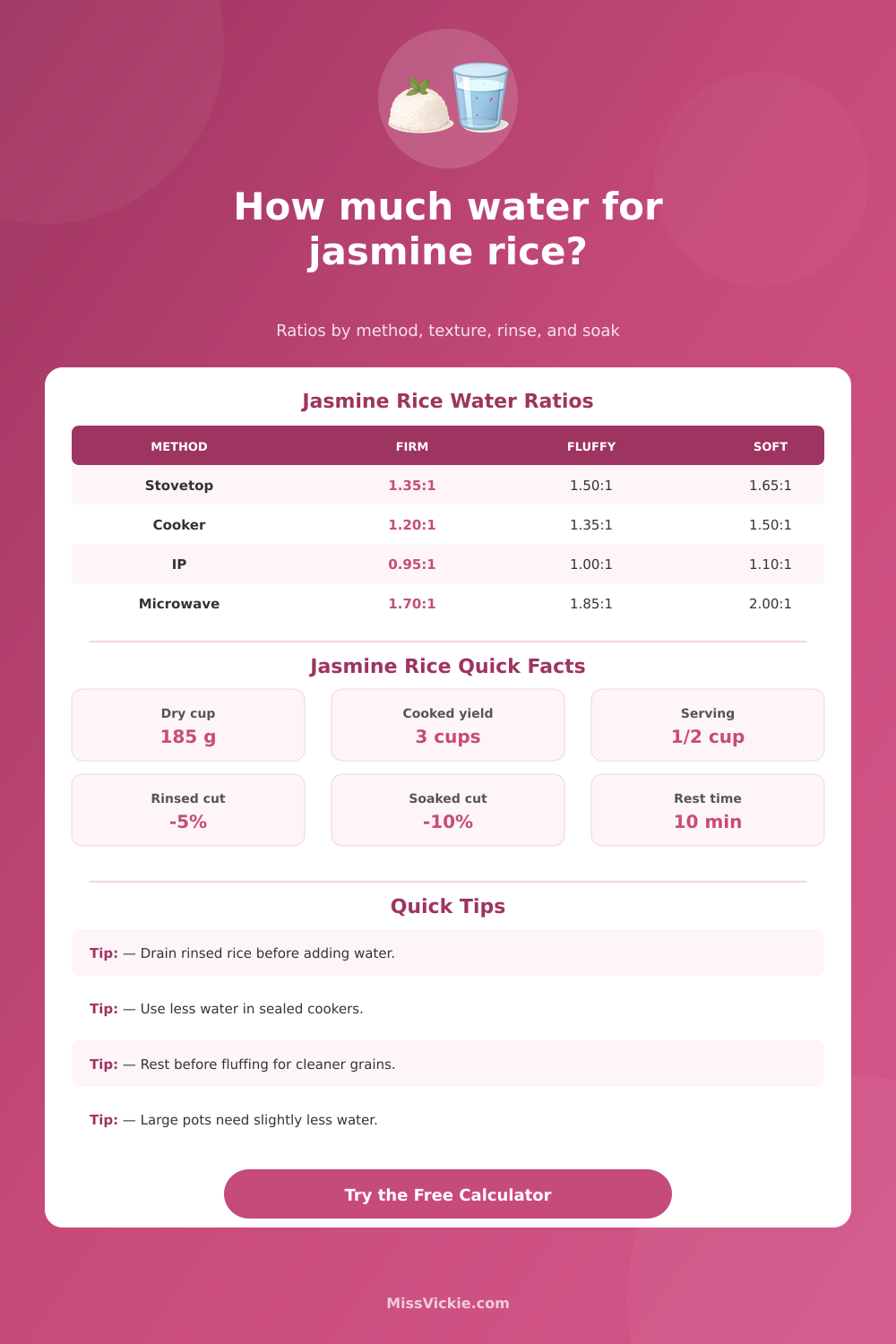
| Method | Firm or Fried Rice | Classic Fluffy | Soft or Saucy Meals | Best Use |
|---|---|---|---|---|
| Stovetop absorption | 1.35 cups water per 1 cup rice | 1.50 cups per 1 cup | 1.65 cups per 1 cup | Most flexible for everyday jasmine rice |
| Rice cooker | 1.20 cups per 1 cup | 1.35 cups per 1 cup | 1.50 cups per 1 cup | Sealed cooker with lower evaporation |
| Electric pressure cooker | 0.95 cups per 1 cup | 1.00 cups per 1 cup | 1.10 cups per 1 cup | Fast sealed cooking with minimal steam loss |
| Microwave covered bowl | 1.70 cups per 1 cup | 1.85 cups per 1 cup | 2.00 cups per 1 cup | Extra evaporation during uncovered heat bursts |
| Oven-baked covered dish | 1.50 cups per 1 cup | 1.65 cups per 1 cup | 1.80 cups per 1 cup | Large covered pans and hands-off batches |
| Pilaf method | 1.45 cups per 1 cup | 1.55 cups per 1 cup | 1.70 cups per 1 cup | Rice toasted in oil before liquid is added |
| Boil-and-drain | 4 cups water per 1 cup rice | 5 cups per 1 cup | 6 cups per 1 cup | Water is drained, so exact absorption ratio is less critical |
Use a heavy pot, simmer gently, then rest covered for fluffy grains.
Use less water than stovetop because the cooker traps more steam.
Use near equal water and rice by volume after rinsing and draining.
Use a tall bowl and more water to offset open-steam evaporation.
| Dry Jasmine Rice | Approx Dry Weight | Fluffy Stovetop Water | Cooked Yield | Side Servings |
|---|---|---|---|---|
| 1/2 cup | 93 g | 3/4 cup water | 1 1/2 cups cooked | 3 half-cup servings |
| 1 cup | 185 g | 1 1/2 cups water | 3 cups cooked | 6 half-cup servings |
| 1 1/2 cups | 278 g | 2 1/4 cups water | 4 1/2 cups cooked | 9 half-cup servings |
| 2 cups | 370 g | 3 cups water | 6 cups cooked | 12 half-cup servings |
| 3 cups | 555 g | 4 1/2 cups water | 9 cups cooked | 18 half-cup servings |
| 4 cups | 740 g | 6 cups water | 12 cups cooked | 24 half-cup servings |
| 6 cups | 1.11 kg | 8 3/4 cups water | 18 cups cooked | 36 half-cup servings |
| 8 cups | 1.48 kg | 11 1/2 cups water | 24 cups cooked | 48 half-cup servings |
| Adjustment | Typical Change | Why It Matters | Calculator Treatment |
|---|---|---|---|
| Thorough rinse, well drained | Reduce added water about 5% | Surface starch is removed and some water clings to grains | Multiplies water by 0.95 |
| Rinsed but wet | Reduce added water about 9% | Extra rinse water remains in the bowl or strainer | Multiplies water by 0.91 |
| 20 to 30 minute soak | Reduce added water 7% to 10% | Hydrated grains need less added liquid during cooking | Applies soak factor after method ratio |
| Loose lid or wide pan | Add 6% to 12% water | Steam leaves before the grain fully hydrates | Adds evaporation factor |
| Large jasmine rice pot | Use slightly lower ratio | Large batches retain steam and lose less per cup | Subtracts 2% to 5% from water |
| High altitude | Add 4% to 8% water | Water boils at a lower temperature and cooking takes longer | Adds altitude factor and cooking time |
To cook jasmine rice, it is important to control the amount of moisture that the rice encounters. If the jasmine rice is exposed to too much water, it will result in a rice product that is gummy and mushy. If too little water is added to the jasmine rice, however, the rice will end up hard and dry after cooking.
The amount of water that you should add to jasmine rice is dependent upon several different variable. One of the variables are the type of cooking vessel in which the rice is cooked. If an electric pressure cooker is use, the steam that heating the rice creates cannot escape the pressure cooker.
How Much Water to Cook Jasmine Rice
Thus, the rice in a pressure cooker only encounters the amount of water that was added to the machine. However, if the rice is cooked in a stovetop pot, the steam can escape the pot. Thus, you must add more water to a pot than to a pressure cooker.
Another variable is whether the rice should be rinsed prior to cooking. Many peoples rinse the rice to remove the starch from the rice grains that can cause the rice to clump together when cooked. However, rinsing introduce moisture into the rice, which can also lead to the rice becoming too soft.
Another variable is the age of the jasmine rice. New crop jasmine rice is naturaly more moist than rice that has sat in storage for longer periods of time. Thus, less water is required to cook new-crop rice than aged rice.
Aged rice tends to be thirsty, meaning it tends to require more moisture to achieve the same texture as rice that is not aged. Another variable is the desired texture of the cooked rice. If fried rice is prepared with the rice, the rice should be slightly under hydrated.
Under-hydrated rice will crisp up when fried, while well-hydrated rice will clump together when fried. If the rice is to be cooked with curry, however, the rice should be softer. Soft rice readily absorbs the curry sauce, which enhances the curry dish as a whole.
Thus, you add more water to rice that will be cooked with curry. Soaking the rice prior to cooking have a similar effect upon the amount of water that is required to cook the rice. If the rice is soaked in water for twenty or thirty minutes, the water will penetrate the rice grains to the center of the grains.
Thus, less water is added to rice that has been soaked compared to rice that has not been soaked. The altitude at which the rice is cooked is another variable. Water boils at lower temperatures at higher altitude.
Thus, the rice simmers at a lower temperature, and takes longer to soften. During this longer simmer period, the water evaporates from the pot of simmering rice. Thus, an additional quantity of water must be added to rice that is cooked at high altitudes.
Finally, you must allow the rice to sit covered for ten minutes after the heat is turned off. During this resting period, the moisture that is within the rice grains redistribute itself from the bottom grains to the top grains of the rice. If the rice is fluffed during this resting period, the moisture will not be able to redistribute itself normaly, and the rice grains may break during the cooking process.
Thus, allowing the rice to rest ensures each grain of rice is tenderly.