Soft Serve Ice Cream Calculator
Scale soft serve mix by serving count, draw size, fat, sugar, overrun, machine capacity, finished yield, and mix temperature before service.
Choose a real service setup, then adjust the mix percentages, overrun, cylinder capacity, draw size, and temperature.
Soft serve plan
Your mix, finished yield, machine cycles, and serving temperature plan will appear here.
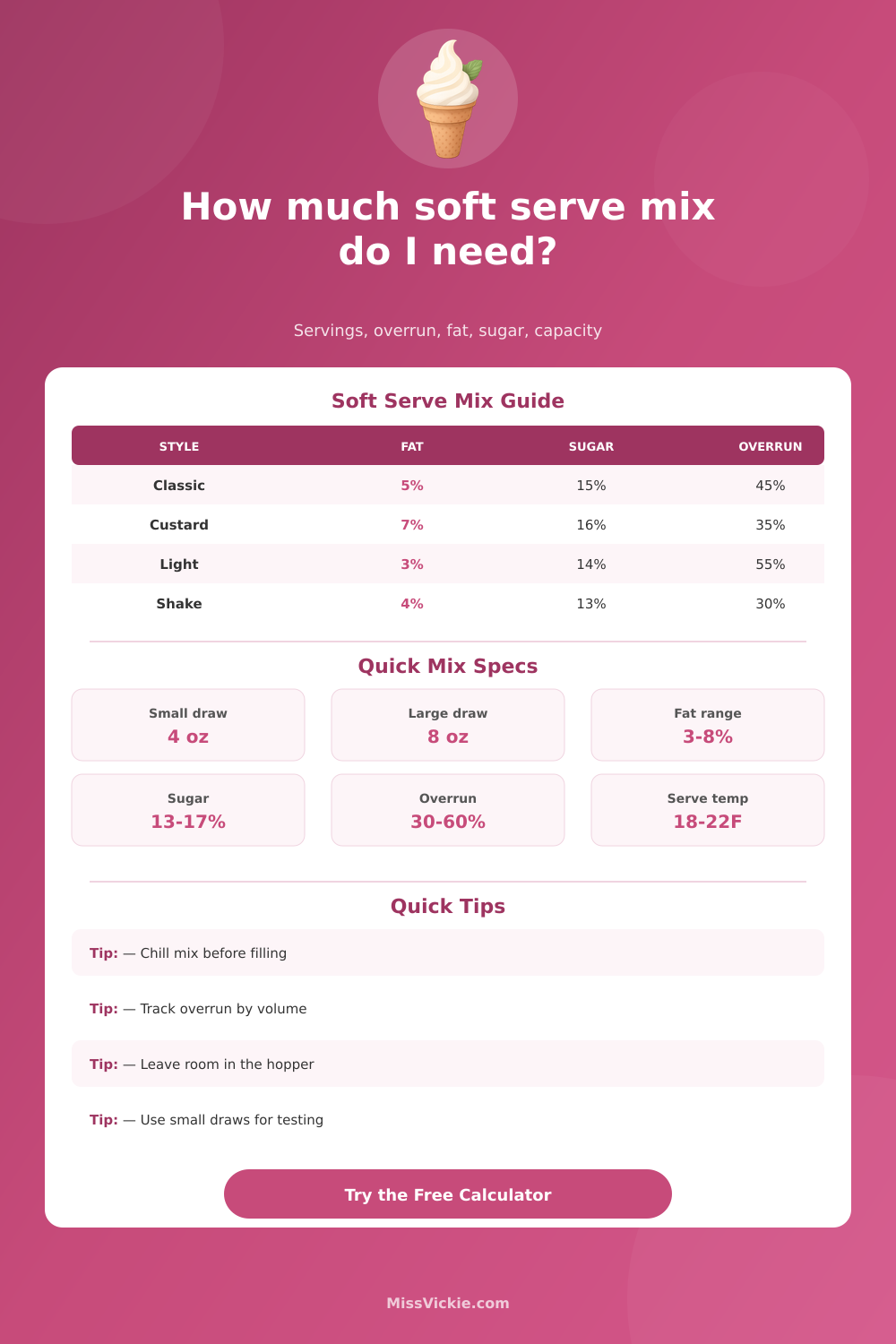
| Mix style | Fat target | Sugar target | Typical overrun | Best use |
|---|---|---|---|---|
| Classic soft serve | 4% to 6% | 14% to 16% | 35% to 55% | Cones, cups, sundaes, and general dessert service. |
| Custard style | 6% to 8% | 15% to 17% | 25% to 40% | Denser draw with richer dairy flavor and slower meltdown. |
| Light dairy mix | 2% to 4% | 13% to 15% | 45% to 65% | Higher air target helps the serving feel less thin. |
| Frozen yogurt | 1% to 4% | 14% to 18% | 35% to 55% | Tart bases need enough sugar for scoopable softness. |
| Milkshake base | 3% to 5% | 12% to 14% | 20% to 35% | Lower overrun keeps the mix pourable after blending. |
| Fruit sorbet base | 0% to 1% | 18% to 24% | 20% to 40% | Sugar and fruit solids carry body when dairy fat is absent. |
| Machine setup | Liquid capacity | Safe fill at 80% | Finished volume at 45% overrun | 5 oz servings |
|---|---|---|---|---|
| Countertop test freezer | 1 qt | 0.8 qt | 1.16 qt | 7 servings |
| Small cylinder | 1.7 qt | 1.36 qt | 1.97 qt | 12 servings |
| Standard cylinder | 3.2 qt | 2.56 qt | 3.71 qt | 23 servings |
| High volume barrel | 5 qt | 4 qt | 5.8 qt | 37 servings |
| Target draw | Texture signal | Mix condition | Practical adjustment |
|---|---|---|---|
| 16°F to 18°F | Very firm ribbons | High solids or high sugar bases may still pull smoothly. | Watch motor load and avoid over-freezing light mixes. |
| 18°F to 22°F | Classic soft serve curl | Most dairy mixes work well in this range. | Use this as the baseline for cones and cups. |
| 22°F to 24°F | Softer draw | Good for low-fat, yogurt, and fast service recovery. | Serve promptly and reduce hold time in warm rooms. |
| 35°F to 40°F mix | Cold hopper feed | Pre-chilled mix freezes faster and improves recovery. | Keep sealed mix cold before filling the machine. |
| Draw size | Finished volume | Typical use | Planning note |
|---|---|---|---|
| 3 oz | 89 ml | Samples and small cones | Good for tastings or kids portions. |
| 4 oz | 118 ml | Small cone or cup | Often used for party service and portion control. |
| 5 oz | 148 ml | Standard cone | Useful default for mixed cone and cup service. |
| 8 oz | 237 ml | Large cup or sundae | Plan more recovery time for repeated large draws. |
To operate a soft serve machine effective, you must plan the amount of mix you will use. Planning the amount of mix that you will use is necesary to avoid running out of mix while you are serving your customers. Should you not have enough mix, your soft serve machine will run out of products before your service is over.
If you prepare too many mix, you may find yourself discarding that mix or it may sit in the machines hopper for too long. Your service will be successful if you can successfully judge the amount of mix that you will use, the amount of air that you will incorporate into the mix, and the number of cycle that the soft serve machine will need to complete during service. Several variable will affect the performance of the soft serve machine.
How to plan the right amount of soft serve mix
The fat content of the mix will affect the richness of the soft serve and how the soft serve holds its shape. The sugar content will affect the sweetness of the soft serve as well as the temperature at which the soft serve draws from the machine. The overrun is a percentage of air that gets mixed into the liquid mix while it is freezing.
This will determine how much the volume of the liquid mix increases to turn it into soft serve. The machines capacity will determine the amount of liquid mix that it can freeze at one time while accounting for the expansion of the mix. The temperature of the mix will affect the temperature at which the soft serve draws from the machine, and the refrigeration system will have to work harder if there is a large temperature gap between the starting and draw temperature.
Overrun is a controllable outcome of the machine; however, overrun is not a fixed property of the soft serve machine. Different types of mix will accept different amount of air when they are operating the soft serve machine. For instance, a dairy mix with moderate fat will often accept more air than a high-fat custard base.
A frozen yogurt mix will often accept an amount of air that is between the amount of air that a dairy mix will accept and the amount of air that a custard base will accept. If you plan for your mix to have a fifty percent overrun, it is possible that it may only produce a thirty-five percent overrun in which case you will run out of servings faster then you planned. Additionally, if you add too much air to the mix, the soft serve will begin to melt quick and will feel thin on the cone.
The size of the serving of soft serve that you provide will play a big part in how much mix you need to prepare. A four-ounce portion of soft serve is a small serving size compared to an eight-ounce serving. If you are providing eight-ounce portion of soft serve, you will use up the machines cylinder capacity faster than if you are providing four-ounce portions.
You must take into account how the size of the portion will affect the number of cycles the machine will have to complete during service. The temperature of the mix will also play a role in the number of cycles that the machine will have to complete during service. A soft serve mix that enters the machines hopper at thirty-eight degrees Fahrenheit will freeze more efficienty than a soft serve mix at room temperature.
If the temperature gap between the mix and the draw temperature is large, the machine will have to take longer to recover periods between cycles. You must also take into account the loss of mix due to prime loss and leftover mix. Prime loss happens when you discard the first few scoops of soft serve that are drawn from a freshly prepared cylinder.
Another form of loss is the leftover mix that remains in the cylinder after you are finished serving your customers. There will almost always be some amount of leftover mix. You must account for this in the amount of mix that you prepare to ensure that you dont run out of mix prior to the last customer of your service.
You can provide a buffer in the amount of mix that you prepare. This will ensure that the machine does not become empty of mix during service. Ambient temperature will impact how quickly the soft serve melts once served to the customer.
Additionally, the level of experience of the staff using the soft serve machine will affect the amount of mix that is dispensed from the machine. An experienced staff member may dispense portions that are slightly different in size from the portion size that is set up on the machine. The type of container in which the soft serve is served can also affect the customers perception of the portion size.
A cake cone will contain less volume of soft serve than a waffle cone; thus the customer may feel that the portion is too small. The reference tables for the different types of soft serve mix will allow you to find the best balance of fat, sugar, and overrun in your mix. For example, a light mix with a high amount of overrun will provide you with more servings from the same quart of liquid mix; however, a light mix with a high amount of overrun will require more frequent monitoring of the machine.
A custard style mix with a low amount of overrun will allow you to have fewer servings from the same amount of liquid; however, the custard style mix with a low amount of overrun will hold its shape better when the soft serve is exposed to warm conditions. By planning ahead, you can determine how much mix you will need to prepare and how many cycles the machine will have to run during service. By determining how much mix to prepare, you can focus on providing excellent service rather than calculating the requirement of the machine during service.