Ice Cream Butterfat Calculator
Calculate butterfat, total solids, and fixed-batch adjustment options from cream, milk, half-and-half, butter, sugar, milk solids, eggs, and stabilizer.
Choose a common mix style, then adjust the batch size, dairy fat percentages, and solids for your own recipe.
Butterfat Mix Result
Your butterfat result appears here.
Mix Breakdown
Adjustment Plan
| Ingredient | Common Fat Range | Nonfat Solids Estimate | Best Calculator Use | Texture Note |
|---|---|---|---|---|
| Skim or nonfat milk | 0 to 0.5 percent | 8.8 to 9.2 percent | Lowering fat while keeping dairy solids | Useful when mix is too rich or greasy |
| Whole milk | 3 to 3.5 percent | 8.5 to 9 percent | Base liquid and dilution reference | Good water, lactose, and protein balance |
| Half-and-half | 10.5 to 18 percent | 6 to 8 percent | Gentle fat increase without full cream | Often smooth but less efficient than cream |
| Heavy cream | 36 to 40 percent | 5 to 6 percent | Main butterfat adjustment ingredient | Adds fat quickly with less water |
| Unsalted butter | 80 to 82 percent | 1 to 2 percent | Small high-fat correction | Needs warm blending and emulsification |
| Style | Butterfat Range | Total Solids Range | Typical Dairy Build | Resulting Texture |
|---|---|---|---|---|
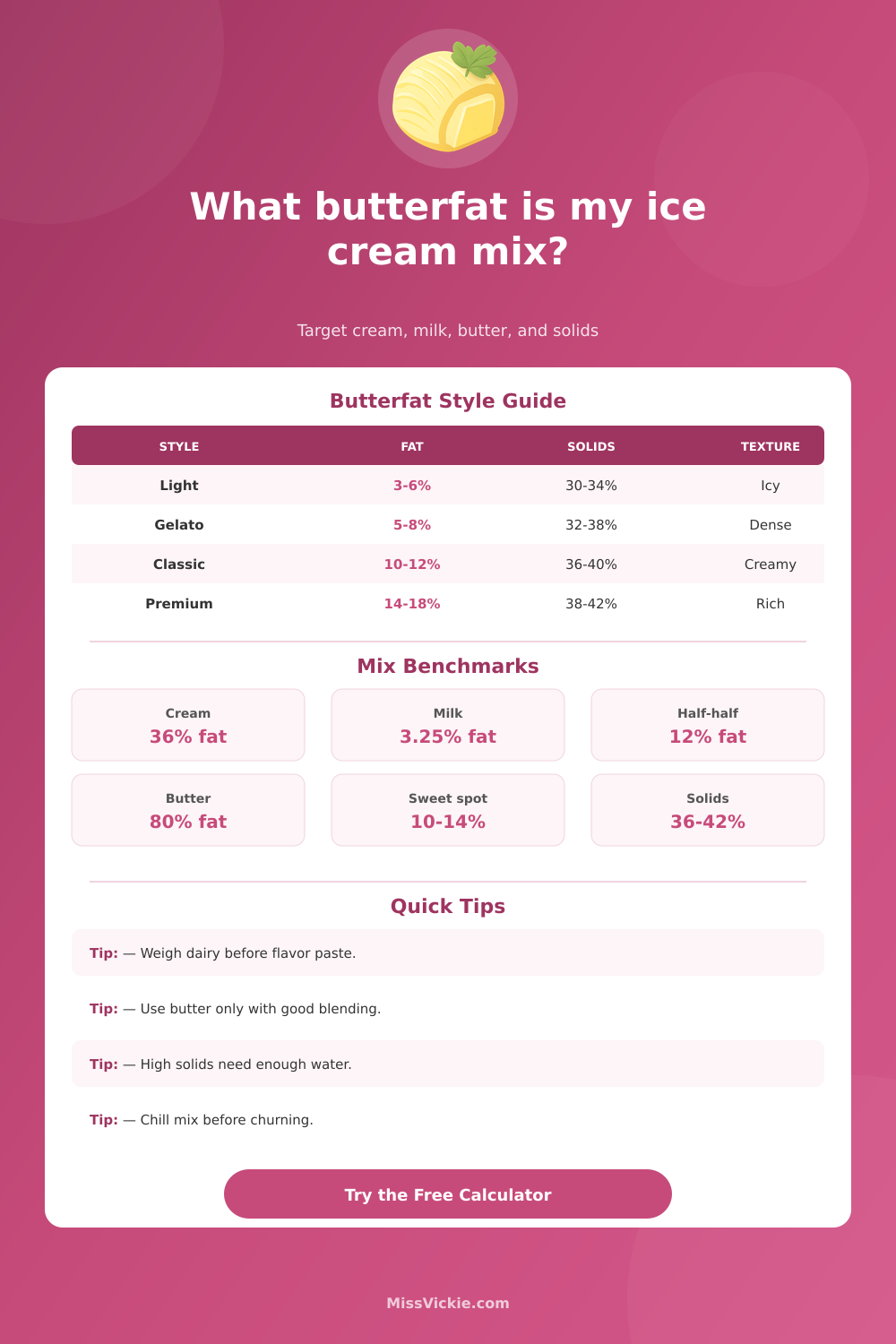
| Light ice cream or ice milk | 3 to 6 percent | 30 to 34 percent | Milk plus a little cream | Clean flavor, firmer freeze |
| Soft serve base | 4 to 7 percent | 32 to 36 percent | Milk, cream, sugar, stabilizer | Lighter body with easy extrusion |
| Gelato | 5 to 8 percent | 32 to 38 percent | More milk, less cream, higher solids | Dense, less buttery, intense flavor |
| Classic homemade ice cream | 10 to 12 percent | 36 to 40 percent | Whole milk plus heavy cream | Creamy scoop with good melt |
| Frozen custard style | 10 to 14 percent | 38 to 42 percent | Cream, milk, yolks, sugar | Smooth, rich, custardy body |
| Premium ice cream | 14 to 18 percent | 38 to 42 percent | More cream, sometimes butter | Dense and rich with slower melt |
| Method | What Changes | When to Use It | Fixed Batch Logic | Kitchen Watchout |
|---|---|---|---|---|
| Add cream, remove milk | Raises fat moderately | Most normal ice cream corrections | Gap divided by cream fat minus milk fat | Can reduce milk solids slightly |
| Add half-and-half, remove milk | Raises fat gently | Small target changes or softer dairy flavor | Gap divided by half-and-half fat minus milk fat | Needs more weight than cream |
| Add butter, remove low-fat base | Raises fat strongly | Short cream supply or high-fat premium mixes | Gap divided by butter fat minus milk fat | Must be emulsified into warm mix |
| Add skim milk or base liquid | Dilutes high fat | When current butterfat is above target | Current fat divided by target fat minus batch | Batch grows unless you also remove mix |
| Add milk solids or sugar | Raises solids only | When fat is right but body is thin | Solids gap times batch weight | Too much solids can feel heavy |
| Finished Mix Size | Approx Weight | 10% Fat Target | 12% Fat Target | 14% Fat Target |
|---|---|---|---|---|
| 1 pint | 475 g | 47.5 g fat | 57 g fat | 66.5 g fat |
| 1 quart | 950 g | 95 g fat | 114 g fat | 133 g fat |
| 1 liter | 1030 g | 103 g fat | 124 g fat | 144 g fat |
| Half gallon | 1900 g | 190 g fat | 228 g fat | 266 g fat |
| Small service batch | 3000 g | 300 g fat | 360 g fat | 420 g fat |
Cleaner flavor and harder freeze; needs solids and stabilizer to avoid iciness.
Classic homemade texture with enough richness and a manageable melt rate.
Dense and luxurious, but too much fat can coat the palate or churn buttery.
Good body comes from fat plus sugar, milk proteins, lactose, yolk, and stabilizer.
Butterfat is an key component in making ice cream. The amount of butterfat that is included in the ice cream mix will determine the texture and freezing properties of the resulting ice cream. If there is to little butterfat in the ice cream, the texture will be icy and hard when it is set and frozen.
Conversely, if there is too much butterfat in the ice cream, the texture will be grease and exhibit a slow melting rate. Butterfat works to coat the air bubbles in the ice cream mixture, which prevents them from forming large crystal of ice. Adding more butterfat will create smaller ice crystals in the ice cream that results in a smoother texture.
How to Balance Butterfat and Total Solids in Ice Cream
However, using too much butterfat will create a heavy ice cream with a strong butter flavor. Because butterfat can impact the texture of the ice cream, the maker must measure the amount of butterfat that is use in the mix to ensure that the resulting ice cream has the texture that is targeted. Beyond the amount of butterfat that is included in the ice cream mixture, another factor that impact the texture of the ice cream is the total solids content of the mixture.
The total solids of the ice cream includes the butterfat, milk protein, lactose, added sugar, egg yolks, and any other ingredient that are included in the mixture. If the total solids content is too low, the resulting ice cream will have an icy texture. If the total solids content is too high, the texture of the ice cream will be dense and chewily.
A calculator that the maker uses to determine the amount of each ingredient that should be added to the ice cream mixture can track the butterfat percentage and the total solids percentage of the mixture. Thus, the calculator can allow the ice cream maker to view the impact that a change in one ingredient will have on both the butterfat and total solids percentage of the ice cream mixture. The different types of dairy product that can be included in the ice cream mixture contain different amounts of butterfat.
For instance, whole milk contains approximately three and a quarter percent butterfat, heavy cream contains approximately thirty-six percent butterfat, and butter contains approximately eighty percent butterfat. Half-and-half contains a medium amount of butterfat; however, because half-and-half contains more water than heavy cream, the maker will need to use more of the half-and-half product in the ice cream mixture to achieve the target amount of butterfat. If the maker is to use butter to increase the butterfat in the mixture, they must emulsify the butter into the remaining liquid ingredients while those ingredients are warmed.
While it may be tempting to increase the amount of heavy cream in ice cream mixtures that have thin texture, doing so will increase the butterfat yet not the nonfat solid in the mixture. To increase the nonfat solids in the mixture without increasing the butterfat of the mixture can be accomplished by the addition of nonfat dry milk or sugar to the mixture. A calculator can display the gap in both butterfat and total solids percentages between the target percentages and the percentages that are create by the amount of ingredients that are currently being used.
Thus, using the calculator will help the ice cream maker to both avoid guessing at the needed ingredients, and also avoid creating an ice cream that is richer in fat than is helpful for the target texture. The weight of the batch of ice cream that will be produced will impact the calculations of the amount of each ingredient that should be used in the mixture. A recipe for one quart of ice cream will require different weight of ingredients than a recipe for a half-gallon of ice cream.
In addition, the maker will perform the calculations with a loss buffer to ensure that enough ice cream mixture is produced to fill the container that is to be used to freeze the mixture. If the loss buffer is not included in the calculations, it is likely that the ice cream maker will not have enough mixture to fill the container with the ice cream. Because the calculator works with the weight of the ingredients rather than the volume of those ingredients, the calculator can remove the types of error that can occur if the measurements of the ingredients are taken with measuring cups.
Thus, using the calculator ensures that the measurements for the ice cream mixture will be more accurately than if the measurements were made without the calculator. Because butter contains very little water and protein compared to other dairy ingredients, it should not be used as a direct replacement for heavy cream. If the maker replaces heavy cream with the same weight of butter, the ice cream mixture will lack both water and protein.
A calculator can be used to determine how much butterfat that butter will add to the mixture. However, the calculator cannot account for ensuring that the butter is proper emulsified into the mixture. Thus, the maker should warm the butter into the other ingredients of the mixture, or an immersion blender can be used to ensure that the butter becomes properly incorporated into the ice cream mixture.
Some of the style presets that can be used in the calculator include settings for ice milk, which has an approximately five percent butterfat level, and settings for frozen custard, which has a butterfat level of approximately twelve percent. Gelato has a butterfat level that is lower than premium ice cream that is produced in America. However, gelato contains a higher amount of milk solids than premium ice cream.
These presets allow the ice cream maker to load the standard amount of each ingredient into the calculator, but the maker can adjust the numbers according to the specific properties of the ingredients that will be used in the ice cream mixture. By balancing the amount of butterfat and total solids in the ice cream mixture, the ice cream maker can have control over the texture of the produced ice cream. By reviewing the data that is collected from the calculator, the ice cream maker can determine whether additional ingredient are needed to adjust the texture of the ice cream mixture to the targeted texture.
For instance, the manufacturer can use the calculator to determine whether additional heavy cream, half-and-half, or butter should be added to the mixture to ensure that the texture of the ice cream will be the targeted texture. Thus, an understanding of the relationship between the amount of butterfat and total solids that are used in the mixture will allow the ice cream maker to make decision regarding the ingredients that are to be used in the making of the ice cream. Getting the level of butterfat and total solids balanced in the mixture will ensure that the ice cream contains fewer error in its production, and will provide the mixture with a better chance of achieving the desired texture.