Ice Cream Mix Calculator
Balance an ice cream base by batch volume, dairy fat, sugar solids, stabilizer, egg yolk, milk powder, target total solids, and expected churn overrun.
Choose a practical base style, then fine-tune the batch volume and composition targets for your cream, milk, sugar, yolk, and stabilizer.
Balanced Mix Formula
Ingredient weights will appear here after calculation.
Ingredient Breakdown
| Mix Style | Fat Range | Sugar Solids | Total Solids | Typical Use |
|---|---|---|---|---|
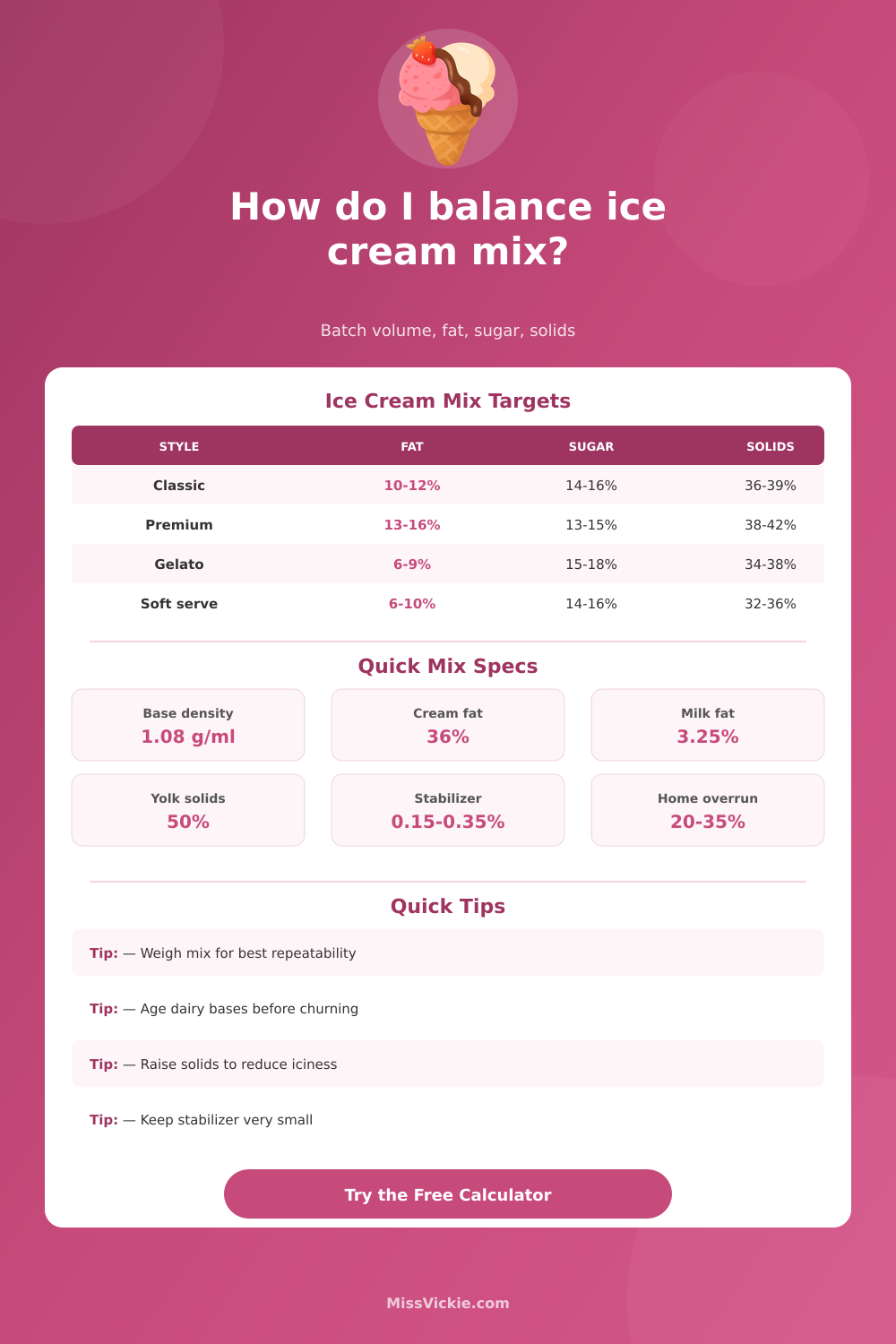
| Classic hard ice cream | 10% to 12% | 14% to 16% | 36% to 39% | Balanced home scoop texture |
| Premium base | 13% to 16% | 13% to 15% | 38% to 42% | Dense, rich vanilla or chocolate |
| French custard | 12% to 15% | 13% to 15% | 39% to 43% | Egg-rich base with cooked custard body |
| Gelato | 6% to 9% | 15% to 18% | 34% to 38% | Lower fat, lower overrun, warmer service |
| Soft serve | 6% to 10% | 14% to 16% | 32% to 36% | Higher overrun and softer draw |
| Dairy sherbet | 1% to 3% | 20% to 24% | 30% to 34% | Fruit-forward frozen dairy dessert |
| Ingredient | Fat Used | Other Solids | Solids Role | Formula Note |
|---|---|---|---|---|
| Heavy cream | User entry | About 5.7% | Fat plus dairy solids | Raises richness quickly |
| Whole milk | User entry | User SNF entry | Milk sugar and protein | Builds body without too much fat |
| Skim milk powder | About 1% | About 95% | Protein and lactose | Used to reach total solids |
| Egg yolk | About 27% | About 23% | Fat, emulsifier, solids | One yolk is estimated at 18 g |
| Sugar | 0% | 100% | Sweetness and freezing point | Modeled as full dry solids |
| Stabilizer | 0% | 100% | Water control | Use tiny percentages only |
| Batch Plan | Mix Volume | Approx Mix Weight | Home Overrun | Finished Yield |
|---|---|---|---|---|
| Test pint | 1 pint | 510 g | 25% | About 1.25 pints |
| One quart base | 1 quart | 1022 g | 30% | About 1.3 quarts |
| Countertop batch | 1.5 quarts | 1533 g | 30% | About 1.95 quarts |
| Family party | 1 gallon | 4088 g | 35% | About 1.35 gallons |
Lower solids freeze firmer and can taste icier unless sugar or fruit solids help.
A practical home range for classic vanilla, fruit, and everyday churned bases.
More fat and milk solids give a dense body with slower melt and richer mouthfeel.
High solids can taste heavy, chalky, or gummy if powder and stabilizer climb too far.
Making ice cream involves several chemical components that interact together to influence the texture of the final product. The amount of fat, sugar, and total solids contained within the batch of ice cream mix determines the texture of the ice cream. If the amount of these components are not set apropiately within the batch of mix, the resulting ice cream may have either too icy a texture, or it may be too thin.
Thus, an understanding of the role that each of these components plays within the ice cream will allow for the adjustments of the batch of mix to achieve the desired texture of the finished ice cream. The component of fat coats the air cells that is created during the churning of the ice cream mix. Because fat coats these air cells, it slows the movement of heat from the ice cream.
How Fat, Sugar and Solids Affect Ice Cream Texture
Thus, if the percentage of fat is increased within the batch of mix, the ice cream will melt at a slower rate. Additionally, more fat will lead to a smootherer texture of the ice cream. The ingredient of sugar also performs a variety of key roles within the batch of mix.
One of the roles of sugar is that it lowers the freezing point of the mix. Thus, less water molecule will become ice crystals within the finished ice cream. A reduction in the formation of ice crystals will reduce the chance that the ice cream will have a sandy texture when eaten.
The component of total solids is the total weight of all ingredients in the batch of mix that are not water. This ingredient determines how much space for the formation of ice crystals within the batch of mix. An ice cream calculator will assist in calculating the amount of each ingredient that are required to create the batch of ice cream.
You must enter the batch volume into the calculator to determine the amount of liquid that will be used for the batch. Based off this batch volume, the calculator will calculate the amount of each of the other ingredient in the batch. In addition to entering the batch volume, you must also enter the amount of fat, sugar, and total solids that should be contained in the batch into the calculator.
The percentage of fat content in the cream and milk must be entered to account for the fact that dairy products contain water, fat, and solids but are not composed entirely of fat. The calculator will use this information to determine the amount of cream and milk that is required to create the batch of ice cream. The churning machine will incorporate the percentage of air for the overrun of the batch.
The overrun will be adjusted to account for the amount of air that can be incorporated by home churning machines compared to commercial machines. Each of the percentages within the calculator should not be considered a fixed number within the batch of ice cream mix. For instance, the percentage of fat in hard ice creams ranges between 10 and 12%.
Percentages of 10-12% will provide a rich flavor to the ice cream yet allow the batch of mix to churn properly. Gelato contains a lower percentage of fat compared to the percentage of sugar within the batch of mix. This is true of gelato because gelato is served at a warmer temperature with a denser texture.
Soft serve ice cream contains a high amount of both sugar and total solids. This ensures that the soft serve ice cream maintains its structure despite the high amount of air contained within the scoop of ice cream. The ice cream calculator will not provide one specific answer to each question regarding the ingredients for the batch of ice cream.
Instead, the calculator will allow the creator to view the different combination of ingredients that will result in the percentage ranges of interest. There are certain mistakes that are committed when adjusting the percentages within the batch of ice cream mix. One common mistake is the addition of too much milk powder to the batch of ice cream mix to increase the total solids percentage within the batch.
Too much milk powder can impart a chalky flavor to the ice cream. Another mistake is the forgetting of the fact that egg yolks contains both fat and solids. Thus, if you make an adjustment to the number of egg yolks that are contained within the batch, adjustments should be made to the amount of dairy products used in the batch.
The percentage of the total batch of ice cream mix that should be reserved for additional uses should be entered into the calculator. Some of the ice cream mix will be lost to the sides of the pot and the strainer during the cooking of the batch of mix. If this percentage is not entered into the calculator, the resulting batch of ice cream will contain less of the product than was calculated.
In addition to the ingredients to be used in the batch of ice cream, there are other factors in the making of the ice cream that must be controlled. The batch of ice cream mix must sit in the refrigerator for several hours prior to churning. During this period of sitting, the fat will crystallize and the proteins will hydrate.
If the proteins in the batch of ice cream mix are hydrated, they will enable the formation of air cells during the churning of the mix. Additionally, if the batch of mix is too warm when churning, the resulting ice cream will have a coarse texture due to the lack of time for the fat to crystallize. The ice cream calculator can be used to scale a recipe from a small batch to a larger batch of ice cream.
If the batch of ice cream mix is to be prepared in amounts greater than the initial batch, the recipe cannot be doubled. The change in the surface area of the batch in relation to the volume of the batch will impact the evaporation of the liquids of the batch. Thus, the ice cream calculator will calculate these changes in the recipe to ensure that the percentages of the batch remain within the acceptable range for the type of ice cream to be made.
The final texture of the ice cream is the result of each of the components that were measured for the batch of ice cream, as well as the way in which the ice cream machine performs its churning responsibilities. Factors outside of the batch of ice cream, such as the temperature of the space in which the batch of ice cream is prepared, or the amount of liquid that is placed within the churning machine will impact the overrun of the batch of ice cream. Thus, the calculator calculates only a starting point for the amount of overrun of the batch.
Adjustments to the recipe for the next batch of ice cream should be made according to the texture of the batch of ice cream that was prepared in the current churning machine. Thus, the use of the calculator allows the creator of the ice cream to understand each of the components that control the texture of the ice cream.