Biscuit Calculator
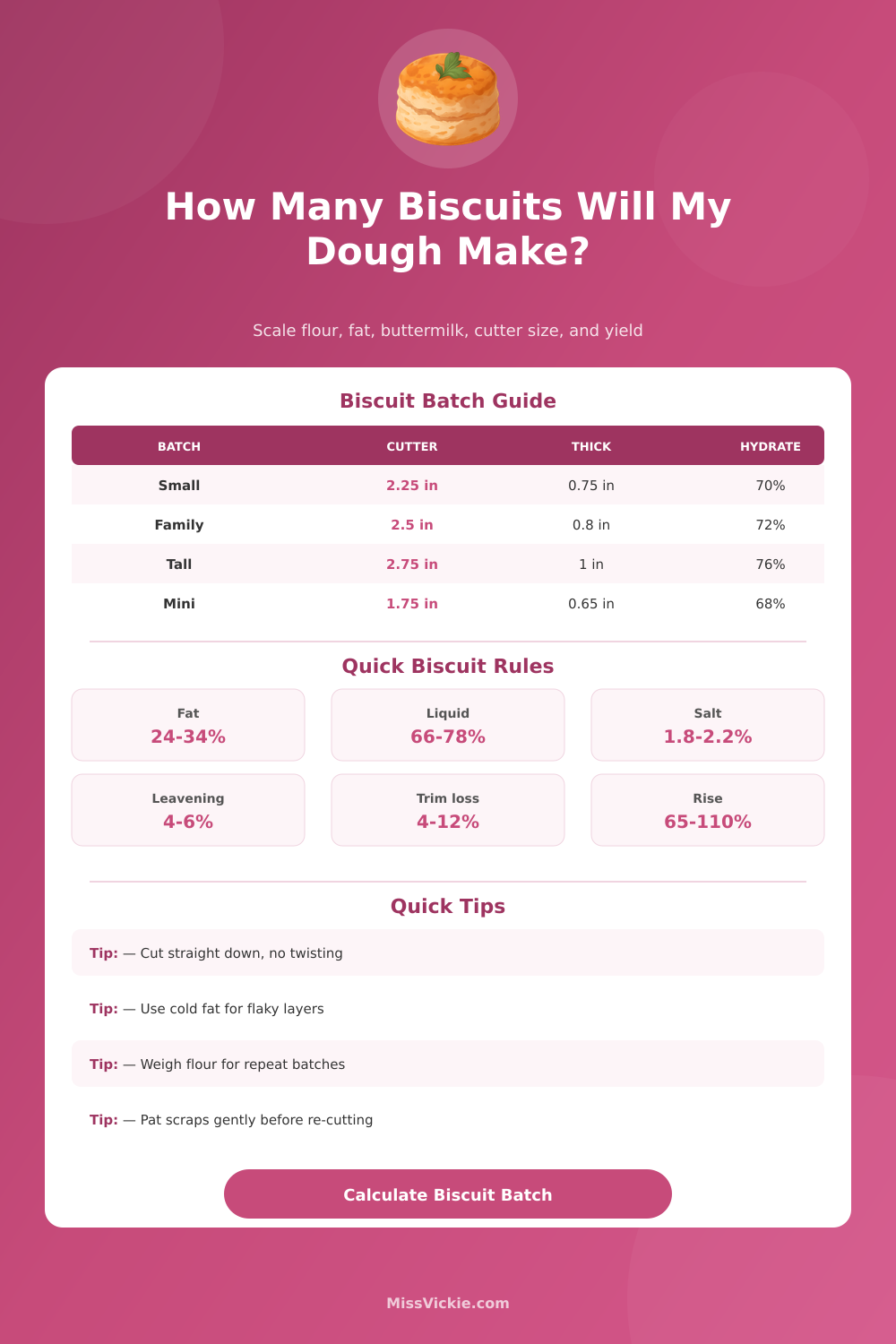
Scale a biscuit batch from either flour weight or target yield, then balance butter or shortening, buttermilk, cutter size, dough thickness, trimming loss, and hydration.
Load a realistic batch, then change any field. Presets include classic buttermilk rounds, tall bakery biscuits, minis, square cuts, and drop biscuits.
Batch Breakdown
Balanced hydration, 28 to 32 percent fat, and a 2.25 to 2.75 inch cutter.
Lower hydration, higher butter, and folding creates defined layers without heavy dough.
Wetter dough is portioned by scoop, so cutter loss is almost zero.
Fastest scaling for large batches because trimming loss stays very low.
| Flour base | 2 in x 0.65 in | 2.5 in x 0.75 in | 2.75 in x 1 in | Best use |
|---|---|---|---|---|
| 250 g flour | 9 to 10 mini | 5 to 6 standard | 3 to 4 tall | Small supper |
| 480 g flour | 18 to 20 mini | 10 to 12 standard | 7 to 8 tall | Family meal |
| 750 g flour | 29 to 32 mini | 16 to 18 standard | 11 to 13 tall | Potluck pan |
| 1200 g flour | 47 to 51 mini | 26 to 29 standard | 18 to 20 tall | Freezer batch |
| Formula | Fat | Buttermilk | Leavening | Dough feel |
|---|---|---|---|---|
| Classic buttermilk | 28 to 32% | 68 to 74% | 4.5 to 5.5% | Soft, pat-able |
| Flaky laminated | 34 to 42% | 62 to 70% | 4 to 5% | Layered, firm |
| Drop biscuit | 22 to 30% | 78 to 88% | 5 to 6% | Scoopable |
| Whole grain blend | 28 to 34% | 74 to 82% | 5 to 6% | Moist, tacky |
| Cream biscuit | 0 to 8% | 85 to 95% | 4 to 5% | Tender, rich |
Small Supper
- Yield
- 6
- Flour
- 250 g
- Cutter
- 2.25 in
- Best for
- 2 to 3
Family Pan
- Yield
- 10 to 12
- Flour
- 480 g
- Cutter
- 2.5 in
- Best for
- 4 to 6
Party Mini
- Yield
- 24
- Flour
- 620 g
- Cutter
- 1.75 in
- Best for
- buffet
Freezer Batch
- Yield
- 30
- Flour
- 1250 g
- Cutter
- 2.5 in
- Best for
- prep
| Ingredient | Approx cup weight | Formula role | When to adjust | Practical cue |
|---|---|---|---|---|
| All-purpose flour | 120 g per cup | 100% base | Always weigh first | Lightly spooned cup varies |
| Cake or biscuit flour | 112 g per cup | Softer crumb | Lower liquid 2 to 4% | Dough feels silkier |
| Cold butter | 227 g per cup | Flavor and steam lift | Use 28 to 40% | Visible pea-size bits |
| Shortening or lard | 205 g per cup | Tender texture | Use 24 to 34% | Less water than butter |
| Buttermilk | 245 g per cup | Hydration and tang | Add slowly near 75% | Dough should look shaggy |
Biscuit dough can behave in different ways depending on an amount of flour that is used to make the biscuits and the result that you would like to achieve from baking the biscuits. Biscuits can have a tender texture and rise tall from the oven or they can be more densly depending on the ratio of ingredients that are used to make the biscuits. By adjusting the ratios of ingredients to the recipe, bakers can more better control the dough and prepare the biscuits in a repeatable process.
One of the main measurement that must be accounted for in biscuit dough is the weight of the flour that is used. All other ingredients will scale according to the weight of the flour that is measured. The percentage of fat that is used in the recipe will determine the amount of steam and tenderness that the biscuits will contain, as well as the number of layers that will form in the biscuits.
How to Measure Ingredients for Biscuits
The percentage of hydration will determine whether the dough will be firm enough to cut with a biscuit cutter or whether it will be too loose to hold the shape of biscuits. The size of the cutter and the thickness of the dough will determine the number of biscuits that can be prepared from a given weight of dough. The trim loss will indicate the weight of the scraps of dough that remain after cutting biscuits with a biscuit cutter.
The baker can adjust each of these measurements, and changing one of these variables will impact the total number of biscuits that can be baked. Many bakers will want to change the batch size of the biscuits without changing the texture of the biscuits. Small batches of six biscuits will allow the baker to use the scraps of dough that is left after cutting the biscuits.
However, large batches of thirty biscuits will require that the baker accounts for the trim loss of dough in the preparation of the biscuits. A calculator can be used to determine the math that will allow the baker to prepare the biscuits for any batch size without having to manually calculating the percentages of each ingredient. The type of fat that will be used in the biscuits is important to the recipe.
Butter will contain some water that will turn to steam while the biscuits are baking. Shortening will contain less water than butter. Therefore, these two ingredients will create a different type of dough.
Using a different fat than the one prescribed in the recipe will alter the way that the dough behaves when preparing and baking the biscuits. The calculator allows bakers to choose the type of fat that they will use to prepare the biscuits. The hydration of the biscuits is another important measurement.
The buttermilk that is used in the biscuits will influence the texture as well as the flavor of the biscuits. Using too little buttermilk will make it difficult to rolling the dough out. Using too much buttermilk can cause the biscuits to slump when baking.
Most biscuit recipes use between 68 and 78 percent hydration. This percentage can change based off the humidity of the kitchen in which the biscuits are prepared. The calculator will show the total weight of the liquid ingredient that must be added to the flour according to the other settings that the baker chooses.
The thickness of the biscuits and the size of the cutter will impact the volume of each biscuit. Using a taller biscuit requires the dough to be rolled out to a thicker portion or the cutter to have a larger diameter. Rolling the biscuits thinner will allow for more biscuits to be prepared from the same weight of flour.
The calculator will indicate the raw weight of the dough that should be prepared for each biscuit as well as the estimated height that each biscuit will achieve when baking. Using round cutters for biscuits will leave scraps of dough that contains the excess portion of biscuits that can be cut from the dough. These scraps will add up to a significant weight of biscuits in a large batch.
Using square cutters will reduce the amount of trim loss. This trim loss can be adjusted in the calculator to reflect the type of cutter that will be used in the baking of biscuits. When biscuits are baking, some of the moisture will leave the biscuits.
Therefore, the weight of the biscuits will be less than the weight of the raw biscuits. The calculator can estimate this baking loss so that the baker is aware that the weight of biscuits will be less when they are finished baking. This information is of importance to the portioning of biscuits.
The calculator also allows presets to be assigned to each style of biscuits. Drop biscuits require more hydration and have no trim loss as they are scooped to form the biscuits. Laminated flaky biscuits have less hydration and require more fat to allow the biscuits to layer while baking.
Cream biscuits use buttermilk as a means of adding richness to the biscuits and require very little fat to the recipe. Each preset can be used as the starting point for the recipe and any individual ingredients can be adjusted to prepare the biscuits in a desired manner. While a calculator is helpful in measuring ingredients, the dough may feel differently in the bakers hand due to the environment in which the biscuits are prepared.
For instance, flour can absorb the liquid differently if it has been sitting out for a week. Butter can behave differently if it is warm or cold to the touch. While the calculator provides the baker with an estimate of the amount of ingredients that are necessary for biscuits, the dough may change due to these environmental factors.
The best way to learn how to bake biscuits is to learn how to weigh the flour for biscuits. Using volume measurements for the flour can lead to uneven results due to the change in the weight of the flour scooped from the bag. By measuring the flour by the weight and using the ratios that is provided by the calculator, the baker can ensure that the biscuits will have a consistent texture.
Additionally, these formulas allow for the baker to prepare biscuits in any batch size without changing the texture of the biscuits.