Cake Pop Calculator
Estimate cake pop yield from cake weight, frosting binder, pop size, coating chocolate, stick count, dipping loss, and a practical backup allowance.
Choose a common batch plan, then adjust the cake weight, binder, coating style, stick pack, and loss settings to match your kitchen.
Cake Pop Breakdown
Use cooled cake weight after removing the pan and any paper.
Trim and dry crust loss is removed before binder math.
Useful for chilling and staging before dipping.
Mixture, coating, and topping after dipping.
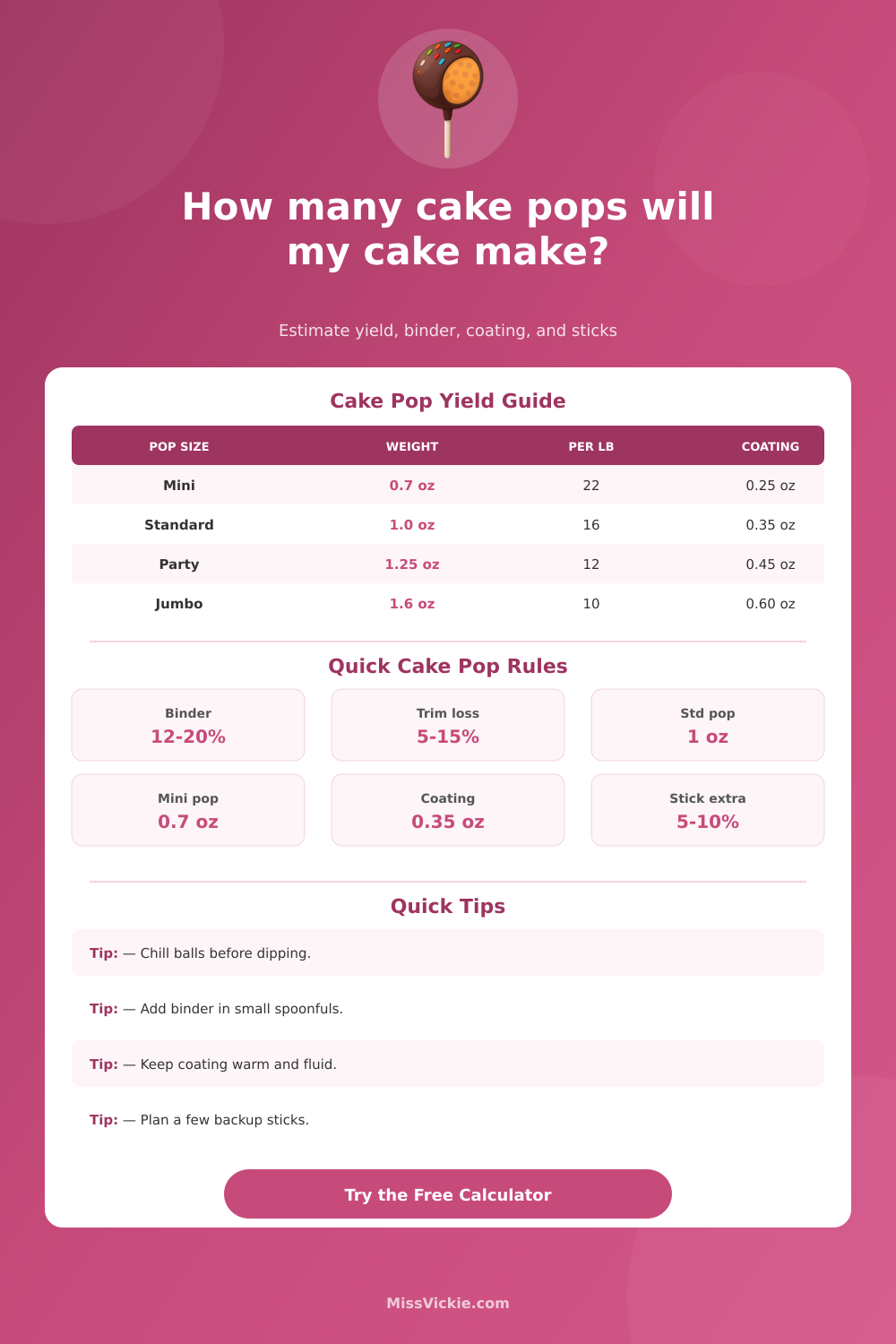
This grid recalculates your same cake and binder mixture across common cake pop sizes so you can compare yield before scooping.
0.70 oz mixture each, good for dessert trays.
1.00 oz mixture each, common party size.
1.25 oz mixture each, larger wrapped favor.
1.60 oz mixture each, bakery-style size.
| Binder style | Typical ratio | Texture effect | Best cake crumb |
|---|---|---|---|
| Buttercream frosting | 14 to 18% | Classic soft bite with enough structure for sticks | Vanilla, yellow, chocolate, boxed cake |
| Cream cheese frosting | 13 to 17% | Tangy and moist, but should stay chilled longer | Red velvet, carrot, spice cake |
| Chocolate ganache | 10 to 15% | Firm, rich texture with less sweetness than frosting | Chocolate, brownie, pound cake |
| Jam or fruit filling | 8 to 12% | Sticky binder with fruit flavor and softer set | Sponge, vanilla, lemon, berry cakes |
| Minimal binder | 6 to 10% | Cleaner cake flavor, but crumbs must already be moist | Fresh moist cake, dense pound cake |
| Gluten-free adjustment | 16 to 22% | Extra binder helps fragile crumbs hold a round shape | Gluten-free or drier cake layers |
| Coating type | Base coating per standard pop | Bowl loss to plan | Kitchen note |
|---|---|---|---|
| Candy melts | 0.35 oz / 10 g | 15 to 20% | Easy shell for beginners, usually thins well for dipping |
| White chocolate | 0.38 oz / 11 g | 18 to 25% | Can be thicker and more heat-sensitive than candy melts |
| Milk chocolate | 0.34 oz / 10 g | 15 to 22% | Smooth coating when thinned and kept gently warm |
| Dark chocolate | 0.32 oz / 9 g | 14 to 20% | Thinner shell, stronger chocolate flavor, less sweet finish |
| Thin shell | 0.25 oz / 7 g | 12 to 18% | Best for small pops or very fluid coating in a deep cup |
| Thick decorative shell | 0.50 oz / 14 g | 22 to 30% | Useful for heavy drizzle, textured coating, or large pops |
A cake pop calculator is a tool that allows you to calculate the amount of each ingredient you will need to make cake pops. Cake pops involve a variety of variables, such as the weight of the cake that you will use, the amount of binder you will use, the size of the cake pops, and the amount of coating that you will need to dip each cake pop in. If you dont consider each of these variables, you may not have enough of each ingredient to make your desired number of cake pops.
A cake pop calculator help you avoid these issues by using specific inputs to determine for you the amount of each ingredient that you will need for your cake pops. The first variable to consider is the weight of the cake that you will use to make your cake pops. The total weight of the cake that was baked will not necessarily be the weight that you use to make your cake pops.
How to Use a Cake Pop Calculator
Some of the baked cake will need to be discarded before the cake can be crumbled, such as the edges and the tops of the cake. Therefore, you will need to subtract the weight of that discarded cake from the total weight of the baked cake. A cake pop calculator allows you to input the percentage of the baked cake that you will discard; the calculator will automatically subtract that amount from the total weight of the baked cake for you.
The second variable to consider is the percentage of binder that you will use with your cake. A binder, such as frosting, will be mixed into the crumbled cake to help hold the cake pops together. Using too little binder will cause the cake pops to crack.
Using too much binder will cause the cake pops to be too sweet and heavy. Most recipes use binders that are between 12% and 20% of the weight of the usable cake (the cake minus the discarded portion). The type of cake that you use will impact the amount of binder that you need; pound cakes require more binder than sponge cakes, for instance.
Another variable is the type of binder; cream cheese frosting will work differently than chocolate ganache. A cake pop calculator will help you to select the percentage of binder that you will use with your specific type of cake and binder. The third variable that you will need to consider is the size of each cake pop.
Smaller cake pops will weigh less than standard cake pops; a small cake pop may weigh 3/4 oz., for instance, while a standard cake pop weighs 1 oz. If you would like to make larger cake pops, you will need to use more cake mixture to produce each cake pop, but you will make fewer cake pops overall. A cake pop calculator will calculate both variables for you.
The fourth variable that you should consider is the amount of coating that will be used to dip each cake pop. You will need to purchase more coating than the weight of your cake pops; some of the coating will remain in the dipping bowl. Some of the coating will drip off of the cake pops when you dip them, and some of the coating will stick to the sides of the container.
A cake pop calculator will include a percentage to account for the amount of coating that will remain in the bowl; the calculator will add that amount to the amount of coating that you will need for the cake pops. Additionally, the type of coating will impact the amount of coating that you need. For example, candy melts will be less thick than white chocolate.
A cake pop calculator will adjust the amount of coating that you will need based on the type of coating that you select. The fifth variable is the number of sticks that will be used to hold each cake pop. You will need sticks to hold each cake pop; however, some of the sticks may break during the making of the cake pops.
Additionally, some of the sticks will become dirty with the chocolate. You should purchase more sticks than the total number of cake pops that you will make. The cake pop calculator will include reference tables to assist you in the recipe.
One reference table may include the ratio of different types of binders to different types of cake. Another table may include the weights of the different types of coating and the amount of that coating that may remain in the bowl. These tables are not exact; you may have more or less of any ingredient than these examples.
However, they provide a range of weights that will work for each ingredient. In addition to the cake pop calculator, there are some habits that should be employed to successfully make your cake pops. For instance, you should chill each ball of cake pops before dipping them in the coating; chilling the cake pops will prevent them from falling off the sticks.
You should keep the coating warm; warm coating will remain fluid when you dip the cake pops in the coating. Finally, you should make small batches of the coating; limiting the amount of coating that you dip the cake in at one time will make it easier to maintain the temperature of the coating. Some mistakes that people make when following a recipe for cake pops involves using the incorrect inputs into the cake pop calculator.
For instance, some people use the total weight of the baked cake, without accounting for the weight of the portions of the cake that will be discarded before crumpling the cake. Additionally, many people do not account for the amount of coating that will remain in the bowl; they purchase less coating than they will need. These mistakes will result in the individual in making the cake pops to have less of the finished treats than they would of made with careful calculation by the cake pop calculator.
Therefore, the cake pop calculator will prevent these mistakes by forcing the individual to input variables such as the percentage of the cake that will be discarded, the percentage of the binder that will be used, and the percentage of the coating that will remain in the bowl. Once you have used the cake pop calculator, you will know how much cake, how much binder, and how much coating will be needed to make your cake pops. Once you have determined this information, you may begin to make your cake pops.
You will need to crumble the cake, mix the binder with the crumbled cake, roll the cake pops, chill the cake pops, dip the cake pops in the coating, and then decorate the cake pops. The cake pop calculator will ensure that you have enough of each ingredient so that you do not run out of frosting or chocolate during the cake pop making process. Its going to help you make alot of cake pops.