Cake Mix Calculator
Scale boxed or homemade cake mix by pan volume, layer count, fill level, eggs, oil, water, servings, and practical kitchen rounding.
Choose a common boxed or homemade baking plan, then adjust the pan, layers, fill level, and liquid ratios to match your recipe.
Calculation Breakdown
| Pan Setup | Capacity | Recommended Batter | Box Equivalent | Typical Yield |
|---|---|---|---|---|
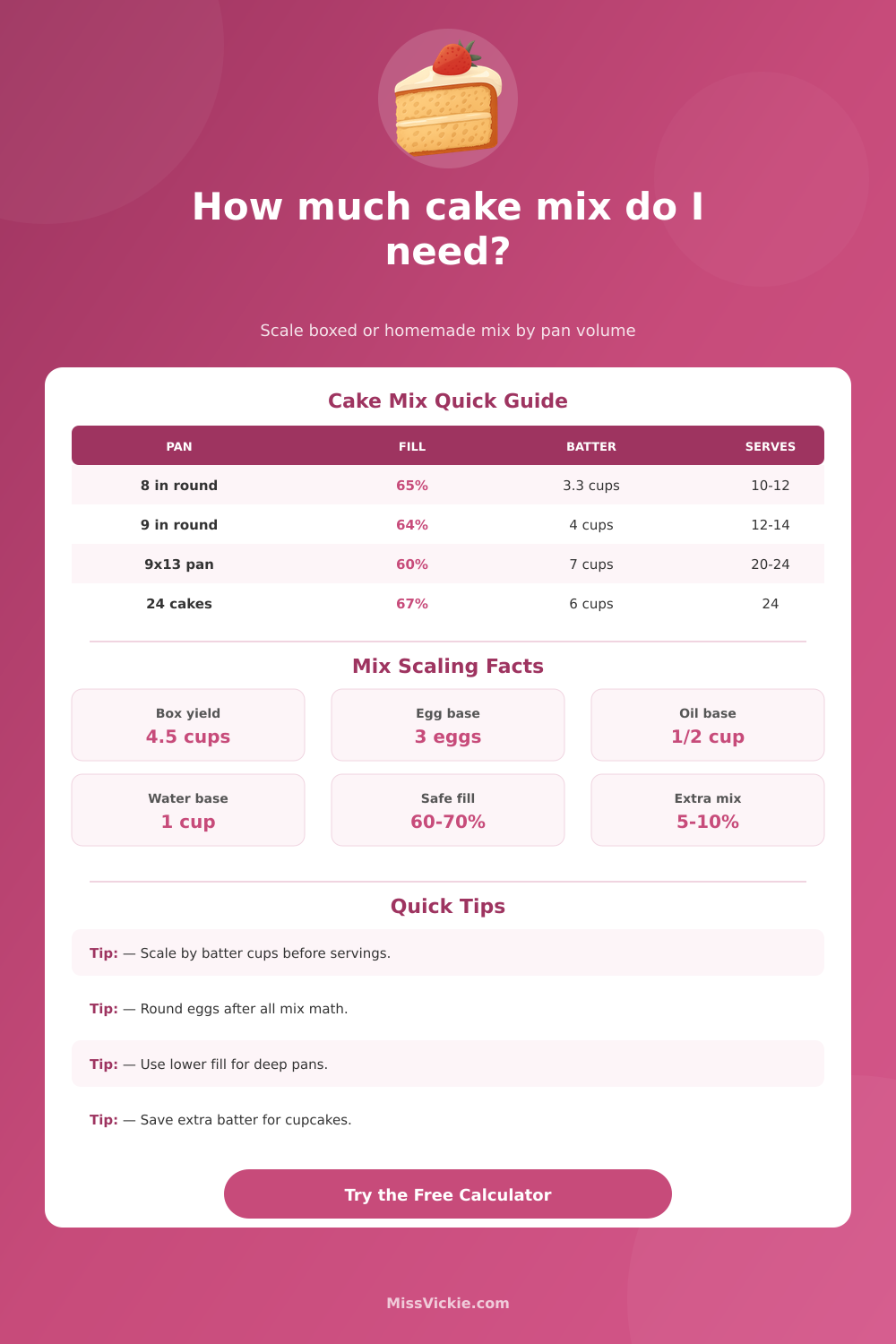
| One 8-inch round, 2 inches deep | 5 cups | 3.2 to 3.4 cups | 0.7 box | 10 to 12 slices |
| One 9-inch round, 2 inches deep | 6.3 cups | 3.8 to 4.1 cups | 0.9 box | 12 to 14 slices |
| Two 8-inch rounds | 10 cups | 6.4 to 6.8 cups | 1.5 boxes | 20 to 24 slices |
| Two 9-inch rounds | 12.6 cups | 7.7 to 8.2 cups | 1.8 boxes | 24 to 28 slices |
| 9x13-inch pan | 11.7 cups | 6.8 to 7.4 cups | 1.6 boxes | 20 to 24 slices |
| 10-inch bundt pan | 12 cups | 8.0 to 8.8 cups | 1.9 boxes | 16 to 20 slices |
| Mix Factor | Dry Mix | Eggs | Oil | Water |
|---|---|---|---|---|
| 0.5 box | 7.6 oz / 216 g | 1 to 2 eggs | 1/4 cup / 59 ml | 1/2 cup / 118 ml |
| 1 box | 15.25 oz / 432 g | 3 eggs | 1/2 cup / 118 ml | 1 cup / 237 ml |
| 1.5 boxes | 22.9 oz / 648 g | 4 to 5 eggs | 3/4 cup / 177 ml | 1 1/2 cups / 355 ml |
| 2 boxes | 30.5 oz / 865 g | 6 eggs | 1 cup / 237 ml | 2 cups / 473 ml |
| 3 boxes | 45.75 oz / 1297 g | 9 eggs | 1 1/2 cups / 355 ml | 3 cups / 710 ml |
Use package yield, then scale eggs, oil, and water by the same mix factor.
Enter your batter yield per recipe and dry mix weight to keep the crumb consistent.
Pan capacity times fill percent is more reliable than counting slices first.
A 5 to 10 percent cushion covers bowl loss, leveling, and a few tester cupcakes.
When doubling a cake mix or altering the size of the baking pan, the ratios of ingredient may no longer be correct. The eggs, oil, and water in the cake mix is calibrated to a specific amount of cake mix. If you alter the amount of cake mix, the ratio of eggs, oil, and water will change.
Using a calculator allow you to scale the recipe by volume rather than guessing at how much extra cake mix you will need. Before you open the cake mix, you must calculate the amount of batter that the specific baking pan can holds. Many bakers fill the baking pan to two-thirds of the depth of the pan.
How to Scale a Cake Mix with a Batter Calculator
Filling the pan to two thirds of its depth allow the cake to fully rise without spilling over the edge of the pan. After you enter the size of the baking pan and the number of layers that you want the cake to have, the cake batter calculator will complete the math for you. This cake batter calculator include a small cushion of extra batter so that you do not run short on batter if some adheres to the bowl, or if you have to level the tops of the cakes when they come out of the oven.
This cushion of extra batter is necessary to account for the fact that the batter may spill when transferring from the bowl into the pan, or when the cake may rise above the batter’s fill level when baking. A five or ten percent overage of batter allow for some loss when baking test cupcakes. If you do not include this extra batter, the main cake may end up short if you must trim the domes of the cake.
The ingredient that may take the most careful consideration is the number of eggs that are to go into the cake mix. Because eggs are an ingredient that have an impact on both the structure of the cake and the moisture content of the baked good, it is important to ensure that the number of eggs is correct. Since eggs are the final step in the calculation of the recipe’s ingredients, you can adjust the number of eggs if the calculation of the number of eggs result in a fraction.
For example, you could add an extra egg yolk to the cake mix for more richness, or you could add a splash of water to the mix to create a light crumb structure in the baked good. The amount of oil and water in the cake mix scale in a linear fashion. Oil and water is the ingredients responsible for the fat and liquid content of the baked good.
To scale these ingredients, the cake batter recipe calculator will multiply the amount of oil and water by the same factor used to scale the dry ingredients in the recipe. It isnt recommended to change only one of these liquids, as this could lead to a dry cake or a greasy baked good. If you are baking into a pan that does not have the same shape as the pan for which the recipe was written, the fill level of the batter can have a large impact upon the baking process.
For instance, a bundt pan and a sheet pan may have similar capacities for the amount of batter that they can hold. Yet, the batter may behave differently in each pan. This cake batter calculator allows you to adjust the fill percentage for each pan.
This adjustment ensures that you do not overfill the pan when using deep pans, or that you do not underfill the pan when using pans of large diameter. For cake mixes that are made at home, you have more flexibility in the recipe to decide on certain variables. For instance, the amount of batter that is measured when beating eggs at home may not be the same from one batch to the next.
For this reason, you can enter the amount of batter that you measured into the cake batter recipe calculator. By entering your own measured amount, the calculator can scale your recipe according to your specific recipe. This same function is used with family recipes without package label.
The cake batter calculator will ask for the number of slices that you would like to have in the finished cake. This question allow the calculator to provide an estimate of the amount of frosting that you will need for the cake. More important, though, is that it allows you to determine the portion size of the cake.
This knowledge will allow you to decide whether a pan of a smaller diameter would be better for your guests, or whether you should use an extra layer of cake to provide enough for each guest. If the calculator reveals that you will have a surplus of batter, use that surplus batter to bake cupcakes. Any surplus batter that is poured into the main baking pan may cause the pan to overflow and the center of the cake to sink.
Additionally, baking cupcakes with the surplus batter provides you with a taste test of the cake before it is cooked in the main pan. As with most tools, this cake recipe and batter calculator is useful for removing uncertainty in a recipe that involves numerous variables. You can adjust the size of the pan, the number of layers of the cake, and the type of cake mix that you use.
Using this cake recipe and batter calculator provides you with clarity in the recipe. This clarity is essential to successfully bake a cake that is consistent in its results.