Cake Calorie Calculator
Estimate total cake calories and per-slice calories from pan shape, pan size, layer height, cake style, servings, icing, filling, and calorie-rich add-ins.
Choose a real cake scenario, then adjust dimensions, icing, filling, servings, or ingredients to match your recipe.
Calorie Breakdown
Base calories from the selected cake style before richness adjustment.
Calories for the chosen exterior icing or glaze.
Calories added between layers for every filled seam.
Serving volume implied by the selected slice style and height.
These cards compare the same cake with four common finishes, using the current pan, layers, filling, add-ins, and serving count.
| Cake style | Calories per cu in | Typical texture | Best calculator note |
|---|---|---|---|
| Vanilla or butter cake | 78 | Moderate crumb | Good default for birthday layer cakes |
| Chocolate cake | 84 | Moist and rich | Often paired with ganache or buttercream |
| Sponge or chiffon | 55 | Airy and light | Use whipped cream or fruit for lighter slices |
| Pound cake | 104 | Dense butter crumb | Small slices carry more calories |
| Carrot cake | 92 | Oil, nuts, and vegetables | Add nuts separately if the recipe is loaded |
| Cheesecake | 130 | Dense custard | Use fewer servings only for very generous slices |
| Component | Calories per oz | Typical use | Planning note |
|---|---|---|---|
| Whipped cream | 75 | Light topping | Best chilled and served soon |
| Buttercream | 140 | Exterior and filling | Classic choice that can dominate calories |
| Cream cheese frosting | 125 | Carrot and red velvet | Softer finish with slightly fewer calories |
| Ganache | 150 | Chocolate coating | Dense finish with high chocolate and cream |
| Fruit jam | 80 | Thin filling | Sweet but usually lighter than buttercream |
| Chocolate chips or nuts | 150-170 | Batter add-ins | Small amounts move per-slice calories quickly |
| Serving style | Footprint | Typical height | Slice volume | Best for |
|---|---|---|---|---|
| Coffee slice | 1 x 1.5 in | 4 in | 6 cu in | Tea table, mixed desserts, tasting portions |
| Wedding slice | 1 x 2 in | 4 in | 8 cu in | Formal service and tall tiered cakes |
| Party slice | 1.5 x 2 in | 4 in | 12 cu in | Birthday parties and home cutting |
| Generous slice | 2 x 2 in | 4 in | 16 cu in | Dessert-focused meals and larger plates |
| Custom portion | By servings | Your cake | Calculated | When labels or pans set the slice count |
| Pan and cake | Layers | Servings | Finish | Typical slice range |
|---|---|---|---|---|
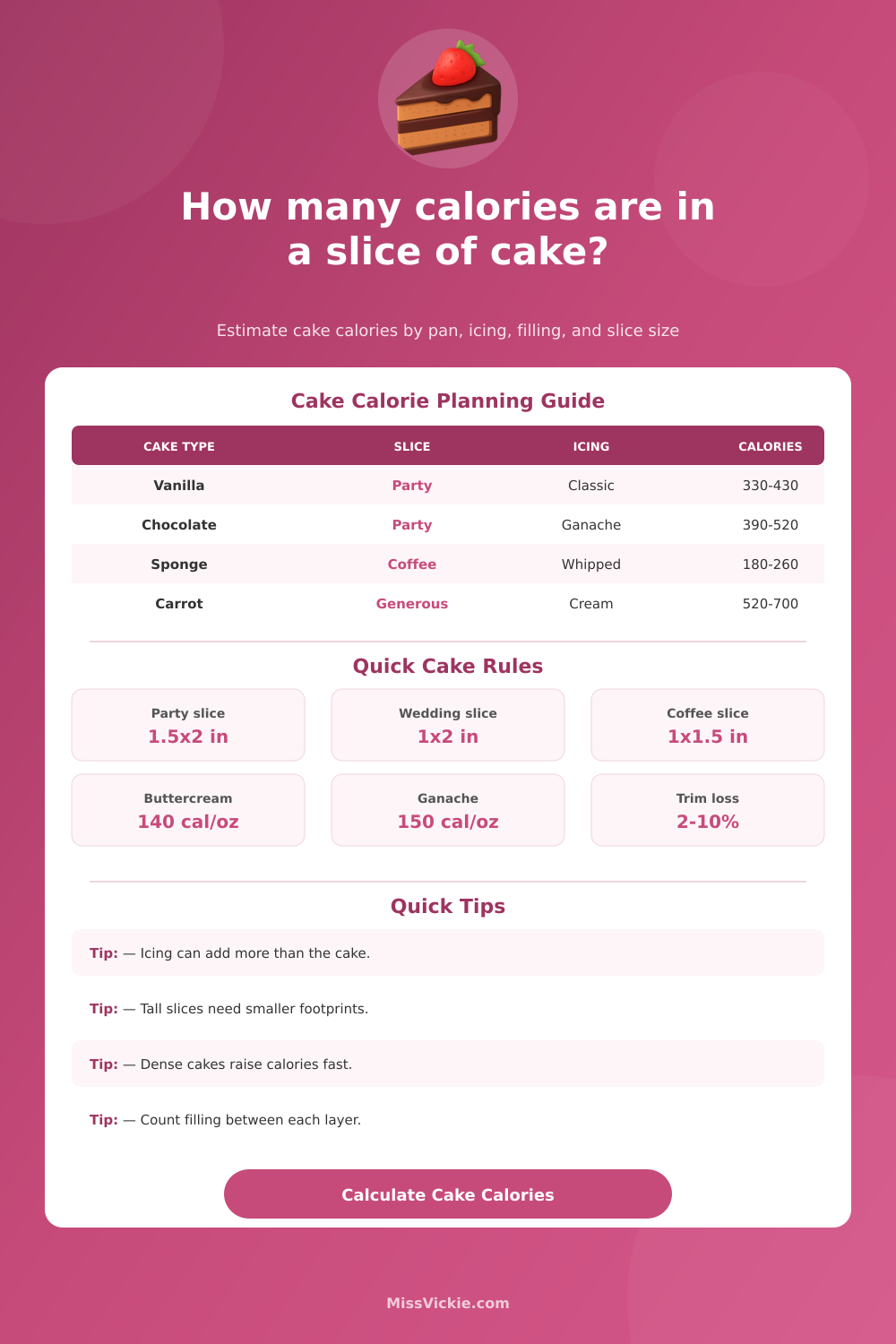
| 6 inch sponge | 2 | 8 | Whipped cream | 180 to 260 calories |
| 8 inch vanilla | 2 | 16 | Classic buttercream | 330 to 430 calories |
| 9 inch chocolate | 2 | 18 | Ganache | 390 to 520 calories |
| 9 x 13 sheet | 1 | 24 | Thin buttercream | 250 to 360 calories |
| 8 inch carrot | 3 | 14 | Cream cheese frosting | 520 to 700 calories |
| Cheesecake | 1 | 12 | No icing | 430 to 620 calories |
To determine the number of calories in a slice of cake, one must consider more than the taste of the cake. A slice of cake contain energy from three different component of the cake: the cake crumb, the cake filling (if any), and the cake icing (if any). The number of calories in a slice of cake can vary by several hundred calories from cake recipe to cake recipe, so the use of a calculator will help in determining the exact number of calories in a slice of cake.
The first factor to consider in the calculation of the calories in a slice of cake are the volume of the cake and the weight of the cake. The size of the pan in which the cake is baked will determine the footprint of the cake. The height of the cake and the number of layers of the cake will determine the volume of the cake.
How to calculate the calories in a slice of cake
The type of cake will impact the density of the cake; a pound cake will be denser than a sponge cake, for instance, meaning that it will contain more calories per unit of volume. A carrot cake will contain more calories then a sponge cake due to the oil and nuts that are included in the batter of a carrot cake. The amount of calories that the icing of the cake contribute to the total calories in the cake will also impact the total number of calories in the cake.
The amount of icing that a cake has will depend upon the type of icing and the surface area of the cake that is to be iced. A thin layer of whipped cream will contain fewer calories than a thick layer of buttercream icing, for instance, because buttercream icing contains more sugar and fat. A tall cake will have more icing applied to its side walls than a short cake of the same size; thus, increasing the amount of icing will increase the total calories of the cake.
The cake calculator will account for the surface area of the cake; therefore, increasing the icing will lead to an increased reading of the total calories in the cake. The type of filling that is contained within the cake will add to the total number of calories of the cake. The number of layers of filling will determine the number of calories of the cake.
A cake with three layers of buttercream filling will contain more calories than a cake with one layer of jam filling, for instance. The calculator will account for the seam of filling; therefore, it will account for the impact that different types of filling will have upon the total calories in the cake. The number of calories that any add-ins, sprinkles, or swirls contribute to the cake will also contribute to the total calories; the cake will contain more calories with swirls of candy or caramel than a cake without swirls.
Additionally, cakes are often trimmed prior to serving; the trimmed portions will contain fewer calories than the baked cake. The cake calculator will account for the loss of volume from trimming the cake. Beyond the total number of calories in the cake, the calculator will also provide other information regarding that cake.
For instance, the calculator will determine the total calories of the cake prior to trimming of the cake, as well as the total calories of the cake after trimming of the cake. Additionally, the calculator will provide the total calories of the cake per slice of the cake according to the selected serving size, as well as the total calories of the toppings of the cake. Many people believe that cakes with tall heights will contain more calories per slice than cakes with short heights.
However, tall cakes may have more total calories, but they may be cut into slice with a small footprint. Thus, a tall slice of cake may contain the same amount of calories as a shorter slice of cake. The cake calculator allows one to separate these two variable to determine how the dimensions of the cake will impact the calories of each slice of cake.
Finally, the richness of the cake recipe will impact the number of calories of each slice of cake. Increasing the amount of butter or number of egg yolk in the cake recipe will increase the density of the cake, leading to an increase in the total calories of the cake. These variable can be manipulated in the cake calculator to determine how the calories will change with these changes in cake recipe.
The main purpose of the cake calculator is to help cake makers determine the tradeoffs of their cake recipe prior to baking the cake. For instance, it is possible to compare the calories of cakes with fewer layers to cakes with more layers. It is also possible to compare cakes with light icing to cakes with heavy icing.
These comparisons enable cake makers to plan around the calories that will be contained within each slice of cake. Thus, using a cake calculator is beneficial in that it will remove the guesswork of the number of calories of each slice of cake that will be served, whether in connection with a party or other social event.