
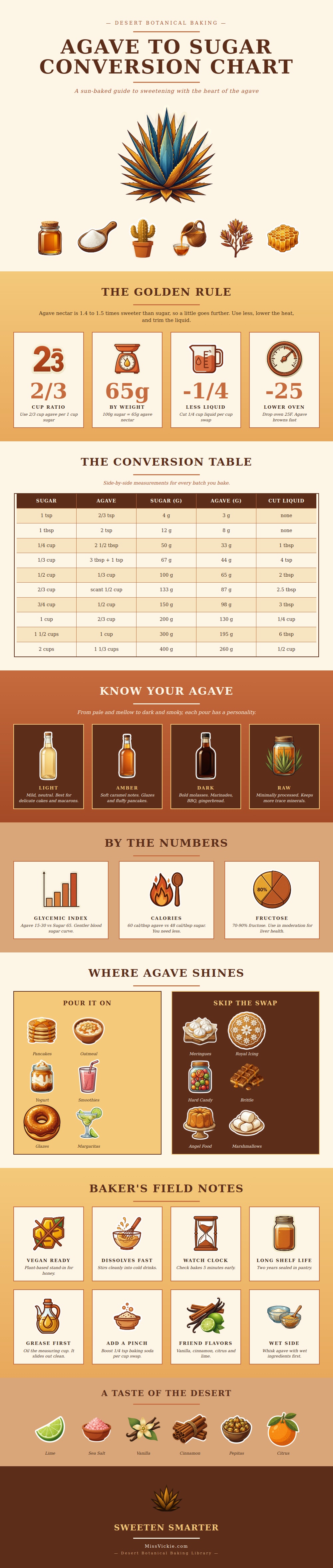
When you are substituting agave nectar for granulated sugar in a recipe, you must understand how the two ingredient behave differntly. Agave nectar is a liquid sweetener, while granulated sugar is a dry sweetener; this difference in the two sweeteners will alter the texture of the food products that you create. Additionally, agave nectar is more concentrated than granulated sugar, which means that agave nectar contains more sweetness than granulated sugar.
Therefore, you must use less agave nectar than granulated sugar to flavor the recipe to the same level of sweetness; using the same amount of agave nectar as granulated sugar would create an overly sweet product. Furthermore, because agave nectar contains water and granulated sugar does not, replacing granulated sugar with agave nectar will increase the amount of liquid in the recipe. Because of the differences in the two sweeteners, you must alter the baking temperature of your product when you use agave nectar in place of granulated sugar.
How to Replace Sugar with Agave Nectar
Agave nectar browns more quick than granulated sugar will brown, so your baked product may brown too quickly. To prevent this from happening, you should reduce the baking temperature of your product; reducing the baking temperature will allow the center of the baked product to cook while the outside of the product dont burn. For instance, if you are baking something like cookies or cakes, using a lower baking temperature will allow the baked product to maintain its shape as it cooks.
Agave nectar is a useful ingredient for applications in which you would like to use a liquid sweetener that dissolves quick. For instance, agave nectar can dissolve easy in cold liquids like yogurt or oatmeal. Additionally, people often use agave nectar in glazes, marinades, and cocktails.
However, agave nectar isnt suitable as a replacement for granulated sugar in recipes like meringues, royal icing, and brittle; the dehydration and crystalline structure of granulated sugar are required for these recipes. Therefore, if you use agave nectar in a recipe that requires granulated sugar, the texture of the agave nectar product will change from the original recipe. Agave nectar has different nutritional property then granulated sugar.
Agave nectar has a lower glycemic index than granulated sugar. However, most agave nectar products are high in fructose, which can impact the liver if used in high amounts. Because of this, you should not use agave nectar as an means of increasing the amount of sweetener that you consume.
Instead, one of the main benefits of agave nectar is that it is significantly sweeter than granulated sugar, so less agave nectar are needed to flavor a product to the same level of sweetness as granulated sugar. To manage agave nectar in your kitchen, follow a few simple steps. You can store agave nectar at room temperature; however, agave nectar may crystallize if the temperature of the agave nectar change.
If the agave nectar has crystallized, the best way to restore the agave nectar to its pourable consistency is to place the container of agave nectar into a warm water bath. When measuring the amount of agave nectar that you need for your recipes, lightly oil your measuring cup or spoon; the agave nectar will otherwise adhere to these measuring tool. Finally, one of the benefits of agave nectar is that it has a faint caramel flavor.
This flavor works well with ingredients like vanilla, cinnamon, citrus flavors, and warm spices. Therefore, agave nectar will contribute to the flavor of your product in a way that granulated sugar will not; agave nectar has a unique flavor. Thus, using agave nectar in your recipes is more than just using a replacement for granulated sugar.
Instead, it is a way to adjust the moisture, the sweetness, the browning, and the flavor of the recipe.