Freezing Point of Water Calculator
Estimate the freezing point of water, brine, syrup, or cocktail-style mixes from salt, sugar, alcohol, batch volume, container depth, freezer temperature, and the ice or slush texture you want.
Start with a real kitchen scenario, then tune the solutes, batch volume, freezer temperature, and container shape for your own tray, bowl, bottle, or pan.
Freezing Plan
Adjust the inputs to estimate your batch.
Freezing Depression Breakdown
Batch and Container Breakdown
| Kitchen Mix | Typical Solutes | Estimated Freeze Point | Planning Use |
|---|---|---|---|
| Plain water or ice cubes | No added solutes | 32°F / 0°C | Hard cubes, blocks, ice beds |
| Lightly salted cooking water | 0.5% to 1% salt | 31°F to 30°F | Almost normal freezing, slightly slower |
| Ice cream salt bath | 6% to 10% salt | 22°F to 15°F | Cold bath for churning and chilling |
| Fruit syrup or granita | 10% to 25% sugar | 29°F to 24°F | Scoopable crystals or soft freeze |
| Alcoholic slush | 6% to 14% ABV | 25°F to 10°F | Slush, soft pops, freezer drinks |
| Batch Shape | Best Depth | Expected Speed | Kitchen Note |
|---|---|---|---|
| Ice cube tray | 0.75 to 1 inch | Fast | Best for solid ice and measured cubes |
| Sheet pan or metal pan | 0.5 to 1.5 inches | Fast | Best for granita and scraping |
| Plastic tub | 1.5 to 3 inches | Medium | Allow more time and headspace |
| Pitcher or bottle | Over 3 inches | Slow | Risky for expansion if sealed |
| Ice bath bowl | Loose ice mix | Immediate chill | Add salt only when colder bath is needed |
| Freezer Temperature | Plain Water | Sugary Mix | Alcohol Mix |
|---|---|---|---|
| 10°F / -12°C | Freezes | Slow soft freeze | Often remains slushy |
| 0°F / -18°C | Freezes well | Good for granita | Works if ABV is modest |
| -10°F / -23°C | Freezes fast | Firmer texture | Better for freezer pops |
| -20°F / -29°C | Very fast | Harder dessert base | Useful for stronger mixes |
Best when you need solid cubes, chilled serving bowls, or predictable expansion.
Useful for colder ice baths, but salt quickly lowers the freezing point.
Good for granita, sorbet base, and scoopable crystals in shallow pans.
Best planned as soft slush unless the ABV is very low or freezer is very cold.
The salt model is capped near the practical kitchen range because sodium chloride brine has a eutectic limit; heavy brines and high-proof alcohol mixes may not freeze solid in a normal home freezer.
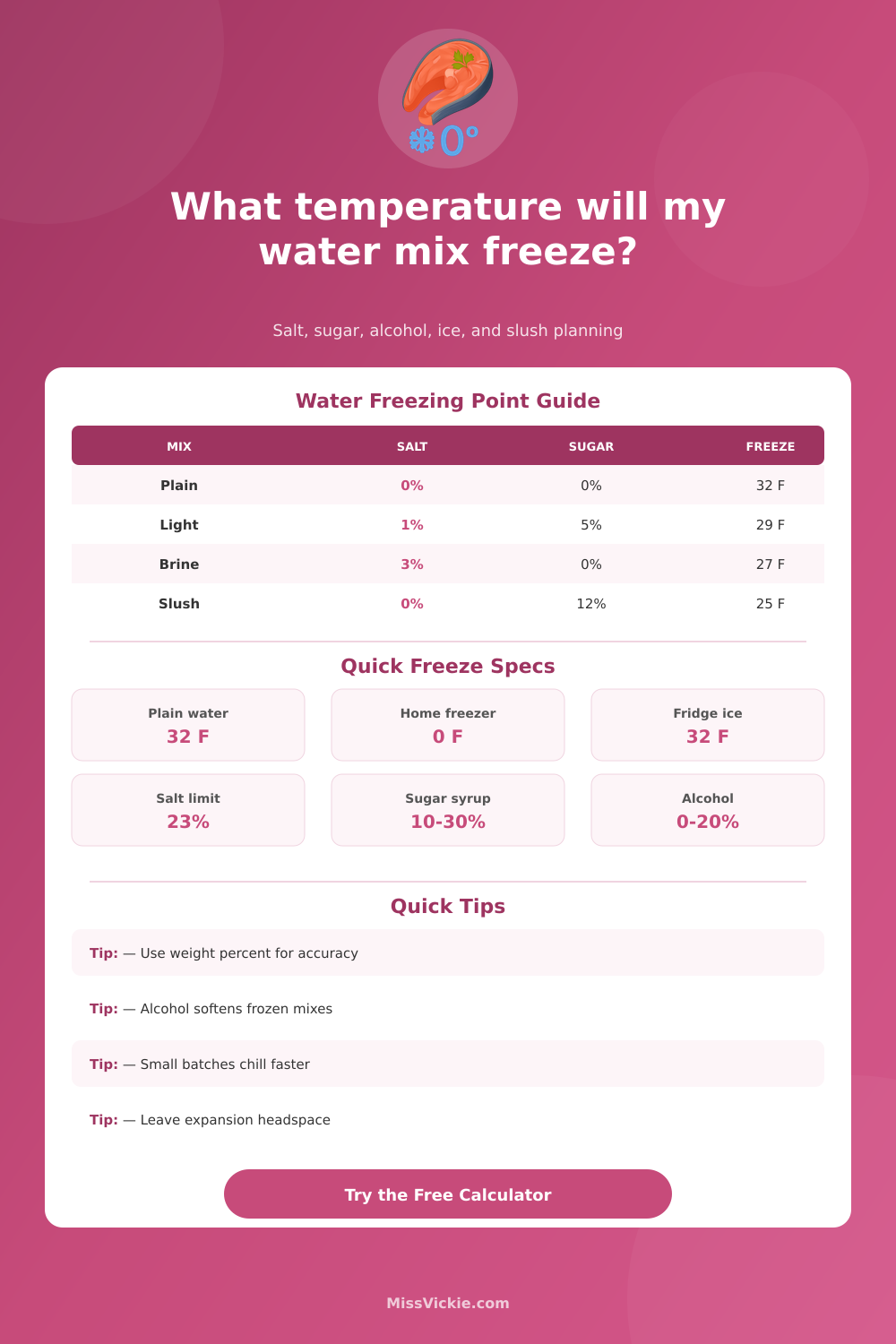
Adding substances to water will changes the freezing point of that water. The freezing point of the water will not stay at 32 degree unless you remove the substance from the water. The water molecule in the water want to lock into a crystal structure.
However, the substances that you add to the water will prevents the water from being able to lock into that structure. As a result, the freezing point will move to a lower temperature then 32 degrees. The type of substance that you add will determine how much the freezing point will move.
What Affects the Freezing Point of Water
For instance, if you add salt to the water, the freezing point of the water will lower by several degree. Because of this, salt is an substance that can be useful when preparing an ice bath for seafood. If you add sugar to the water, the freezing point will lower, but not as aggressive than salt will lower the freezing point.
As a result, a water and sugar mixture will remain scoopable. If you add alcohol to the water, the freezing point will again lower, but to an even more greater extent than salt or sugar. As a result, a liquid with alcohol will remain much more softer than a liquid without alcohol.
The shape and size of the container in which the water sits will change the freezing point of the water. For instance, a liquid in a shallow metal pan will reach the freezing point faster then a liquid in a deep plastic tub. This is due to the greater surface area of the shallow metal pan that is able to allow cold air to remove heat from the water.
Additionally, the number of times that the cook stir the container will impact the texture of the resulting frozen liquid. If you stir the container at regular interval, large chunk of ice will not form. If the mixture isnt stirred, the mixture may freeze in an unevenly manner so that the liquid portion of the mixture may be located at the bottom of the container of the mixture while the mixture is solid at the top.
The starting temperature of the liquid will impact the length of time that it take to reach the freezing point. A liquid that originates from a refrigerator will contain less heat than a liquid that is at room temperature. Thus, a liquid that originates from a refrigerator will reach the freezing point of 32 degrees faster.
As a result, it is possible to enter the starting temperature of the liquid into the calculator so that the calculator can provide an accuracy estimate of the length of time that it will take for the water to freeze. Other variable in the kitchen may impact the freezing point of the water. For instance, the minerals that are dissolved in tap water, fruit pulp, or the fat that is contained in cream will impact how quickly the water freezes.
The function of the freezer also impact the freezing rate of the water. For instance, a chest freezer that is set to a very low temperature will freeze the water faster than a frost free freezer that remains at around zero degrees. Freezers may contain different temperatures so the freezers temperature in the kitchen should be measured with a thermometer.
Another factor to consider is the fact that water and its mixtures expand when they reach the freezing point. Therefore, headspace should be left in the container so that the liquid does not overflow once it freezes. The calculator considers this variable and provide an appropriate recommendation of the size of the container that should be used.
Depending on the goal of the freezing of the water, there are different strategy that should be utilized. If the intention is to create solid ice cube, very little salt or sugar should be added and the container of the water should be allowed to sit for an extended period of time. If the goal is to create a scoopable dessert, sugar or alcohol should be added and the mixture should be stirred at regular interval.
Finally, if the goal is to prepare an ice bath, salt should be added to the water and the depth of the container should be consider. Each of these variable will impact how much the freezing point of the water has move and the length of time it will take for the water to reach the freezing point. Thus, the salt water freezing point calculator will allow cooks to better plan their kitchen task.