
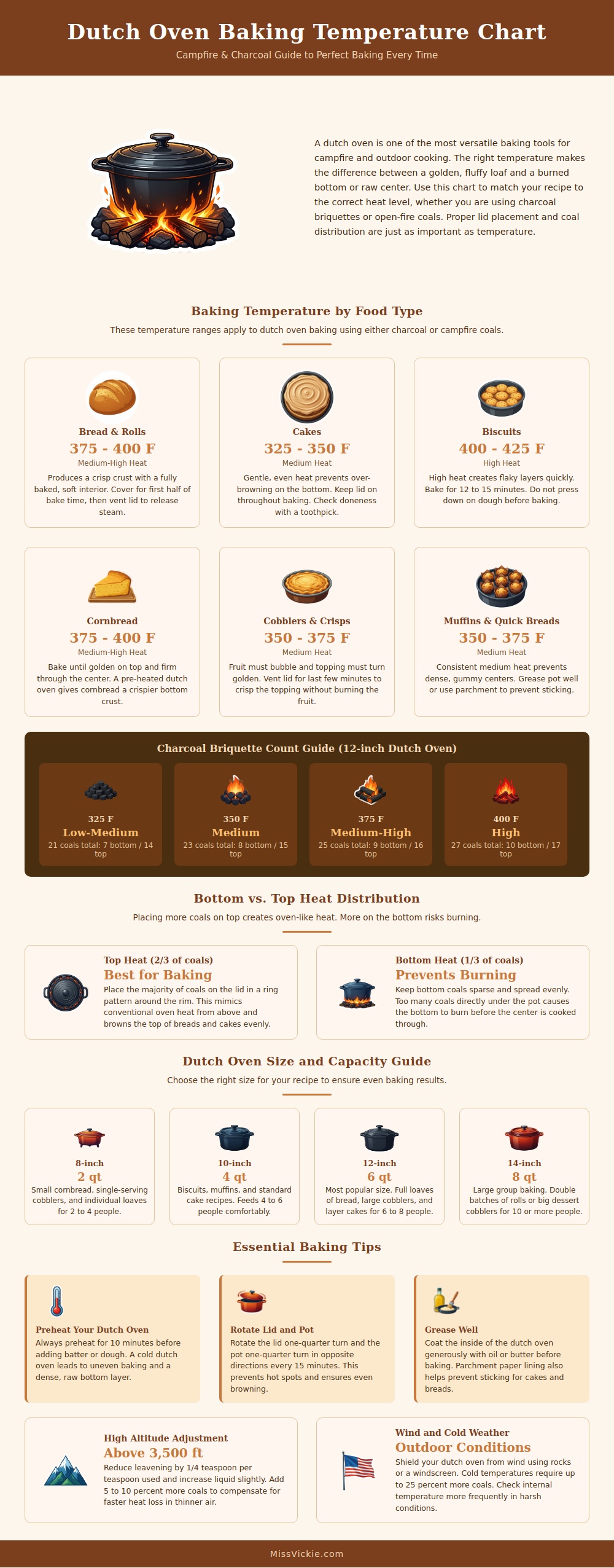
To perform baking with a Dutch oven, an individual must manages the heat of the Dutch oven to ensure that the food performs well when baked within the Dutch oven. The temperature of the Dutch oven will determine whether an individual’s baking attempt are sucessful or unsuccessful. Different foods requires different temperatures to allow those foods to bake into successful baked goods.
For instance, bread and rolls require temperatures that lie in the upper middle range of the temperature scale associated with a Dutch oven. Rolls and bread require this middle range of heat to allow for the creation of the crust of the bread without drying out the rolls or bread. Other foods, like cakes, require temperatures that are lower than the temperature ranges that is required of bread products.
How to Manage Heat When Baking in a Dutch Oven
Cakes require more time to set the structure of the cakes before the exterior of the cakes begin to darken. Finally, items like biscuits require high temperatures to allow for the biscuits to steam and lift while baking within the Dutch oven. Each type of food require the placement of the food into a Dutch oven that has been heated to the correct range of temperatures to ensure that the food performs well while baking within that Dutch oven.
Another consideration in baking with a Dutch oven is the distribution of the coals within the Dutch oven. Dutch ovens lose heat from the top of the Dutch oven more faster than they gain heat from the bottom of the Dutch oven. Accordingly, one should place more coals on the lid of the Dutch oven than underneath the Dutch oven.
Additionally, you should place fewer coals underneath the Dutch oven to prevent the bottom of the food from burning while the center of the food is cooking. The number of coals that people place inside of the Dutch oven should be considered relative to the need of balancing the heat between the top and the bottom of the Dutch oven. By maintaining such a balance between the top and the bottom of the Dutch oven, the cook will prevent the bottom of the food from scorching.
The size of the Dutch oven may also impact the baking process with a Dutch oven. Small Dutch ovens will heat up quick, but will also lose that heat quickly. Additionally, Dutch ovens of small sizes cannot be unattended.
Large Dutch ovens will retain heat longer than small Dutch ovens. However, to reach the desired temperature with the large Dutch oven, more coals will be required to achieve the temperatures to which the recipe for the baking good within the Dutch oven calls. The size of the Dutch oven that is used in the baking process should be chosen in relation to the recipe that is to be performed with the Dutch oven.
The altitude at which baking with the Dutch oven occurs can also impact the recipe. Dutch ovens tend to lose heat to the surrounding environment, especially at high altitudes. At high altitudes, the air pressure is lower, which allows for the liquids in the baked good to evaporate at a faster rate.
To compensate for this, recipes that are performed at high altitudes require less baking powder or baking soda to counteract the effect of the lower air pressure. Additionally, the amount of liquid that is used in the recipe should be increased to compensate for the increased evaporation of the liquids in the recipe at high altitudes. Additionally, the environmental temperature may impact the baking process.
For instance, the wind that exists in the environment may strip the heat from the lid of the Dutch oven. Additionally, the ground temperatures can impact the Dutch oven if the ground is exposed to the cold temperatures. To combat the effect of the wind, one can place barriers such as rocks or screen covers between the Dutch oven and the wind to prevent the Dutch oven from losing heat to the environment.
Another way to adjust the heat within the Dutch oven is to make observations of the foods while they are baking within the Dutch oven. If an individual observes that the top of the food is coloring too quick, removing some of the coals from the lid will help to even out the heat within the Dutch oven. Additionally, if the bottom of the Dutch oven is too hot, using fewer coals underneath the Dutch oven will even out the heat for baking within the Dutch oven.
Thus, an individual can use the temperature ranges and the number of coals indicated within a recipe as a point of start to baking with a Dutch oven. However, using the observations of the baking food will allow adjustments to the heat within the Dutch oven. Furthermore, by understanding how the heat within a Dutch oven can be controlled, an individual can use that same Dutch oven to perform a variety of baking recipes.