Boiling Point Altitude Calculator
Estimate the boiling point of water by altitude, pressure, simmer style, added salt, pot coverage, and recipe time so high-altitude cooking adjustments feel less mysterious.
Start with a common kitchen scenario, then adjust the altitude, pressure, salt, simmer target, lid, and recipe time for your own pot.
Your Altitude Boiling Result
Boiling point and time adjustment will appear here.
Boiling Point Breakdown
Cooking Time Breakdown
Use these tables for quick checks. Actual cooking depends on food size, pot geometry, burner recovery, and how much cold food enters the water.
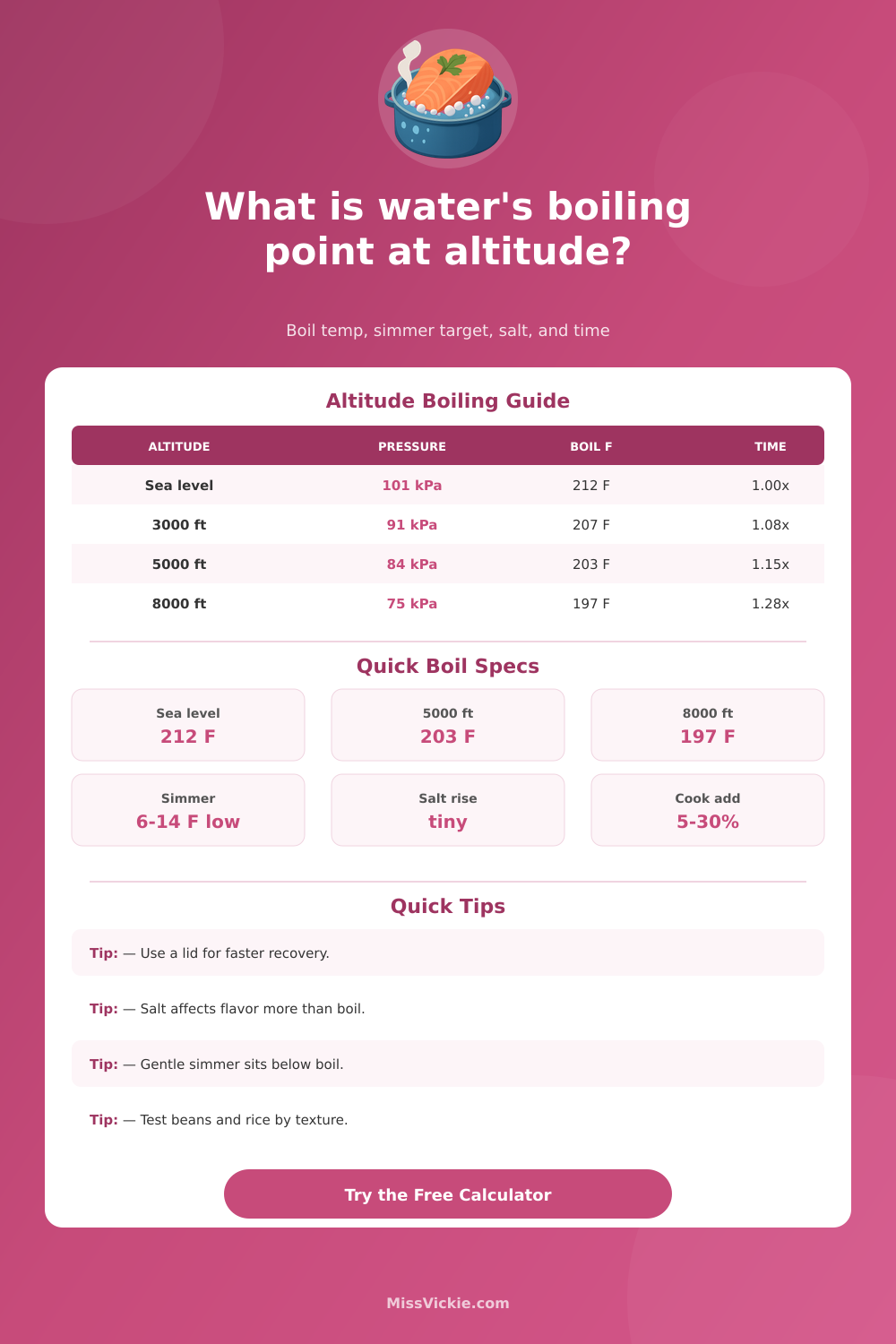
| Altitude | Pressure | Water Boil | Typical Adjustment |
|---|---|---|---|
| 0 ft / 0 m | 29.92 inHg / 101.3 kPa | 212.0°F / 100.0°C | Use sea-level recipe time |
| 2000 ft / 610 m | 27.82 inHg / 94.2 kPa | 208.4°F / 98.0°C | Add about 4% to 7% |
| 5000 ft / 1524 m | 24.90 inHg / 84.3 kPa | 202.9°F / 94.9°C | Add about 10% to 18% |
| 8000 ft / 2438 m | 22.22 inHg / 75.3 kPa | 197.5°F / 91.9°C | Add about 20% to 35% |
| 10000 ft / 3048 m | 20.58 inHg / 69.7 kPa | 193.6°F / 89.8°C | Use texture checks often |
| Pot Setup | Salt Level | Boil Change | Best Use |
|---|---|---|---|
| Unsalted water | 0 g per quart | No salt lift | Tea, eggs, neutral boiling |
| Lightly seasoned | 2 to 3 g per quart | About +0.03°F | Vegetables and grains |
| Pasta water | 5 to 6 g per quart | About +0.06°F | Pasta flavor, not heat |
| Very salty water | 12 g per quart | About +0.13°F | Shellfish or heavy seasoning |
| Gentle simmer | Any normal salt | 6 to 14°F below boil | Rice, beans, soups, sauces |
| Food | Altitude Sensitivity | At 5000 ft | Cook by Feel |
|---|---|---|---|
| Pasta or noodles | Low to medium | Usually +1 to +3 min | Taste for tender bite |
| Rice or grains | Medium | Add 10% to 18% | Rest covered after cooking |
| Dry beans | High | Add 18% to 35% | Check creamy centers |
| Potatoes and roots | Medium | Add 10% to 20% | Knife should slide through |
| Eggs | Medium | Add 1 to 3 minutes | Chill and test one egg |
| Candy and syrup | Temperature target | Lower target by boil drop | Use a thermometer |
Use for pasta, blanching, and fast heat recovery after cold ingredients go in.
Good for beans, soups, and uncovered reductions that need steady movement.
Best for rice, grains, sauces, and foods that scorch or break with hard boiling.
Useful for delicate stocks and poaching when occasional bubbles are enough.
Pressure reports can be confusing: station pressure is the actual pressure at your location, while sea-level adjusted pressure is corrected for weather mapping. For boiling point, station pressure is the useful number.
Boiling water change when you cook at high altitudes due to the change in the boiling point of water at high altitudes. At high altitudes the air are thinner. The thinner air has fewer air molecule that press down upon the surface of the water.
There is less pressure upon the water molecules at high altitudes than there is at sea level. As a result of the less pressure upon the water molecules, the water molecules leave the liquid phase as steam at a lower temperature than at sea level. For instance, at an altitude of five thousand feet above sea level, the boiling point of water drop approximately nine degrees from that of sea level.
How High Altitude Changes Boiling Water and Cooking Times
This change in boiling point change how you must cook your food; the lower boiling point of water change the length it takes to cook your food. The primary variable that affect the boiling point of water is the pressure. Pressure indicate how much heat the water can hold.
Weather report can display the pressure in the area. However, the sea level adjusted pressure is provided; you should utilize the station pressure in the calculator for the most accurate results. The station pressure will determine the simmer target for the water.
The simmer target is different than the boiling point of the water; it is the temperature that should be used when cooking the food. Salts can be add to the boiling water. However, the boiling point of the water dont change significently with the addition of salt.
Several gram of salt can be added to the water; however, the boiling point will only mathematically change by a fraction of a degree. While the benefit of adding salt to the food is present; the benefit of salt in relation to the boiling point of water is minimal. Thus, when calculating the boiling time for the food, you should not consider the influence of salt.
Because each food have a different reaction to the boiling point of water, each food will require a different adjustment in cooking time. For instance, pasta will cook more easy in water with a lower boiling point than dry beans will cook in water with a lower boiling point. Thus, the cooking time for pasta will be less than the cooking time for dry beans.
The calculator account for the different cooking times for each food. Additionally, if a lid is covered onto the pot, the covered lid will retain heat and the cooking time will be shorter. The other common mistake is to increase the heat of the stove burner to make the water hotter than the boiling point of the water.
However, increasing the heat of the burner will not increase the boiling point; it will only increase the rate of evaporation of the water. Therefore, if anyone attempt to make the water hotter than its boiling point by increasing the heat of the burner, the water will never reach that temperature; cooking time will have to be increased. A pressure cooker is different than a cooking pot.
The reason that cooking in a pressure cooker take less cooking time is because the pressure cooker increase the pressure within the pot. The increase in pressure within the pot increase the boiling temperature of the water within that pot. Because the boiling point of the water is higher within the pressure cooker, it take less time for the food to cook within that pressure cooker than within a standard cooking pot.
While the reference table can help cooks to determine the boiling temperature of water at different altitudes, it is still important to check the food. The reference tables will indicate the boiling temperature of water at various elevation. Furthermore, the reference tables will indicate the time adjustment needed for the various foods at different altitudes.
However, the actual time needed to cook the food will also depend upon the size of the beans, the amount of water within the pot, and whether the lid remain on the pot throughout the cooking process. Furthermore, only a thermometer will reveal to a cook the temperature of the water within the pot; however, it will not tell the cook if the food is cooked. Thus, a cook will have to use a fork or their teeth to taste the food to determine if it is cooked.
An understanding of the way in which altitude change the boiling point of water will help cooks to read the recipe written for cooks of various altitudes. If the recipe is written for cooks that live at sea level, you must increase the cooking times if the food is to be cooked at high altitudes. If the recipe is written for cooks that live at high altitudes, the cooking times will have to be decrease if the food is to be cooked at sea level.
Thus, the cook can use the cooking time calculator to translate these times; planning the cooking time in advance would of prevented the food from being undercooked when it is served to the eater.