Cooking Time Adjustment Calculator
Convert a recipe time when your oven temperature, pan size, food thickness, convection setting, cover style, altitude, or target doneness changes.
Pick a common kitchen change, then fine-tune the exact oven, pan, thickness, cover, altitude, and doneness inputs for your recipe.
Important: This calculator estimates schedule changes. Always verify doneness with recipe cues, a probe thermometer for meat and fish, and visual checks for baked goods.
Adjusted Cooking Plan
Your converted timing will appear here.
Time Conversion Breakdown
Cooking Cues
| Food Type | Heat Sensitivity | Thickness Sensitivity | Best Doneness Check |
|---|---|---|---|
| Cakes and quick breads | Moderate; edges brown before center sets | Medium; batter depth matters | Clean pick, springy center, set crumb |
| Brownies and bars | Moderate; carryover is important | Medium-high; thick slabs stay fudgy | Moist crumbs on pick, set edges |
| Casseroles | Lower; filling temperature dominates | Medium; deeper dishes need time | Bubbling center and safe filling temp |
| Chicken breast pieces | High; lean meat dries quickly | High; center thickness rules timing | Probe the thickest piece |
| Whole chicken or roast | High; surface browns while center lags | High; mass and shape matter most | Probe center away from bone |
| Fish fillets | Very high; small changes matter | High; thin fillets cook fast | Flakes easily, opaque center |
| Yeast bread loaf | Moderate; crust color can mislead | Medium; loaf height matters | Internal temperature and hollow sound |
| Potatoes and roots | Lower; moisture and size dominate | Very high; large roots take longer | Skewer slides through center |
| Recipe Temp | New Temp | Starting Time Change | Use This Check |
|---|---|---|---|
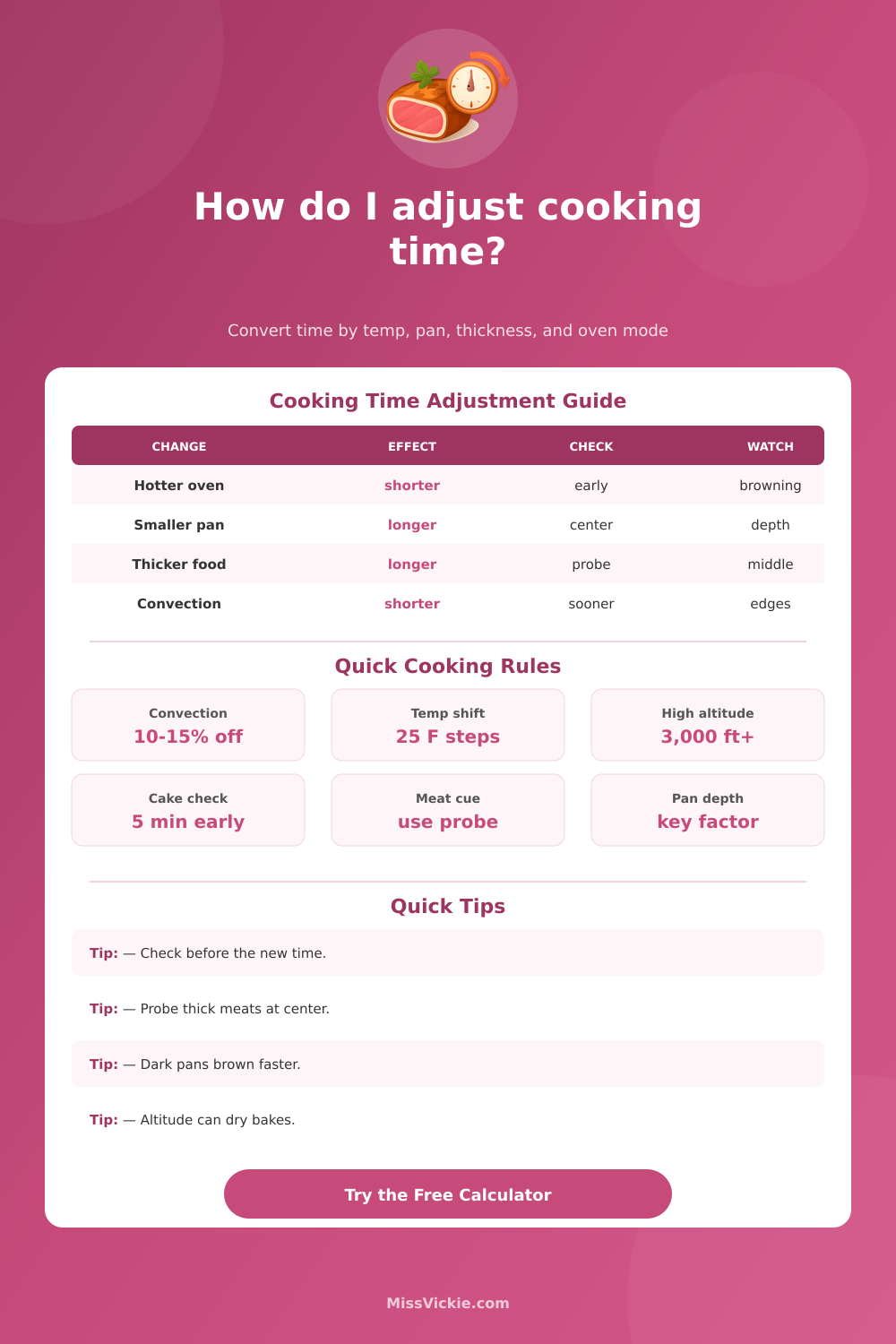
| 325 F to 350 F | Hotter by 25 F | About 5-10% shorter | Start checking early, watch browning |
| 350 F to 375 F | Hotter by 25 F | About 6-12% shorter | Shield edges if they color fast |
| 375 F to 350 F | Cooler by 25 F | About 8-15% longer | Wait for center set, not just color |
| 400 F to 350 F | Cooler by 50 F | About 15-25% longer | Expect paler tops and slower crisping |
| Convection same temp | Fan-assisted heat | About 10-15% shorter | Rotate if edges brown unevenly |
| Convection lowered 25 F | Gentler fan bake | Often close to recipe time | Use normal cues but check early |
The same batter or food sits deeper, so the center heats more slowly.
A thinner layer cooks faster, but edges may dry or brown sooner.
Thickness has a stronger effect than surface area for meat and potatoes.
Moisture evaporates faster, so baked goods need closer checking.
| Adjustment | Typical Effect | Calculator Factor | Kitchen Cue |
|---|---|---|---|
| Dark metal pan | Faster browning at edges | Slightly shorter | Check color before center is done |
| Glass baking dish | Holds heat after removal | Slightly shorter | Use carryover and avoid overbaking |
| Silicone mold | Slower browning and heat transfer | Slightly longer | Look for a fully set center |
| Tight cover or lid | Moister heat, slower browning | Longer | Uncover near end if browning matters |
| Crisper target | Extra browning or crust | Longer | Use color and texture cues |
| Moist target | Stop before full firm set | Shorter | Account for carryover heat |
The formula blends practical cooking heuristics rather than replacing food safety guidance. For poultry, meat, seafood, and leftovers, verify safe internal temperature with a thermometer.
When a cooking time is provided for a recipe, that cooking time is an guideline for the food. However, various factor can change how that cooking time may apply to the food that you are preparing and your specific oven. If you change the size of the pan in which you cook the food, if you change the cooking temperature, or if you change the altitude at which you are cooking the food, the guideline cooking time for that recipe may no longer be accurately.
Thus, you may end up with either undercooked or overcooked foods. To account for these different variable, cooking time calculators is available for cooks to use. These cooking time calculators allow cooks to input the different variables for a given recipe (such as the shift in cooking temperature, pan area, food thickness, oven mode, cover style, altitude, and desired doneness) to calculate the new cooking time required to achieve the same results then the original cooking time guideline for that recipe.
How to Use a Cooking Time Calculator
Thus, cooks can use these calculators to avoid having to calculate these variables themselves. One of the variables that can change the cooking time for a recipe is the cooking temperature of the oven. If you increase the cooking temperature, the outer layer of the food will cook more faster than if the food were cooked at the original temperature, and the center of the food may reach the desired cooking temperature before the surface of the food begin to brown.
Conversely, if the cooking temperature is decreased, the cooking period will need to be lengthened to allow for the cooking of the food to be even. These two different temperatures can be input into the cooking time calculator to determine the new cooking time required to prepare the food. The size of the pan in which the food is cooked can also impact the cooking time.
If you place the same amount of food into a smaller pan, the thickness of the food will increase, which will lead to longer cooking times. If you place the same amount of food into a larger pan, the thickness of the food will decrease, leading to shorter cooking times. These pan area and food thickness variables can be entered into the cooking time calculator.
The thickness of the food also has a significant impact upon cooking time. For foods like chicken breast or potatoes, even a small change in thickness can lead to changes in cooking time that add or subtract many minutes from the original cooking time guideline. Thus, cooking time calculators ask for cooks to enter the thickness of the food into the cooking time calculator.
Additionally, cooks should enter cooking time to allow for cooking to be checked early in the cooking process if the thickness of the food to be prepared is thicker than that described in the original recipe. Additional variables to consider include cooking mode and cooking cover style. If the fan circulates the hot air around the food in a convection oven, it will shorten the cooking time.
Additionally, if the pan is covered in the oven, the steam will make the cooking time for food like casseroles even more longer. These variables can also be entered into the cooking time calculator. The altitude at which the food is prepared can also have an impact upon cooking time.
At higher altitudes, the air pressure of the environment is lower. At lower air pressures, water molecules in foods such as cakes will evaporate at a faster rate. This can lead to the batter of cakes setting before they have had time to rise.
Because of this, cooking time calculators apply an upward adjustment to cooking time for altitudes above 1,000 feet. Finally, cooks can adjust the doneness level of the food using cooking time calculators. For instance, some cooks prefer there brownies to have a soft center while others prefer their baked goods to have a crisp surface.
The desired doneness can be entered into the cooking time calculator. Additionally, cooking time calculators provides cooks with a range of cooking times rather than a specific number. Thus, cooks know that the cooking time guidelines are an estimate only and account for the fact that the calculators are planning tools only.
It is also important for cooks to consider the cooking time guidelines provided for a recipe as a starting point for cooking times. Beyond entering the specifics of the food and its thickness into the cooking time calculator, cooks should also use different methods to determine if the food is fully cooked. These methods might include inserting a food thermometer into the center of food that is cooking (like chicken), using a skewer to stab the center of potatoes, or knowing that cake batter should become a clean pick when fully cooked.
These methods are the final way to determine if food is properly cook. Since cooks may change several variables for a recipe at once, cooking time calculators can also calculate the effect of these several changes at once. Additionally, cooks should always check the food early in the cooking process when using dark pans, in a convection oven, at higher temperatures, or when cooking thinner food.
Checking the food during the low end of the cooking time suggested by the cooking time calculator will ensure that the food is not cooked too dry or too darkly when prepared.