Gammon Roast Cooking Time Calculator
Plan a gammon joint by weight, smoked or unsmoked cure, simmer and roast method, soak time, glaze phase, target temperature, rest time, and carved yield.
Pick a realistic joint and serving plan, then adjust the cure, oven, glaze, soak, and doneness target for your kitchen.
Your Gammon Roast Timeline
Adjust the inputs and calculate to build a phase-by-phase plan.
| Raw Weight | Simmer + Roast Plan | Roast-Only Plan | Typical Rest |
|---|---|---|---|
| 2-3 lb / 0.9-1.4 kg | 45-65 min simmer, 20-30 min roast or glaze | 55-80 min covered roast, then glaze | 15 min |
| 4-5 lb / 1.8-2.3 kg | 85-115 min simmer, 25-40 min roast or glaze | 1 hr 35 min-2 hr 15 min roast | 18-20 min |
| 6-7 lb / 2.7-3.2 kg | 2 hr-2 hr 45 min simmer, 35-50 min roast | 2 hr 20 min-3 hr 15 min roast | 20-25 min |
| 8-10 lb / 3.6-4.5 kg | 2 hr 50 min-3 hr 55 min simmer, 45-65 min roast | 3 hr 20 min-4 hr 45 min roast | 25 min |
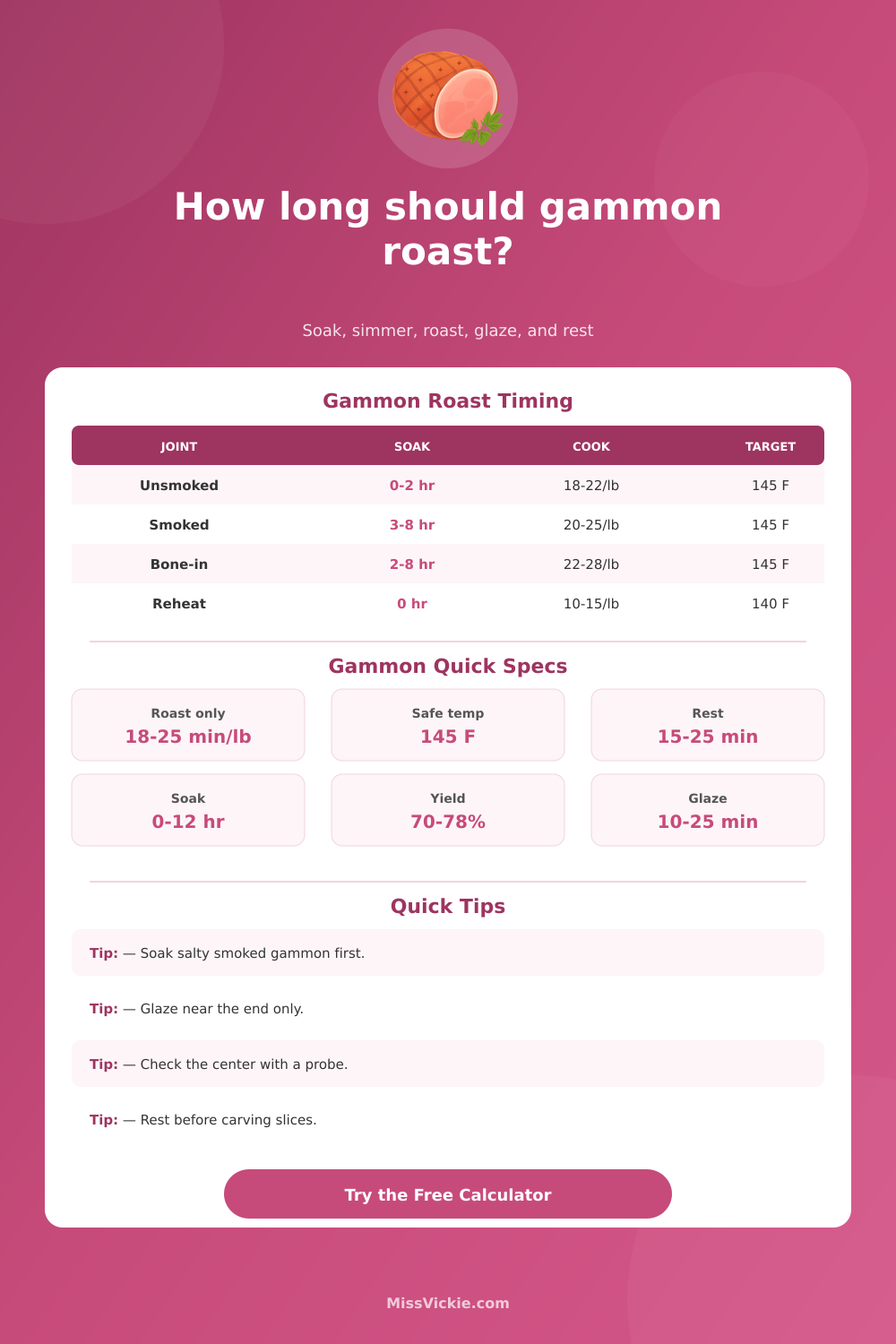
Use this table as a cross-check. The calculator adjusts further for cure saltiness, cut shape, oven temperature, glaze style, and starting temperature.
| Cure Style | Recommended Soak | When to Extend | Cooking Note |
|---|---|---|---|
| Unsmoked mild cure | 0-2 hours, or a rinse only | Extend if the package says soak or if the joint tastes very salty after a test trim. | Fastest timing and cleanest pork flavor. |
| Lightly smoked | 1-4 hours in cold water | Extend for larger rolled joints or salt-heavy supermarket cures. | Keep glaze moderate so smoke stays balanced. |
| Smoked gammon | 3-8 hours, changing water once | Use overnight for thick or strong-smoked joints. | Add a small simmer buffer because cured smoke can firm the surface. |
| Extra salty or country-style | 8-24 hours, changing water | Extend when cooking for low-salt eaters or buffet service. | Soak first, then simmer gently before glazing. |
Gentle simmer cooks the center, then the oven sets glaze and browns the outside.
Covered roasting keeps moisture in, but thicker joints need more careful temperature checks.
Useful for sandwiches and cold platters when a sticky glaze is not needed.
For fully cooked ham, plan a lower target when the source is inspected and reliable.
| Target | Use For | Texture | Rest / Yield Note |
|---|---|---|---|
| 140°F / 60°C | Reheating fully cooked inspected ham | Moistest reheated slices | Rest 10-15 minutes; do not use for raw cook-before-eating gammon. |
| 145°F / 63°C | Cook-before-eating gammon or fresh ham | Juicy, slightly firmer cured pork | Rest at least 3 minutes for safety; larger joints carve better after 15-25 minutes. |
| 150°F / 66°C | Neater hot slices | Firm, easy carving | Expect a little more shrink than a 145°F finish. |
| 160-165°F / 71-74°C | Well-done texture or reheating unknown-source leftovers | Firmest and driest | Rest well and slice thinly to protect tenderness. |
| Phase | What It Does | Common Range | Calculator Adjustment |
|---|---|---|---|
| Soak | Pulls excess salt from the cure before heat is applied. | 0-24 hours | Based on smoked or unsmoked cure, weight, and selected soak plan. |
| Simmer | Gently cooks the center while keeping the joint moist. | 18-28 min/lb | Adjusted for cut, cure saltiness, shape, and starting temperature. |
| Roast | Sets the surface and finishes cooking in dry heat. | 10-28 min/lb | Adjusted for oven temperature and whether simmering happened first. |
| Glaze | Caramelizes sugar after the meat is mostly cooked. | 0-25 minutes | Based on none, light, classic, or sticky glaze finish. |
| Rest | Lets juices settle and makes carving cleaner. | 10-30 minutes | Based on weight, bone, and target slice quality. |
Cooking a gammon joint require several decisions. The properties of a gammon joint differs depending on its weight and the cure of the gammon joint. You must decides how many people you are feeding and whether the gammon joint will be smoked or unsmoked.
Furthermore, the cook can simmer the gammon joint first or roast it throughout the cooking process. Using a planning tool for cooking a gammon joint will help you to make these decisions and turn them into a timeline for cooking you gammon joint. The calculator will ask for weight of the gammon joint, the style of the cure, the cooking method, and the target temperature.
How to Plan and Cook a Gammon Joint
The weight of the gammon joint will affects cooking time. Smoked gammon joints requires a buffer in the cooking process because of the firmer surface of the meat. Bone-in gammon joints will cook more differently than boneless joints, and the calculator will adjust for this.
Finally, the starting temperature of the joint will affect cooking time. Cold joints will take longer to cook than those at room temperature. Another step is soaking the gammon joint to remove excess salt from the cure of the gammon joint.
Skipping this step are an option, but it is helpful to soak the joint prior to cooking. The length of the soak will depend on the cure of the gammon joint. Mild unsmoked joints may only need be rinsed, but heavily smoked joints may need to soak in cold water for several hour or overnight.
The calculator has these plans preset so that you dont have to remember these times. However, the calculator cannot taste the joint, so you must taste a piece after soaking to ensure the salt level is to your liking. The joint can be simmered first or it can be roasted from a raw state.
Simmering will cook the center of the joint and keep the meat moist. Roasting the joint will sear the gammon joint and require more attention to the cooking process. These options are available on the planning tool so that you can see how cooking method will affect the total time to cook the joint.
Glazing the gammon joint requires careful consideration of cooking time because sugar will burn quick if exposed to heat in the oven. The calculator will separate the glaze time from the cooking time for the joint. A light glaze requires less time to glaze than a thick glaze.
Finally, glazing should occur after the joint is cooked to the desired temperature, as glazing at the beginning could result in the glaze scorch in the oven. Resting a gammon joint after it is cooked allows the muscle fibers in the joint to relax. As the joint cools, the juices will move toward the outer portion of the joint.
By resting the joint, the juices will redistribute within the joint, resulting in cleaner slice when carving the gammon joint. The calculator will incorporate time for resting the joint based on the weight and cut of the joint. The amount of edible meat that will be obtained from the joint is referred to as the yield.
The yield of a bone-in joint will be less than a boneless joint. Additionally, the cut of the joint will affect the amount of edible meat. The calculator will estimate the yield based on the cut of the joint.
This will allow you to calculate how many person the joint will serve. If you enter the number of portions that you need, the calculator will provide an estimate of how many portions each person will receive. The calculator will provide you with a plan to cook your gammon joint based on the parameters that you enter.
However, always use a meat thermometer to measure the internal temperature of the joint. The oven temperature may differ from the desired temperature settings for the oven. Using a thermometer will allow you to ensure that the gammon joint has cooked to the correct temperature.
These reference tables are an additional tool that you can use to verify the calculations that the calculator provided for you. While the reference tables will provide you with an idea of the weights of gammon joints, the calculator is the main tool that you will use to create a timeline to cook your gammon joint. Following the timeline that the calculator provides for you will allow you to successfully cook your gammon joint.