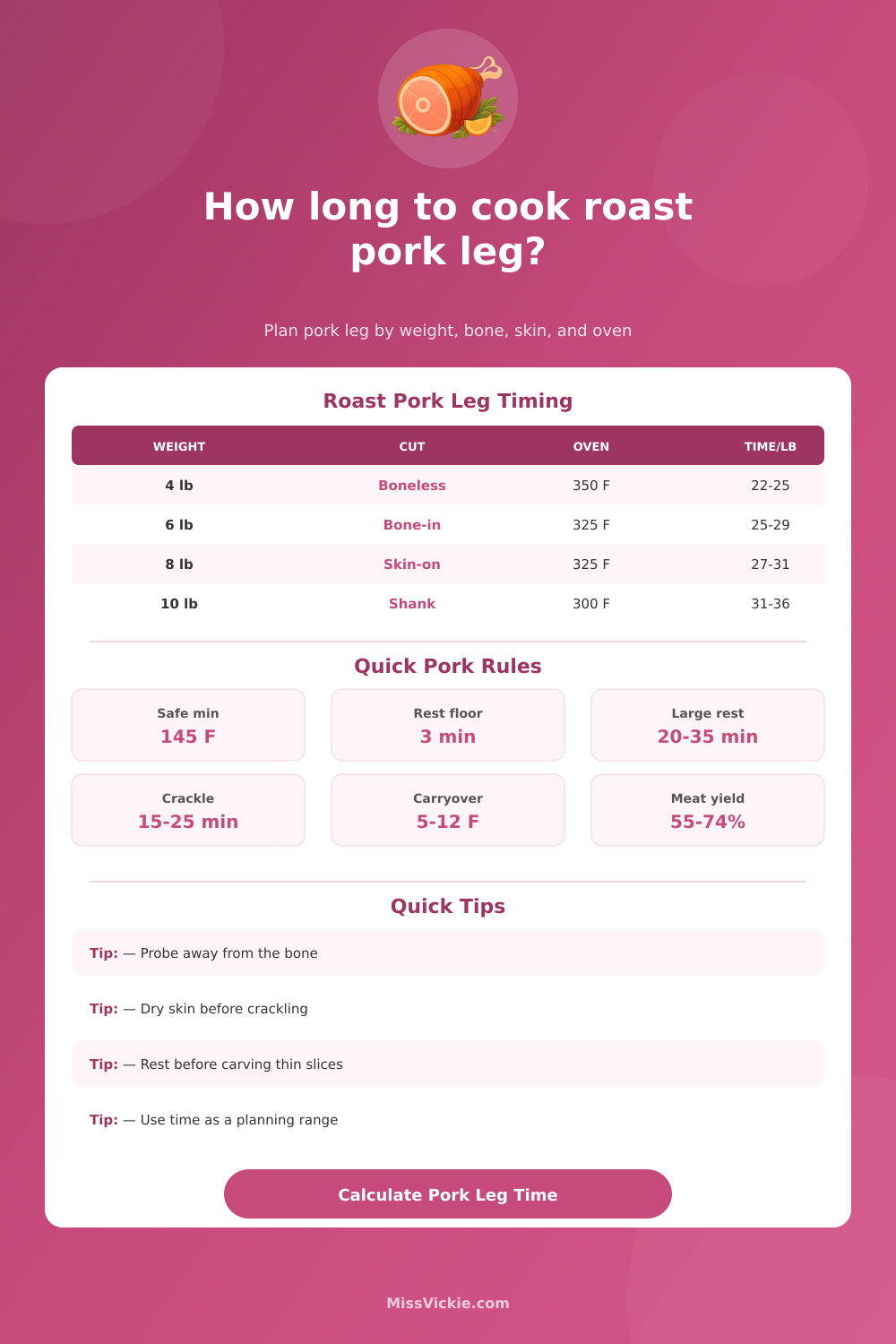
Roast Pork Leg Cooking Time Calculator
Estimate roast pork leg timing from weight, bone-in style, skin and crackling phase, oven temperature, target temperature, rest, carryover heat, and carved yield.
Choose a realistic starting point, then adjust the weight, cut style, oven, crackling phase, rest, and target finish. Time is a planning range; use a thermometer in the thickest meat away from bone.
Pork Leg Timing Breakdown
| Main Oven | Boneless Rolled | Bone-In Center Leg | Skin-On / Shank End | Best Use |
|---|---|---|---|---|
| 275°F | 29 to 34 min/lb | 32 to 37 min/lb | 35 to 41 min/lb | Gentle roast, lower moisture loss |
| 300°F | 26 to 30 min/lb | 28 to 33 min/lb | 31 to 36 min/lb | Large pork leg with steady heat |
| 325°F | 23 to 27 min/lb | 25 to 29 min/lb | 27 to 32 min/lb | Classic roast pork leg timing |
| 350°F | 20 to 24 min/lb | 22 to 26 min/lb | 24 to 29 min/lb | Smaller legs and weeknight roasts |
| 375°F | 18 to 22 min/lb | 20 to 24 min/lb | 22 to 27 min/lb | Quicker roast with closer checking |
Times are planning estimates for whole pork leg roasts. Shape, oven accuracy, pan depth, and starting temperature can move the actual finish time.
| Choice | Added Time | Temperature Effect | Yield Effect | Use When |
|---|---|---|---|---|
| No rind | 0 min | Main oven only | Least surface loss | Boneless or trimmed pork leg |
| Scored dry skin | 0 to 5 min | Depends on main oven | Moderate shrink | Skin is already dry and salted |
| 450°F start | 22 to 25 min | Early skin blistering | More fat render | Best all-purpose crackling plan |
| 425°F finish | 14 to 18 min | Late surface heat | Slightly drier edge | Skin needs color near the end |
| Broiler finish | 6 to 10 min | Very fast surface heat | Watch closely | Use only with careful monitoring |
| Finish Temp | Texture | Pull Guidance | Rest | Serving Notes |
|---|---|---|---|---|
| 145°F | Juicy, slightly pink | Pull no lower than 145°F | At least 3 min | USDA minimum for whole pork roasts |
| 150°F | Lightly pink | Pull 145°F or above | 10 to 25 min | Good balance for dinner slices |
| 155°F | Mostly cooked through | Pull around 147 to 150°F | 15 to 30 min | Firmer texture with less blush |
| 160°F | Firm slices | Pull around 150 to 154°F | 20 to 35 min | Traditional well-cooked roast pork |
| 165°F | Well done | Pull around 154 to 160°F | 20 to 35 min | Use extra pan juices when serving |
Cooking a pork leg roast require careful timing due to the muscle and connective tissue contents of the pork leg roast. A pork leg roast contain muscle and connective tissue, so it requires some steady heat and patience to properly cook the roast. If a person cooks the pork leg roast without using a correct amount of time, the roast can end up dry.
To avoid using guesses regarding the cooking time for the pork leg roast, a planning calculator can be use. The planning calculator allow a person to input information regarding the pork leg roast so that the recipe calculates the cooking time. The weight of the pork leg roast is one of the factors that can be entered into the planning calculator.
How to plan cooking time for a pork leg roast
The weight of the pork leg roast will determine cooking time for the roast. For instance, a four-pound boneless pork leg roast will cook differently then an eight-pound bone-in pork leg roast. The cut of pork leg roast will have different cooking times for the bone-in pork leg roast compared to a boneless pork leg roast.
The planning calculator include a factor for the cut of pork leg roast that is selected, so the cooking times will account for both the weight of the pork leg roast and how the bone in the roast will impact the even cooking of the roast. Another factor that will impact the time that it takes to properly cook the pork leg roast is the temperature of the oven in which the pork leg roast will be cooked. Using a lower oven temperature will allow the pork leg roast to retain more moisture during the roasting process; however, it will take longer for the pork leg roast to cook to the proper doneness.
Using a higher oven temperature will cook the pork leg roast to doneness in a shorter period of time; however, the cooking time will be more limited before overdone results. Using the planning calculator, a person can select the oven temperature that they would like to use to cook there pork leg roast. A reference table can also be use to see the cooking times for different oven temperatures.
Additional factors that will impact the cooking time for the pork leg roast include the skin and crackling that will be created on the roast. If the pork leg roast is to be crackled, it will need to be cooked on high heat. Using high heat during the crackling process will reduce the final yield of the roast.
Planning calculators includes the percentage of pork leg roast that will be lost to crackling to the estimation of the total number of portions of pork leg roast that will be served. Planning calculators also separate the time for crackling from the cooking time to allow a person to see how the crackling will increase the total time needed to cook the roast. Other variables for the pork leg roast that can be entered into the planning calculator include the starting temperature of the roast and the pan in which it will cook.
If the pork leg roast starts at the refrigerator temperature, it will take longer to reach the target cooking temperature. If the roast is allowed to sit on the counter for the pork leg roast to come to room temperature, it will reach the target cooking temperature in a shorter amount of time. Using a deep pan for roasting will slow the roast because the deep pan will affect the amount of air that can surround the roast.
These variables are entered as multipliers to the cooking time because the effect of each of these factors is greater with pork leg roasts of increasing weights. The planning calculator will not provide a specific number for cooking time. Instead, the planning calculator will provide a range of time that is needed to properly cook the pork leg roast.
Because cooking ranges will vary from oven to oven and because the thickness of the roast will vary, the time range will allow for the pork leg roast to rest after cooking. Allowing the roast to rest will allow the temperature of the roast to even out and allow the juices to settle within the roast. The longer that the pork leg roast rests, the longer that the resting period should of been allowed if the amount of pork leg roast is large.
In contrast, shorter resting periods is required for smaller roasts. Yields are also calculated with the planning calculator using the same information that is used to calculate cooking time. Depending on the cut of pork leg roast, yields will be different for bone-in pork leg roasts versus boneless pork leg roasts.
The percentage of the pork leg roast that will yield usable pork will be factored into the calculation of the number of portions of pork leg roast that will be prepared from the roast. This number will help a person to decide whether or not the pork leg roast will provide enough protein for their guests. One of the main values of using a planning calculator for pork leg roasts is that it removes the uncertainty that is associated with the cooking time of the pork leg roast.
By noting the calculated start time for the pork leg roast, a person can adjust their schedule to ensure that the roast will be ready at the time that they would like to serve the roast. The time range will provide some flexibility in case of unexpected cooking issues. If the time range is too narrow for the cooks schedule, the cook can push the start time further into the future by adding buffer minutes to the cooking time.
Alternatively, the cook can move the start time forward by using a lower cooking oven temperature. Each of the variables can be manipulated with the planning calculator and the cooking time and yield can be observed for changes. These changes will provide a person with an understanding of how the selected variables will impact the pork leg roast prior to beginning to cook the roast.