Top Round Roast Cooking Time Calculator
Estimate cooking time, pull temperature, carryover, resting window, and slicing yield for lean top round roast using weight, thickness, oven temperature, doneness, shape, sear method, and starting temperature.
Pick a common roast scenario, then adjust the measurements and finish style for your oven and thermometer.
Roast Time Estimate
Calculated timing appears here.
Timing Breakdown
Carryover and Slicing Notes
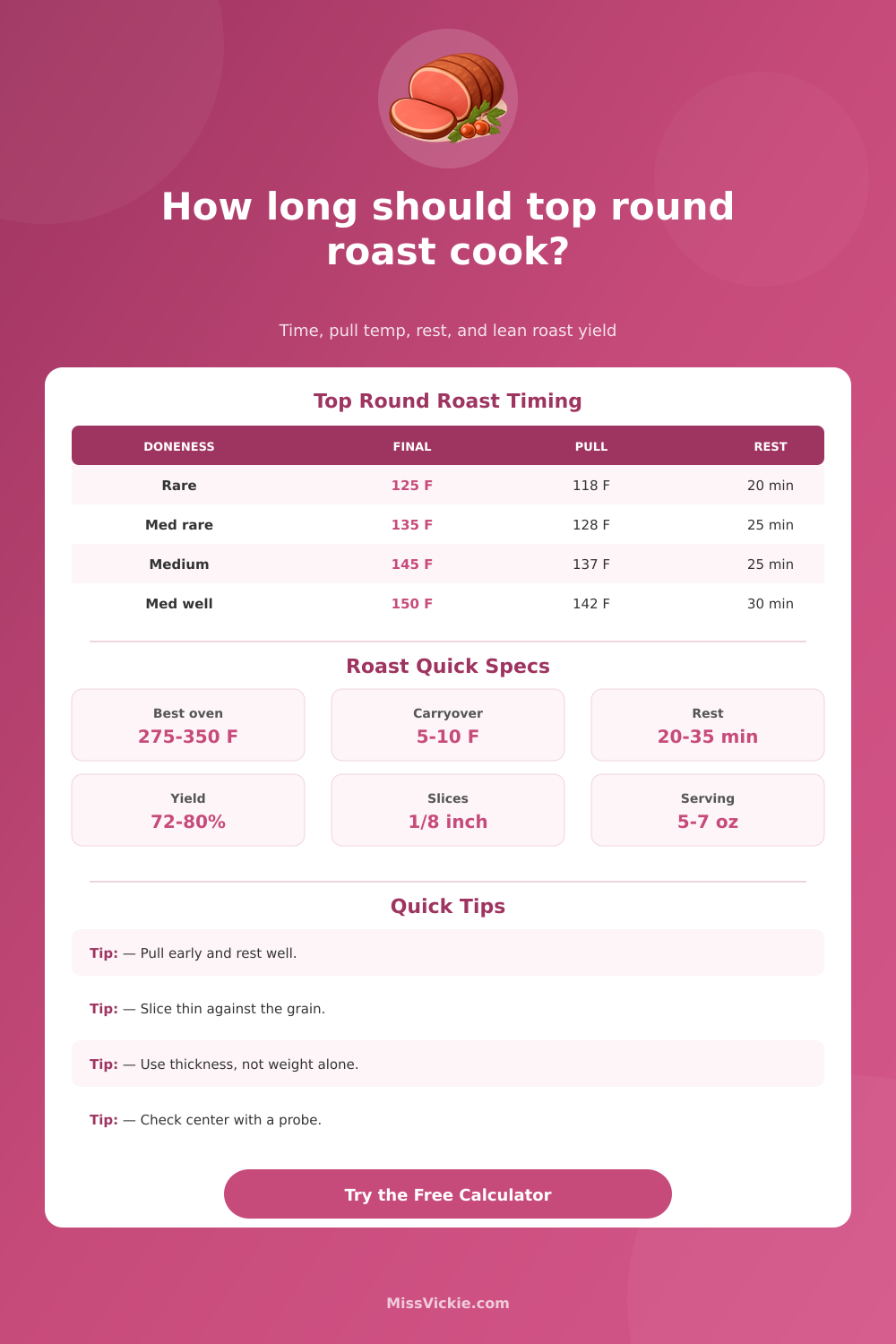
| Doneness | Final Center Temp | Typical Pull Temp | Best Use | Lean Roast Note |
|---|---|---|---|---|
| Rare | 125 F / 52 C | 116 to 120 F | Deli-style roast beef | Most tender, needs very thin slicing |
| Medium rare | 135 F / 57 C | 126 to 130 F | Classic dinner roast | Good balance of color, juiciness, and sliceability |
| Medium | 145 F / 63 C | 136 to 140 F | Family roast with less pink | Use gravy or pan juices because top round is lean |
| Medium well | 150 F / 66 C | 141 to 145 F | Minimal pink slices | Cook gently and avoid holding hot for long |
| Well done | 160 F / 71 C | 151 to 154 F | Fully cooked preference | Slice extra thin and serve with moist sauce |
| Main Oven Temp | Timing Character | Approx Min Per Lb | Carryover Tendency | Best For |
|---|---|---|---|---|
| 225 F / 107 C | Slow and even | 32 to 42 | Low, about 4 to 6 F | Reverse sear, deli slices, very even color |
| 275 F / 135 C | Gentle roast | 26 to 34 | Moderate, about 5 to 7 F | Lean roasts where tenderness matters |
| 325 F / 163 C | Standard roast | 21 to 29 | Moderate, about 6 to 9 F | Weeknight and holiday top round |
| 350 F / 177 C | Faster roast | 19 to 26 | Moderate-high, about 7 to 10 F | Smaller roasts with careful temp checks |
| 425 F / 218 C | Hot roast | 14 to 20 | Higher, about 8 to 12 F | Short browning phase, not the whole cook |
Minute-per-pound ranges assume a 3 to 5 lb top round roast and must be adjusted for thickness, shape, starting temperature, and target doneness.
Uses one moderate temperature and is easiest to schedule for family dinner.
Starts hot for surface color, then finishes lower to protect the lean center.
Low oven first, then a hot finish for the most even pink band and clean slicing.
Reduces drying early, then uncovers near the end for better surface texture.
| Raw Top Round | Expected Cooked Yield | Thin Dinner Servings | Deli Slice Servings | Planning Note |
|---|---|---|---|---|
| 2.5 lb / 1.1 kg | 1.8 to 2.0 lb | 4 to 5 | 6 to 8 | Small roast; temperature rises quickly near the end |
| 4 lb / 1.8 kg | 2.9 to 3.2 lb | 6 to 8 | 10 to 12 | Common family roast size |
| 6 lb / 2.7 kg | 4.3 to 4.8 lb | 10 to 12 | 15 to 18 | Check both ends because shape often varies |
| 8 lb / 3.6 kg | 5.8 to 6.4 lb | 14 to 16 | 20 to 24 | Use a probe and allow a longer rest |
| 10 lb / 4.5 kg | 7.2 to 8.0 lb | 18 to 22 | 26 to 30 | Often better split into two roasts for even doneness |
| Slice Style | Approx Thickness | Serving Weight | Texture Effect | Best Use |
|---|---|---|---|---|
| Deli thin | 1/16 inch | 3 to 4 oz | Most tender bite | Sandwiches and cold roast beef |
| Thin dinner | 1/8 inch | 5 to 6 oz | Tender if cut across grain | Main plate with jus or gravy |
| Medium slices | 1/4 inch | 6 to 8 oz | Chewier but hearty | Family roast platters |
| Thick slices | 3/8 inch | 8 oz plus | Can feel firm because top round is lean | Only for very tender, lower-temp roasts |
Top round roast is a lean cut of meat and an affordable cut of beef for many people. Because top round roast is very lean in it’s composition of fat, top round roast have the potential to become dry if it isnt cooked correctly. Beyond considering the weights of the roast when preparing to cook the top round roast, the weight of the roast isnt the only factor to consider in the cooking process.
Thickness is also a major factor in cooking a top round roast. A top round roast that is long and narrow will cook faster then a top round roast that is compact in shape and oval in the cross-section of the roast. The difference in cooking times is due to the fact that the heat will reach the center of the long, narrow roast more quick than it will travel to the center of the compact top round roast.
How to Cook a Top Round Roast
A cooking time calculator can help to account for the thickness of the roast in addition to the weight of the roast to allow the cook to accurately determine the cooking time of the roast. Oven temperature is another factor that will impact the cooking process of the top round roast. If you use a low oven temperature to heat the top round roast, the roast will cook more even and the center of the roast will reach the target cooking temperature.
Furthermore, using a low oven temperature will result in less carryover cooking of the roast. However, using a low oven temperature will increase the length of time that it take to cook the top round roast to the target temperature. In contrast, using a high oven temperature will allow the top round roast to cook to the target internal temperature in a shorter period of time.
Furthermore, the high temperature will result in the development of more brown crust on the roast. However, high cooking temperatures increase the chance that the exterior of the roast will become overcooked before the roast reach the target internal cooking temperature. The starting temperature of the top round roast is an important factor that many cook consider.
If you take the roast directly from the refrigerator, it will take longer for the center of the roast to reach the target cooking temperature. However, if you allow the roast to sit out on the counter for one hour prior to cooking, the roast will reach the target cooking temperature more quickly. Furthermore, many cooks find that tempering the roast (allowing it to stand out at room temperature for a period of time) before cooking help to prevent drying out of the roast.
Another factor to consider with cooking a top round roast is allowing the roast to rest after cooking. Because top round roast is very lean in its composition of fat, it will continue to rise in internal temperature after the cook has removed the roast from the oven. This phenomenon is referred to as carryover cooking.
If the roast is allowed to rest in the oven past the target cooking temperature, the roast will cook past the target temperature which will dry the roast. If you remove the top round roast from the oven too early, the roast may feel tight when slice. The final step in cooking a top round roast is to slice the roast correctly.
The roast should be sliced into thin slice that are cut across the grain of the roast. Slicing the roast across the grain will make the roast feel tender when eaten which is the desired outcome. Many cooks make the mistake of treating a top round roast like a fat cut of meat which it isnt.
Common mistakes in preparing a top round roast can be avoided by measuring the internal temperature of the roast early in the cooking process. The cook should measure the internal temperature of the roast with a probe that is inserted into the thickest part of the roast. If the temperature is rising at a rapid rate, it is possible to lower the cooking temperature or to remove the roast from the oven.
If the rate of rising temperature of the roast is slow, the roast can be left in the oven for an additional period of time. Thus, by measuring the internal temperature of a roast, cooks can avoid over or undercooking the roast.