
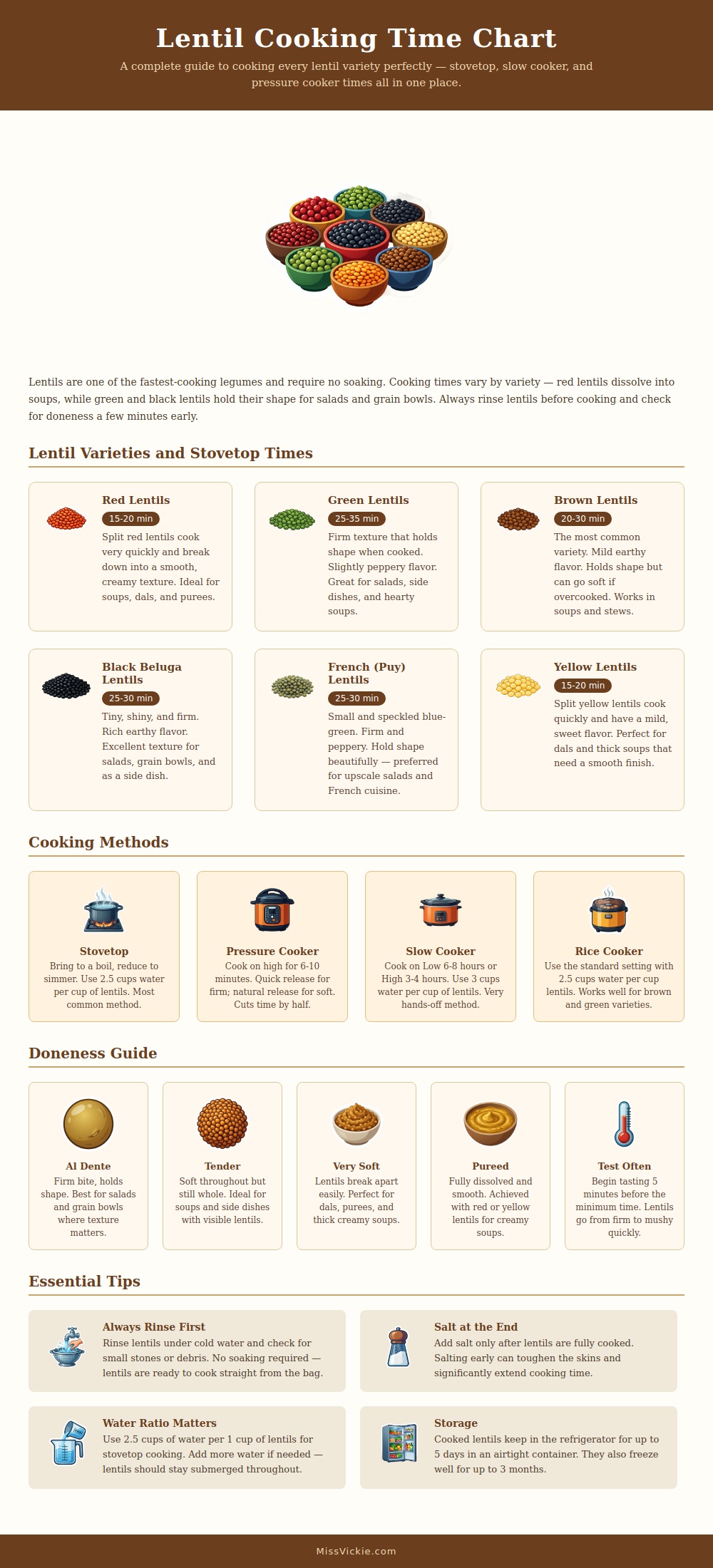
Lentils are a type of legume that can be cooked in a variety of ways depending on the variety of lentil that is being used. Lentil varieties can be split or they can be whole lentils. Lentil varieties that tend to be split include red lentils and yellow lentils.
Because red lentils and yellow lentils are split, these types of lentils tends to cook very quickly. Additionally, because these lentil varieties is split, their starches releases quickly when they are cooked. Red lentils and yellow lentils tend to become soft and creamy when they are cooked.
Lentil Types and How to Cook Them
Other varieties of lentils, such as green lentils, brown lentils, and black lentils tend to be whole lentils. Because green lentils, brown lentils, and black lentils are whole lentils, they have an outer seed coat that prevents the water from immediately reaching the center of the lentil. For these reasons, green lentils, brown lentils, and black lentils take longer to cook then split lentil varieties.
Cooking lentils can be done with a variety of appliances, each of which takes a different length of time to cook the lentils. For instance, a pressure cooker will greatly reduce the time that it takes to cook lentils. For example, green lentils may take thirty minutes to cook on the stove, but they may only take ten minutes in a pressure cooker.
Slow cookers, on the other hand, will take more time to cook lentils than a stove top or pressure cooker. You can use the different cooking methods for lentils depending off the amount of time that you has to cook the lentils. The salt that is added to lentils should be added at a specific time during the cooking of the lentils.
If salt is added to lentils at the beginning of the cooking process, the salt can draw moisture out of the outer seed coat of the lentils, making the lentils feel leathery. If salt is added to lentils only after they have been boiled, the salt will season the lentils without adversely affecting the structure of the lentils. Before cooking lentils, it is recommended that the lentils are rinsed under cold water.
This step helps to remove any dust or small stones that may be on the lentils, and it allows the person who is preparing the lentils to inspect each lentil for any damage. Because lentils dont require an overnight soak in water, rinsing the lentils is the only preparatory step that is generally necessary prior to cooking lentils. Cooked lentils can have a variety of textures.
For instance, lentils can be cooked until they are al dente, meaning they are firm to the bite. Because they are firm, people often use al dente lentils in salads. Cooked lentils can also be prepared until they are tender, meaning they are soft but remain intact as whole lentils.
These lentils is often used in side dishes or soups. Lentils can also be cooked until they are very soft to the bite. Very soft lentils are often used in lentil purees or thick soups.
In each of these instances, lentils will change from one texture to another very quickly, so you should take care in the cooking process. Cooked lentils can be stored in the refrigerator or they can be frozen. Cooked lentils will generally remain good in the refrigerator for several days.
Cooked lentils can be reheated, though the lentils may lose some of their texture when reheated. For best texture, you should portion cooked lentils before they are frozen. When reheating lentils that have been frozen, some water or broth may need to be added to the lentils since the lentils may have tightened in texture while they were cold.
Finally, using a cooking time chart ensures that you will not guess at the time that it will take to cook lentils; the chart will provide a baseline for the cooking time of lentils of each variety.