Sirloin Tip Roast Cooking Time Calculator
Estimate sirloin tip roast oven time from weight, triangular roast shape, oven temperature, doneness, sear method, starting temperature, rest, and expected carryover heat.
Choose a starting roast plan, then tune the weight, shape, oven, doneness, sear, and rest. Sirloin tip is lean, so thermometer checks matter more than the clock.
Sirloin Tip Roast Plan
Adjust the inputs to calculate a roast window.
Inputs and Timing
Formula Adjustments
| Oven Temperature | Medium-Rare Tip Roast | Medium Tip Roast | Best Use |
|---|---|---|---|
| 225°F / 107°C | 36 to 44 min/lb | 40 to 48 min/lb | Reverse sear, most even rosy center |
| 250°F / 121°C | 32 to 38 min/lb | 36 to 42 min/lb | Gentle low roast for lean cuts |
| 275°F / 135°C | 28 to 34 min/lb | 32 to 38 min/lb | Large roasts or holiday schedule |
| 300°F / 149°C | 24 to 30 min/lb | 28 to 33 min/lb | Balanced moisture and browning |
| 325°F / 163°C | 20 to 24 min/lb | 24 to 29 min/lb | Classic sirloin tip roast timing |
| 350°F / 177°C | 18 to 22 min/lb | 22 to 26 min/lb | Smaller weeknight roasts |
| 375°F / 191°C | 16 to 20 min/lb | 19 to 23 min/lb | Fast roast, check tapered end early |
| 400°F / 204°C | 14 to 18 min/lb | 17 to 21 min/lb | Small lean roasts with close monitoring |
| Doneness | Finish Temperature | Typical Pull Range | Sirloin Tip Note |
|---|---|---|---|
| Rare | 125°F / 52°C | 118 to 121°F | Below USDA roast minimum; tender but very red |
| Medium-rare | 135°F / 57°C | 128 to 131°F | Juicy slices when carved thinly across grain |
| Medium | 145°F / 63°C | 137 to 141°F | USDA minimum finish after rest for beef roasts |
| Medium-well | 155°F / 68°C | 148 to 151°F | Firmer slices; use gravy or pan juices |
| Well done | 160°F / 71°C | 154 to 157°F | Check early because lean sirloin tip dries quickly |
| Factor | Typical Adjustment | Why It Matters | Calculator Effect |
|---|---|---|---|
| Typical triangular tip | Baseline | One thicker end and one tapered side cook unevenly | Uses standard sirloin tip pace |
| Long tapered roast | 8 to 12% faster | More surface area and thin end heat quickly | Shortens time and check window |
| Compact thick roast | 10 to 16% slower | Center is farther from hot oven air | Adds time and carryover |
| Tied round roast | 6 to 10% slower | Uniform round shape increases heat travel depth | Adds moderate time |
| Wet marinade surface | 3 to 7% slower browning | Moisture must evaporate before crust forms | Adds small surface factor |
| Longer rest | More carryover | Exterior heat keeps moving into the center | Lowers pull target slightly |
| Slice Style | Raw Weight Per Serving | Cooked Yield | Best For |
|---|---|---|---|
| Thin slices | 6 to 7 oz raw | About 72% after roast | Lean dinner plates, gravy, or buffet carving |
| Dinner slices | 8 oz raw | About 70% after roast | Classic family meal portions |
| Thick slices | 10 to 12 oz raw | About 68% after roast | Steak-like plating from the thick end |
| Sandwich slices | 4 to 5 oz raw | About 72% after roast | Chilled roast beef sliced very thin |
Sirloin tip is a lean cut from the round. Slice across the grain, and keep the tapered end in mind when checking temperature.
Fast enough for weeknights, but the thin end can overshoot while the center finishes.
Most predictable at 300 to 350°F with a 15 to 25 minute rest.
Cooks more evenly than a loose triangular roast but needs a little more time.
Best for even color, then a hot finish builds crust without overcooking the center.
A sirloin tip roast is a lean cut of meat. Because a sirloin tip roast roast requires careful planning regarding teh cooking time, a cooking time calculator can assist cook in determining the cooking time of a sirloin tip roast roast. A sirloin tip roast roast requires consideration of four main factor: the shape of the roast, the oven temperature, the starting temperature of the roast, and the desired doneness of the roast.
A cooking time calculator can factor in these variable and provide an estimate of the cooking time. The shape of the sirloin tip roast roast is one of the most important variables in determining the cooking time for the roast roast. The shape of the roast can change the cooking time because areas of the roast that are thin will reach the desired temperature more fast than areas of the roast that are thick.
How to Use a Cooking Time Calculator for Sirloin Tip Roast
A cooking time calculator allows cooks to select the shape of the roast. If the roast is short and thick, it will require more time to cook than a sirloin tip roast roast that is thin and long. The oven temperature in which a sirloin tip roast is cooked also change the cooking time.
If a cook choose to use a low oven temperature, such as 250 to 275 degrees, the roast will cook more slow. This is useful for large roasts that need to even cook from end to end. If a cook chooses a higher oven temperature, the cooking time will be shorter.
However, there will be less flexibility between the finished roast and an overcooked roast. The cooking time calculator allows cooks to factor in the oven temperature. The starting temperature of a sirloin tip roast also affects the cooking time.
If the roast started at a refrigerator temperature, it will require more time to cook than if it rested on the counter for thirty minute prior to cooking. The cooking time calculator includes an input for the starting temperature of the roast. This can change the total cooking time by up to ten percent for a four or five pound roast.
A cook should account for the starting temperature so that they can properly preheat the oven and sear the roast. The target doneness for a sirloin tip roast will determine the pull temperature for the roast. The pull temperature is the temperature that is displayed on a thermometer when the roast is removed from the oven.
When the roast is removed from the oven, the roast continues to cook due to carryover temperature. Carryover temperature is the heat that continues to move towards the center of the roast after it is removed from the oven. Carryover temperature is related to the size of the roast.
The larger the roast, the more carryover temperature the roast will exhibit. Therefore, cooking time calculators adjust for the size of the roast to account for this carryover temperature. Resting the roast after it is taken from the oven is a crucial step in the cooking process.
Resting the roast allows the juices to redistribute throughout the roast. Additionally, the carryover temperature allows the center of the roast to cook after the roast is removed from the heat source. A cooking time calculator will ask cooks for the rest time that they would like to allow the roast to rest.
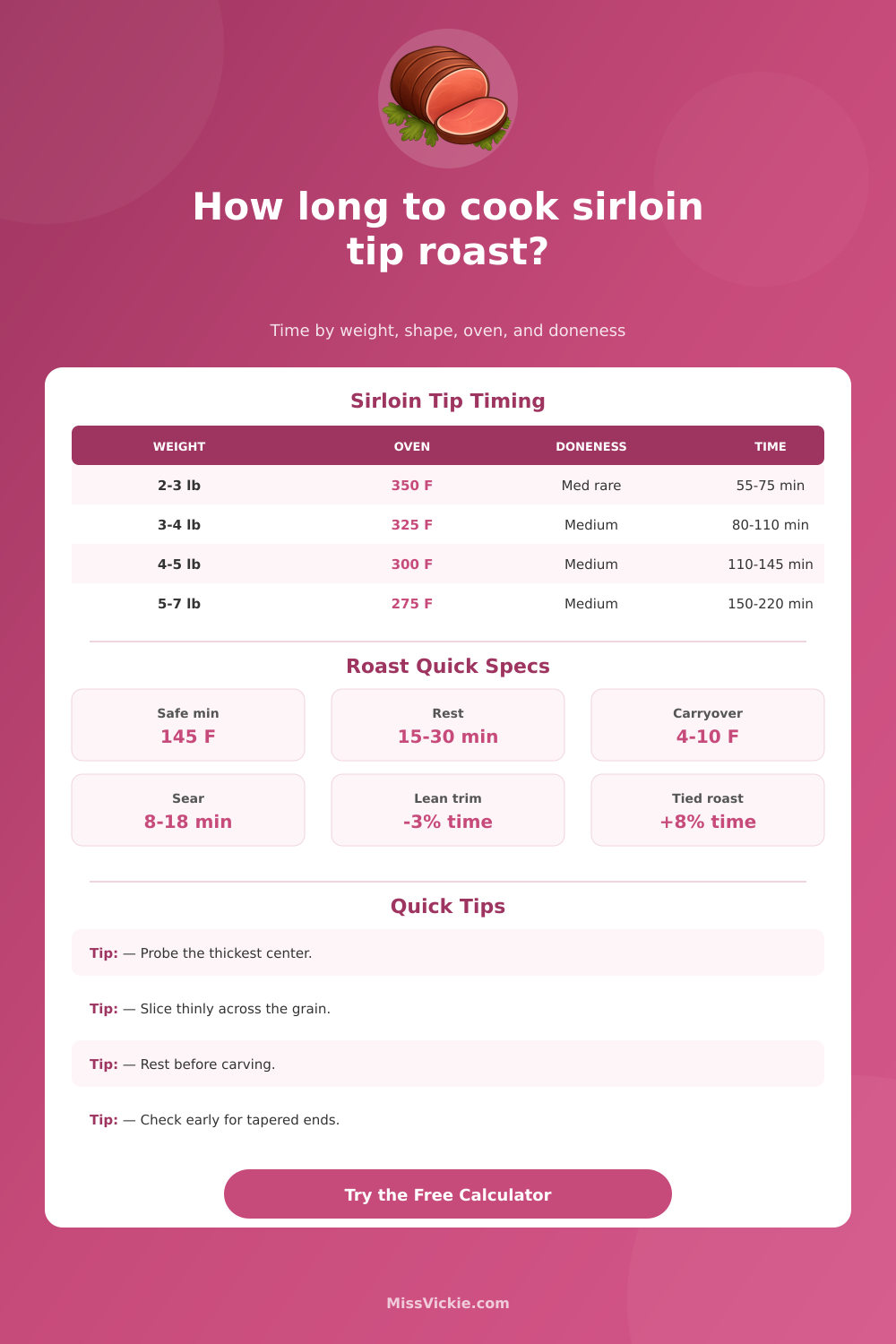
This will impact the total time that the roast is cooked and serve. If a cook chooses to skip the resting period, the roast may become dry. Reference tables list the cooking times for roasts of different weights, in different temperatures, and with different doneness levels.
These time tables are a helpful reference tool for cooks. However, the tables dont replace the cooking time calculator. The tables provide only general estimate for cooking time.
The cooking time calculator is more accurately in determining the time required to cook a sirloin tip roast roast to the desired doneness by factoring in the weight, shape, starting temperature, sear method, and rest time. The sear method will impact the cooking time of the roast. If a cook chooses to sear the roast on the stovetop prior to roasting it in the oven, the cooking time will be shorter because the roast will start with a high temperature.
A reverse sear will also add time to the cooking schedule for the roast. A reverse sear involves roasting the roast at a low temperature and then cooking it on the stovetop to finish the exterior of the roast. A cooking time calculator takes into account these different method so that cooks are aware of the total cooking time.
Using a cooking time calculator forces cooks to decide on all the variables in the cooking process prior to beginning to roast the sirloin tip roast. Cooks must decide on the shape of the roast, the oven settings, the target doneness, and the resting time for the roast. By establishing a plan for the roast prior to beginning to cook the roast, cooks can avoid making any mistake in the cooking process.
The cooking time calculator will calculate the cooking time so that cooks can focus on the remaining cooking steps. A sirloin tip roast is a lean cut of meat. Lean cuts of meat contain less marbling than other cuts of meat.
If a cook prepares a sirloin tip roast, they must slice the meat across the grain for even eating. While a cooking time calculator will help cooks reach the correct temperature for the roast, it will not aid in the slicing of the roast. A cooking time calculator will help cooks plan the serve time for the roast.
By entering the desired serve time and a buffer time for the roast into a cooking time calculator, cooks will be able to determine when to begin searing the roast and when to place it in the oven. The cooking time calculator will produce a schedule that cooks can follow to ensure the roast is cooked and rested at the time that they would like to serve the roast. If cooks use a cooking time calculator, they can successfully plan the cooking of a sirloin tip roast roast, regardless of the size of the roast or the target doneness level.
A cooking time calculator ensures that a sirloin tip roast roast is cooked perfectly and is ready to be eaten at the time that it is intended to be serve.