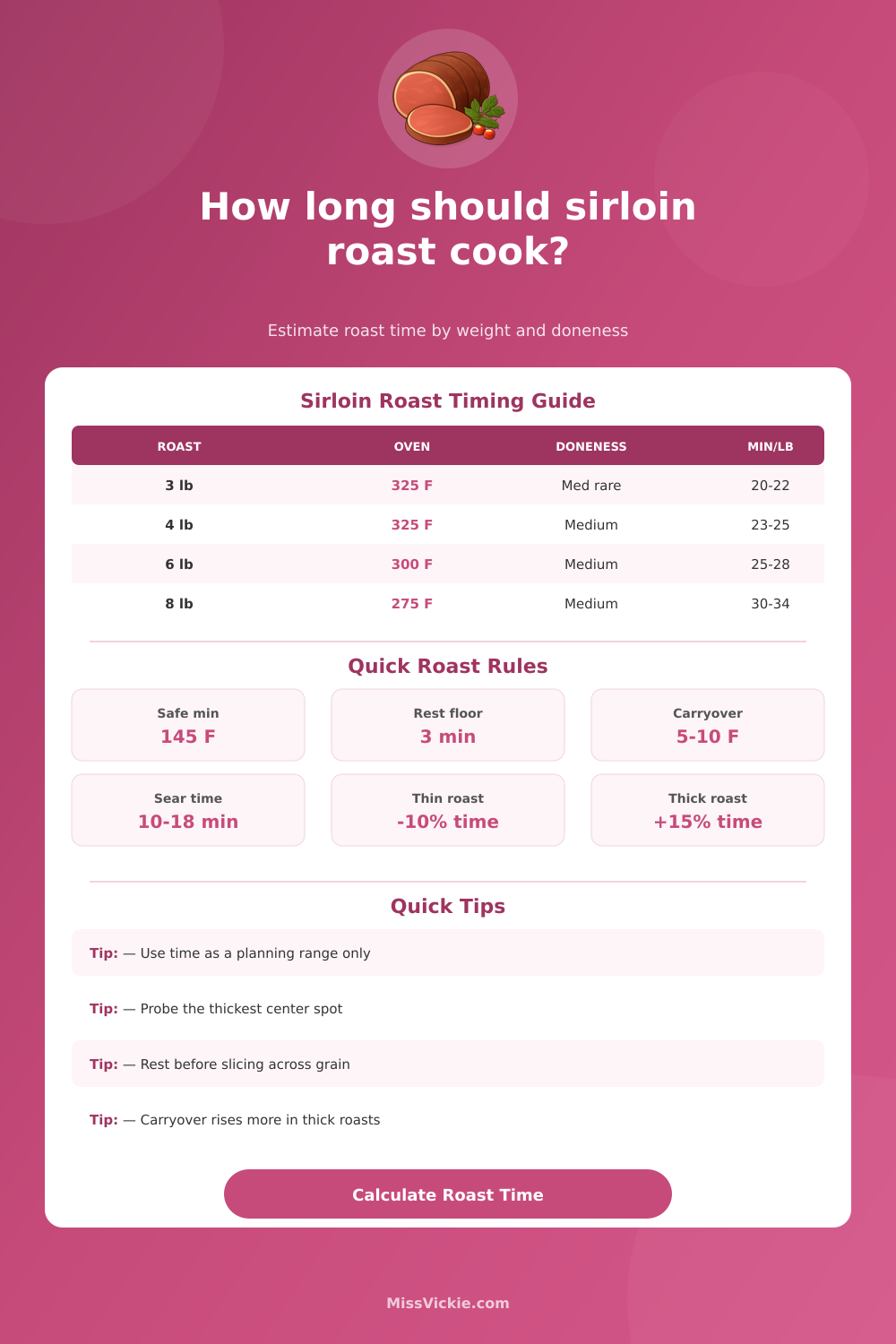
Sirloin Roast Cooking Time Calculator
Plan a top sirloin roast by weight, roast shape, oven temperature, doneness, searing method, rest time, and expected carryover heat.
Pick a realistic roast scenario, then adjust the weight, shape, temperature, and doneness. Times are planning estimates; finish with a thermometer in the thickest center.
Roast Timing Breakdown
| Oven temperature | Medium-rare finish | Medium finish | Best for |
|---|---|---|---|
| 225°F / 107°C | 32 to 38 min/lb | 36 to 42 min/lb | Gentle reverse sear, most even center |
| 250°F / 121°C | 28 to 34 min/lb | 32 to 38 min/lb | Low roasting with less gray band |
| 275°F / 135°C | 24 to 30 min/lb | 28 to 34 min/lb | Large roasts and holiday timing |
| 300°F / 149°C | 21 to 26 min/lb | 25 to 30 min/lb | Balanced tenderness and schedule |
| 325°F / 163°C | 18 to 22 min/lb | 23 to 26 min/lb | Classic sirloin roast timing |
| 350°F / 177°C | 16 to 20 min/lb | 20 to 24 min/lb | Weeknight roast with browning |
| 375°F / 191°C | 14 to 18 min/lb | 18 to 22 min/lb | Small roasts under 4 pounds |
| 400°F / 204°C | 12 to 16 min/lb | 16 to 20 min/lb | Fast cooking, check early |
| Doneness | Pull target | Expected finish | Safety note |
|---|---|---|---|
| Rare | 118 to 120°F | 125°F after rest | Below the 145°F USDA minimum for beef roasts |
| Medium-rare | 128 to 130°F | 135°F after rest | Below the 145°F USDA minimum for beef roasts |
| Medium | 138 to 140°F | 145°F after rest | Matches 145°F finish when carryover is correct |
| Medium-well | 148 to 150°F | 155°F after rest | Firm slices with less pink |
| Well done | 155 to 158°F | 160°F after rest | Check early to avoid drying |
| Factor | Typical adjustment | Why it changes time | Calculator effect |
|---|---|---|---|
| Long narrow roast | 10 to 14% faster | More surface area per pound loses chill quickly | Shortens oven time |
| Thick blocky roast | 12 to 18% slower | The center is farther from hot air | Adds time and carryover |
| Tied or netted roast | 6 to 10% slower | Uniform round shape keeps heat outside longer | Adds a moderate buffer |
| Stovetop sear | 10 to 12 active minutes | Browns the outside before roasting | Adds active time, trims oven time slightly |
| Reverse sear | 12 to 18 minutes after rest | Roasts gently first, then browns last | Adds finish time after rest |
| Longer rest | More carryover | Heat equalizes from exterior to center | May lower pull temperature |
Cooking a sirloin roast require an understanding of the variables that affects the cooking time of the roast. The total cooking time for a sirloin roast depend upon the weight of the roast, the shape of the roast, the cooking temperature of the oven, and the desired doneness of the roast. The cook must account for the weight and the shape of the roast because these two factors impacts the way in which the heat evenly distribute throughout the roast.
If these factors are not accounted for, the roast may become dry and gray on the outside while the center of the roast is undercooked. The weight of the roast is one of the primary factor that impacts cooking time, though it isnt the only factor that impacts cooking time. For instance, a four pound sirloin roast will cook in shorter periods of time than a six pound roast of the same thickness and shape if placed into the same oven at the same temperature.
What Affects the Cooking Time of a Sirloin Roast
This is because the heat must travel a longer distance to reach the center of the larger roast. Additionally, the shape of the roast can also impact cooking time. For instance, a compact roast will cook different than a roast that is narrow in thickness; the narrow ends of the roast may become overcooked before the center of the roast is fully cooked.
The oven temperature that is use to cook the roast is another variable that may impact the cooking process. Using lower oven temperatures will create a more gradual gradient of the temperature from the outside of the roast to the center of the roast, decreasing the chance that the outside of the roast is cooked beyond the desired doneness. However, higher oven temperatures will shorten the cooking time required for the roast.
The downside to using high temperatures, though, is that a wider portion of the roast will pass through the target cooking temperature before the cook can remove the roast from the oven. A planning tool for cooking times can help to balance these variables to ensure that the desired cooking temperature is reach in a timely manner. The desired doneness of the roast will impact the temperature at which the cook removes the roast from the oven.
For those who prefer their roasts cooked to medium doneness, the roast should reach approximately 145 degrees. Additionally, the cook should take the roast from the oven several degrees below this target temperature. This is because the roast will continue to cook to this temperature after it is remove from the oven; the process is referred to as carryover cooking.
If the roast is not allowed to rest after cooking, the roasts temperature may land below the target temperature when it is sliced. The method in which the cook sears the roast prior to place it into the oven will also impact the cooking time. For instance, if the cook sears the roast on the stovetop prior to being placed into the oven, that will increase the time in which the roast needs to be cooked.
This is because the stovetop roast will begin to reach the target cooking temperature prior to entering the oven. Additionally, methods like reverse searing will require an additional step to the cooking process that will increase the total time required to prepare the roast. In addition to the factors discussed thus far, the starting temperature of the roast and its placement within the oven are also additional variable.
For instance, a roast that is directly from the refrigerator will take longer to reach the target cooking temperature than a roast that has sat on the counter for thirty minutes. Additionally, the placement of the roast within the oven will affect the cooking time; placing the roast on an open rack allow for even cooking of the roast, but placing it on a pan that will remain covered will slow the browning of the roast. A planning tool will allow for each of these variables to be named in the cooking process rather than have to guess the outcome of each factor.
If the weight, shape, oven temperature, doneness, and searing methods are entered into the planning tool, the tool will reveal a time window within which the roast should be cooked. This time window is helpful in that it allow the cooks to check the internal temperature of the roast prior to cooking. Based off the internal temperature at this early stage in the cooking process, it will be possible to determine if the roast should of been cooked for another ten minutes or if it should be removed from the oven as indicated by the time window provided by the planning tool.
Finally, the cook should check the internal temperature of the thickest portion of the roast with a thermometer. This will ensure that the roast has an accurate measurement of the internal temperature of the roast. This is more accurate than a rule that states that the roast should cook for X amount of minutes per pound of roast.
Due to the variables of roast weight, roast shape, and roast temperature changing with each recipe, a cook must account for both the planning tool and the use of the thermometer to prepare the roast correct.