
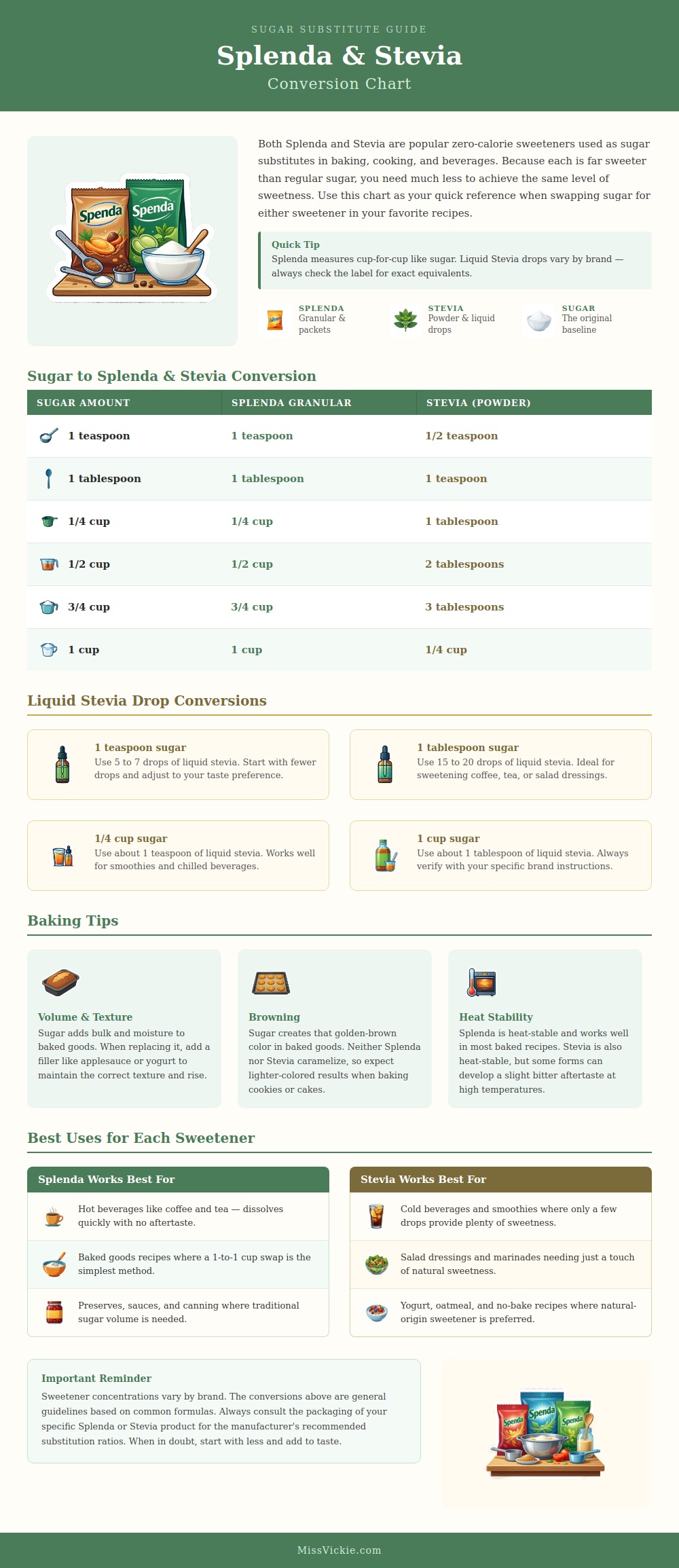
Splenda and stevia are two different types of sweeteners that can be used to replace sugar in food and drinks. Splenda is made from sucralose and has a sweetness level that is almost identical to the sweetness level of sugar. Because Splenda has the same sweetness level as sugar, you can use it in a one-to-one ratio with sugar when measured by volume.
For example, if a recipe call for one cup of sugar, one cup of Splenda can be substituted. Stevia, on the other hand, is a sweetener that is derived from the leaf of the stevia plant. Stevia is much more concentrated and much stronger than sugar.
Using Splenda and Stevia Instead of Sugar
Because of the strength of stevia, a person will use less of the sweetener than they would sugar. For example, one cup of sugar can be replaced with approximately one quarter cup of powdered stevia. Liquid stevia is a form of stevia that come in concentrated drops.
Additionally, liquid stevia is even more concentrated than powdered stevia. Consequently, even less of the sweetener is required to sweeten foods and drinks. For example, one teaspoon of sugar may only require five or six drop of liquid stevia; one cup of sugar may only require one tablespoon of liquid stevia.
However, the strength of liquid sweeteners can differ from brand to brand. Therefore, it is recommended to begin with a small amount of liquid sweetener and to taste the food after preparing it to ensure that it is the correct sweetness level. Using too much of the sweetener can create bitterness and a cloying flavor in food.
Sugar perform several important functions in baking that Splenda and stevia do not perform. Sugar helps to trap moisture in baked goods, sugar can feed the yeast that sets breads and other baked goods, and the sugar helps the crust of those baked goods to turn a golden brown color when cooked. Should sugar be removed from these recipes, moisture and color will be lost.
To compensate for the loss of moisture, moist ingredient can be used in its place; alternatives to sugar include applesauce, mashed banana, or plain yogurt. Each of these ingredients can be used in an amount that is roughly equal to the amount of sugar that you should of removed from the recipe. Using these alternatives will ensure that the baked goods does not dry out during the baking process.
Baked goods made with Splenda or stevia will not naturaly caramelize to the same degree as those made with sugar only. Consequently, baked goods will be paler when Splenda and stevia is used. To obtain the same dark color as baked goods that use only sugar, you can brush the baked goods with milk or an egg wash prior to baking.
Splenda and stevia exhibit some difference in their reaction to heat. Splenda remains stable with high temperatures; Splenda maintains its sweetness with any oven temperature. Consequently, Splenda can be used in muffins, quick breads, and sauces that cook on the stovetop.
Stevia is also stable with heat; however, some types of stevia may become bitter if exposed to high heats for long periods of time. Thus, recipes that cook for long periods of time may be tested with a small batch of the recipe prior to cooking the entire recipe. Beyond the baking recipes that contain Splenda and stevia, these sugar alternative can be used in a variety of other settings.
Splenda can be dissolved easy in hot coffee or tea. Additionally, Splenda can be used in preserves and jam; Splenda can be measured by volume to help set the texture of these jams. Stevia is useful in drinks that are consumed at room temperature or cold drinks and smoothies.
Stevia can be easily added to yogurt and oatmeal. Finally, stevia can be added to salad dressing to balance the acidity of the dressing; however, only a very small amount of stevia is required to perform this function due to the strength of the sweetener. To avoid any mistake when using Splenda or stevia, it is best to treat the use of these sweeteners as an experiment.
Begin with using the amount of Splenda