Hot Sauce Brine Calculator
Plan fermented hot sauce by pepper weight, added produce, brine style, jar volume, salt percentage, starter brine strength, fermentation temperature, finishing vinegar, and expected sauce yield.
🌶Choose a hot sauce batch preset
Presets fill real fermented hot sauce starting points. Change any input after choosing one.
⚖Fermented hot sauce inputs
Your fermented hot sauce brine plan
Salt, brine water, jar space, and finished sauce yield update from your inputs.
Full calculation breakdown
Jar, pace, and finish notes
📏Quick fermented sauce planning grid
The calculator separates water brine strength from total-batch salt percent because pepper mash, cover brine, and starter top-off styles behave differently in the jar.
🧪Pepper and brine comparison grid
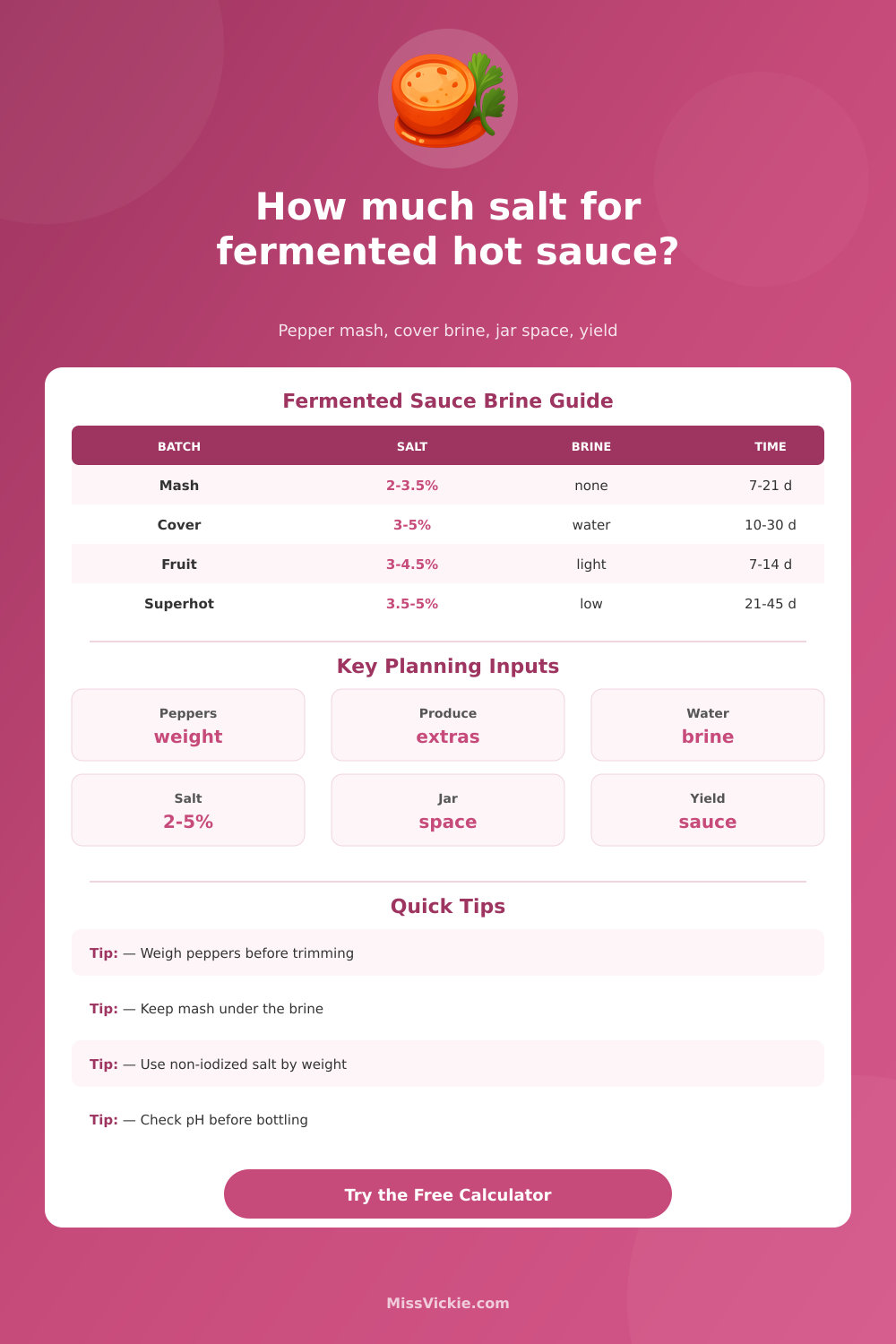
📚Reference table: salt targets by hot sauce style
| Ferment Style | Best Salt Range | Water Basis | Use This When |
|---|---|---|---|
| Chopped peppers with cover brine | 3 to 5 percent brine | Salt is based on water weight | You want pepper pieces fully submerged under a salty liquid. |
| Total-batch equilibrium brine | 2.5 to 4 percent total | Salt is based on peppers plus water | You want one salt percent across everything in the jar. |
| Salted pepper mash | 2.5 to 3.5 percent mash | Salt is based on pepper and produce weight | You are blending crushed peppers without added cover water. |
| Mash with starter top-off | 2.5 to 4 percent mash plus 3 to 5 percent top-off | Uses two salt calculations | You need a small amount of brine to cover a dense mash. |
| Fruit-heavy hot sauce | 3 to 4.5 percent total | Include fruit in the salted mass | Mango, pineapple, peach, carrot, or onion raises sugar and activity. |
| Long-aged pepper base | 4 to 6 percent total | Use mash or equilibrium basis | You plan months of aging before blending and finishing. |
🫙Reference table: jar size, brine, and headspace
| Vessel | Comfortable Fill | Typical Headspace | Brine Planning Note |
|---|---|---|---|
| 1 pint / 475 ml jar | 350 to 400 ml | 60 to 90 ml | Good for test batches, small superhot ferments, and garlic-heavy sauces. |
| 1 quart / 950 ml jar | 700 to 820 ml | 120 to 180 ml | Works for 650 to 900 g chopped peppers depending on pepper density. |
| 1 liter jar | 760 to 850 ml | 130 to 180 ml | Easy metric choice for cover brines and weights. |
| Half gallon / 1.9 L jar | 1.45 to 1.6 L | 250 to 350 ml | Use a weight and tray because active pepper ferments can push brine upward. |
| 2 liter crock | 1.5 to 1.7 L | 300 to 450 ml | Best for low-water mash or larger blended pepper bases. |
🌶Reference table: pepper profile assumptions
| Pepper Profile | Packing Density | Yield Character | Brine Advice |
|---|---|---|---|
| Jalapeno or poblano | About 0.72 g/ml chopped | Juicy, mild, green flavor | Moderate salt and enough brine to cover floating pieces. |
| Serrano or finger chili | About 0.68 g/ml chopped | Bright, grassy, medium heat | Use a weight because slender peppers trap air pockets. |
| Cayenne or long red chili | About 0.64 g/ml chopped | Thin skin, classic sauce color | Packs tighter after crushing; check brine again after day one. |
| Habanero or Scotch bonnet | About 0.60 g/ml chopped | Fruity, aromatic, high heat | Pair fruit additions with at least a mid-range salt target. |
| Thai bird or pequin | About 0.58 g/ml chopped | Tiny, seedy, sharp heat | Low-water mash keeps flavor concentrated. |
| Ghost, scorpion, or reaper | About 0.55 g/ml chopped | Very hot, slow to mellow | Use gloves, small batches, and longer fermentation time. |
🫗Reference table: finishing and blending choices
| Finish Choice | Typical Add-In | Calculator Field | What It Changes |
|---|---|---|---|
| Thin strained sauce | 8 to 20 percent vinegar | Finishing vinegar and loss | Raises final yield after straining, brightens flavor, and thins texture. |
| Medium blended sauce | 5 to 15 percent vinegar | Finishing vinegar | Keeps pepper body while making the sauce pourable. |
| Thick spoon sauce | 0 to 8 percent vinegar | Low vinegar and low loss | Concentrates mash texture and keeps more fermented solids. |
| Aged pepper base | Salt only until blending | Longer days and higher salt | Lets the ferment mellow before final acid, spice, or sweet balance. |
💡Fermented hot sauce planning tips
Kitchen note: pH, salt, sanitation, temperature, and time work together. Refrigerate or process finished sauces unless you have verified pH and a tested storage method for your recipe.
To make fermented hot sauce, you need to use salts. The amount of salt that you use is important to the fermentation process. When adding salt to hot sauce, you have to decide whether you calculate the salt weight against the weight of the peppers that you use, or if you calculate the salt weight against the weight of the peppers that you use and the weight of water that you add.
If you calculate the salt against the weight of the peppers only, you will get a different amount of salt than if you calculate the salt against the weight of the peppers and the water. Depending on the amount of salt that you use in your fermented hot sauce, you can either ferment your peppers successful, or mold can grow within your hot sauce. Therefore, you must decide this variable before you begin to make your fermented hot sauce.
How much salt to use for fermented hot sauce
The first measurement of the ingredient for making fermented hot sauce is the weight of the peppers that you will use. The weight of the peppers will determine how much salt you need if you are making a mash style fermented hot sauce. Furthermore, the weight of the peppers will allow you to determine how much space they will occupy within the jar.
If you dont take the time to weigh the peppers that you use for your fermented hot sauce, you may either under-salt your peppers or you may overfill the jar with the peppers. Both of these variable can lead to problems when fermenting your peppers. In addition to the peppers that you use in your fermented hot sauce, there are other ingredients that can be added to the jar.
Ingredients like fruit, carrots, onions, or garlic can be added to fermented hot sauce. These ingredients will add both sugar and moisture to the jar. The weight of these ingredients will affect the fermentation process.
You have to account for the weight of these ingredients in the total amount of the salted mass within the jar. If you do not account for the weight of these ingredients, the level of salt within the jar may end up too low for the total contents of the jar. A low level of salt may allow mold to grow within the jar of fermented hot sauce.
A common source of mistake when fermenting hot sauce is the addition of water. If you calculate the amount of salt that you use only against the weight of the water that you use (cover brine), then you are using a different amount of salt than if you calculate the salt against the weight of the peppers that you use and the weight of the water (equilibrium approach). These two methods of calculating the amount of salt to use will create different strengths of brine.
Depending on the type of hot sauce that you are fermenting, you will need to use one method or the other. This type of calculator will help you to determine which method of salt calculation you should use to create your fermented hot sauce. The size of the jar in which you ferment your peppers and the amount of space that the peppers will occupy when the jar is filled with hot sauce will impact how you ferment your peppers.
When fermenting hot sauce, the peppers will release gas. Due to the release of this gas, the peppers will eventually float to the top of the hot sauce within the jar. To account for this floating of the peppers, you must leave some space within the jar for the peppers to float, even if the jar appears to only contain half of its total volume with peppers.
Using the percentage of the jar that you plan to fill the jar with peppers, you can determine the amount of water that you will add to the jar. Adding too much water to the jar can cause the brine to overflow the jar onto your countertops. The temperature at which you ferment your peppers and for how many days you ferment your peppers will have an impact on the fermentation process.
If you ferment your peppers at warmer temperatures, fermentation will occur at a faster rate than if you fermented the peppers at cooler temperatures. Warmer temperatures may speed up the fermentation process, but they may also impact the ability of the peppers to age good after the fermentation process is complete. If you ferment your peppers at cooler temperatures, the peppers will ferment at a slower rate, but the texture of the peppers will remain firm.
If the peppers are left at cooler temperatures, however, molds may grow on the peppers. Fermenting peppers at a slow pace allows for more control over the process. Using the temperature and number of days that you plan to ferment your peppers, the calculator will allow you to estimate how many days it will take to ferment your peppers to your desired level.
After you have fermented your peppers, you must make additional decisions regarding the peppers. Adding vinegar to fermented hot sauce can brighten the flavor of the sauce. Additionally, adding vinegar can help reach the pH level that is required for storing your fermented hot sauce.
Adding vinegar, however, will thin the texture of the sauce. Due to the fermentation process, some of the liquid will be lost when straining and blending the sauce. Additionally, some of the liquid can evaporate over time.
Therefore, if you are making fermented hot sauce, you will lose volume of the sauce after it is finished fermenting. By deciding to add vinegar to your hot sauce, you will lose additional volume due to the additional liquid from the vinegar. Three different reason cause the three most common problems that occur in fermented hot sauce.
The first reason is that the person who makes the fermented hot sauce uses volume measures (teaspoons) of salt instead of weight measures. The different types of salt has different weights. The second reason that problems occur is if the individual making the hot sauce does not keep the peppers (and solids) submerged in the liquid for the first week of fermenting the peppers.
The third common problem is if the person bottles the sauce without first checking its pH level. If you plan to store the fermented hot sauce at room temperature, you must check the pH level to ensure that the sauce is safe to consume.