Ham Brine Calculator
Plan a ham wet cure by weight instead of guesswork. Calculate cover brine, equilibrium salt, sugar, Cure #1, pump strength, curing time by thickness, finished yield, and sodium estimates for smoked or cooked ham.
🥩Ham brine presets
Choose the closest ham project, then adjust the weight, water, Cure #1 target, pump pickup, thickness, salt, sugar, and finished yield.
⚖Ham cure and brine inputs
Inputs use pounds, quarts, and inches.
Sets default yield, time curve, and serving size.
Changes the salt and cure basis.
Use Cure #1 only in tested cured-ham processes.
Trimmed green weight in pounds.
Actual water in quarts.
Percent extra water to keep the ham submerged.
Retained injected brine as percent of ham weight.
Equilibrium percent by meat plus counted brine.
Brown sugar, white sugar, maple sugar, or honey solids.
Ingoing ppm for Cure #1 math.
Cure #1 is commonly 6.25% sodium nitrite.
Deepest thickness in inches.
Ham brines should stay refrigerated.
After curing, cooking, smoking, and trimming.
Cooked ham serving in ounces.
Changes the practical notes and yield expectation.
Ham brine plan ready
Salt, sugar, cure, pump brine, and timing update from the form.
Full brine breakdown
Pump, yield, and sodium notes
📊Ham brine result helpers
The pump helper estimates how much injected brine the ham should retain. Prepare extra injection brine for syringe loss, but calculate sodium and cure from retained pickup.
🧪Ham brine method comparison
📏Reference tables
Ham cut brine targets
| Cut | Salt target | Sugar | Typical method |
|---|---|---|---|
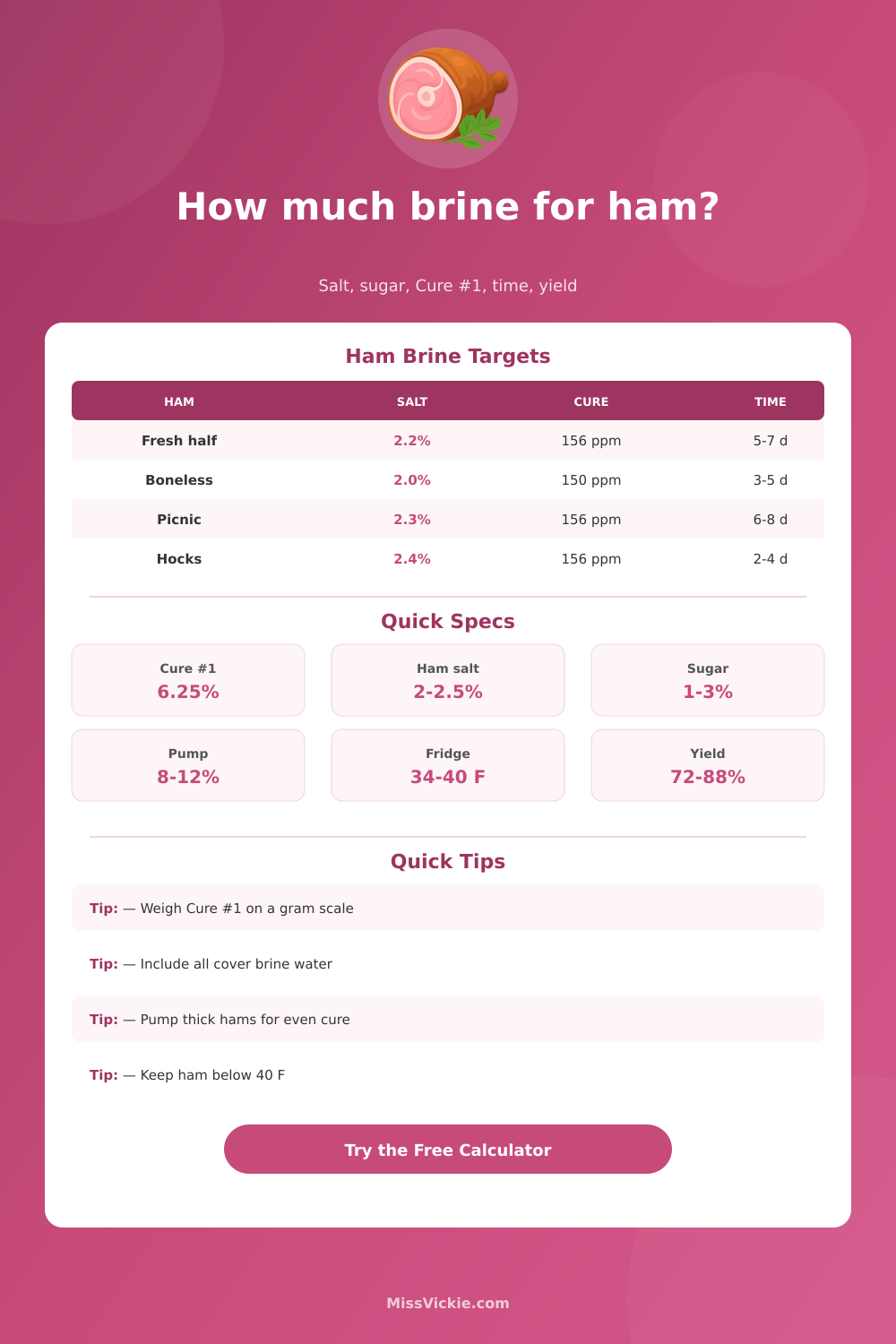
| Fresh ham half | 2.1 to 2.4% | 1 to 2.5% | Pump plus cover brine for thick pieces. |
| Whole fresh leg | 2.2 to 2.5% | 1 to 3% | Pump in several paths, then equilibrium cover. |
| Boneless roast | 1.9 to 2.2% | 1 to 2% | Equilibrium bag or pump-only method. |
| Ham hocks | 2.3 to 2.6% | 0.5 to 1.5% | Cover brine; small diameter cures faster. |
| Pork loin ham | 1.8 to 2.1% | 1 to 2% | Pump or low-water equilibrium brine. |
Cure #1 reference
| Target | Cure #1 per kg | Use note |
|---|---|---|
| 120 ppm | 1.92 g | Milder cured color for some pumped products. |
| 150 ppm | 2.40 g | Common ham planning target below 156 ppm. |
| 156 ppm | 2.50 g | Standard reference target for many cured meats. |
| 180 ppm | 2.88 g | Use only when a tested process calls for it. |
| 200 ppm | 3.20 g | Upper planning limit for this worksheet. |
Thickness timing guide
| Thickest point | Cover brine | Pumped ham | Check |
|---|---|---|---|
| 1 in / 2.5 cm | 2 to 3 days | 1 to 2 days | Thin steaks and hocks. |
| 2 in / 5 cm | 4 to 6 days | 3 to 4 days | Small roasts or loin ham. |
| 4 in / 10 cm | 7 to 10 days | 5 to 7 days | Fresh ham half. |
| 6 in / 15 cm | 10 to 14 days | 7 to 10 days | Large bone-in ham. |
| 8 in / 20 cm | 14 to 21 days | 10 to 14 days | Whole leg; validate process. |
Yield and serving guide
| Style | Finished yield | Serving | Note |
|---|---|---|---|
| Hot smoked ham | 78 to 86% | 3 to 5 oz | Moist cooked ham for slicing. |
| Baked bone-in | 68 to 78% | 4 to 6 oz | Bone and trim reduce plated meat. |
| Boiled ham | 75 to 88% | 3 to 5 oz | Gentle simmer keeps yield high. |
| Deli-style loin | 82 to 92% | 2 to 3 oz | Lean, thin-sliced portions. |
| Ham hocks | 55 to 70% | 2 to 4 oz | Bone, skin, and collagen dominate. |
📝Batch planning grids
Common ham batch examples
| Raw ham | Water | Salt at 2.25% | Cure at 156 ppm |
|---|---|---|---|
| 5 lb / 2.27 kg | 1.5 qt / 1.4 L | 83 g | 5.8 g |
| 10 lb / 4.54 kg | 3 qt / 2.8 L | 166 g | 11.5 g |
| 15 lb / 6.80 kg | 4.5 qt / 4.3 L | 249 g | 17.3 g |
| 20 lb / 9.07 kg | 6 qt / 5.7 L | 332 g | 23.1 g |
| 25 lb / 11.34 kg | 7.5 qt / 7.1 L | 415 g | 28.8 g |
Flavor brine add-ins by ham weight
| Add-in | Light | Classic | Strong |
|---|---|---|---|
| Brown sugar | 1% | 1.5% | 3% |
| Black pepper | 1 g/kg | 2 g/kg | 4 g/kg |
| Bay leaf | 1 per kg | 2 per kg | 3 per kg |
| Allspice | 0.3 g/kg | 0.6 g/kg | 1 g/kg |
| Garlic powder | 1 g/kg | 2 g/kg | 3 g/kg |
Flavor add-ins are seasoning estimates only. Cure #1, salt, time, temperature, pH, cooking, and cooling are the safety-sensitive parts of a ham process.
💡Two ham brining tips
A brine calculator is a tool that will assist you in a planning of the process of making ham at home. Making ham at home require that the salt and cure be distribute evenly into the meat. A brine calculator will help to ensure that the salt and cure are distribute evenly into the ham.
To use the calculator, you will need to enter the weights of the ham that you intend to make, the amount of water that will be used in the brining process, the amount of salt that you would like to use, the amount of sugar that you would like to use, and the amount of nitrite that you would like to use. Based off these entries, the brine calculator will provide you with the amount of each ingredient that you will need to purchase, the length of time that the ham will need to cure, and the estimated weight and sodium content of the ham after the brining process is complete. Many individuals may attempt to make these calculations and decisions by guessing at each of the values; however, guessing at these amounts may lead to uneven color and flavor of the ham.
How to Use a Brine Calculator to Make Ham at Home
The amount of ham that you intend to use and the amount of water that will be used are both inputs that you will need to provide to the brine calculator. The weight of the ham that you will be making must be entered, as well as the amount of water that will be used in the curing of the ham. The amount of water is important to ensure that the ham is cover in the brine; however, using too much water will dilute the salt that is used in the brining process.
Thus, the brine calculator also asks for a buffer percentage to account for water that will be displaced by the bones that are present in the ham. If you do not use the buffer percentage in the calculation of the amount of water to be used, the salt level in the ham may be too low. The type of curing process that you use will affect the calculation of the length of time that the ham will need to cure.
If you use a straight cover brine method, the salt will move from the outside of the ham to the inside of the ham; thus, the thickness of the ham and the length of time in which the ham is cured are the two most importently factors in the cover brining process. If you decide to use a pump step in your brining process, salt and nitrite will be pumped into the thickest muscles of the ham. In this case, the brine calculator will adjust the length of time that the ham will be cured according to the inclusion of a pump step, as will the amount of the injected brine that the ham retains; only the brine that is retained by the ham counts towards the total salt and nitrite levels in the ham.
The target levels of nitrite that will be used in the ham should be 156 part per million. This nitrite level is targeted to ensure that the color of the ham and the safety of the ham is ensured. The brine calculator will calculate the amount of Cure #1 that will be used in the ham according to the percentage of nitrite that is contained in the curing salt that will be used.
The curing salt will need to be weighed on a gram scale; volume measurements may not be accurate for such a potent ingredient. The thickness and the temperature of the ham will impact the length of time that the ham will need to be cured in the brine. The salt move through the ham; however, the salt moves through the ham more slow if the temperature of the ham is low.
Thus, the brine calculator will use the thickness of the thickest portion of the ham to calculate the length of time that the ham will need to be cured, as well as ask for the temperature of the refrigerator where the ham will be cured. For instance, a four-inch thick ham will require more time to be cured at 38 degrees than a four-inch ham that is cured at 34 degrees. One of the factors that the brine calculator can track is the yield of the ham.
Ham that contains bones will lose some of its weight during the curing process, trimming process, and cooking process. The brine calculator allow you to enter the percentage of the ham that will remain after these processes are complete. Based upon the percentage of ham that is entered, the brine calculator will provide an estimate of the number of servings that will be yielded by the ham, as well as the amount of sodium that will be contained in each serving.
The amount of sodium is calculated according to the amount of salt that is to be used in the ham; thus, if the amount of salt is changed, the amount of sodium that will be provided by each serving will change as well. Tables next to the brine calculator can include tables of typical amounts of salt for different type of meat, cure times based upon the thickness of the cuts of meat, and the yield of the ham based upon the cooking method of the ham. These tables can help to ensure that the inputs for the brine calculator are correct, or can help to ensure that the amount of salt that is to be used in the ham is within the normal range for that type of cut of ham.
Using the calculator force an individual to consider the entire brining process at the same time. For instance, if an individual decides to use a pump step in the curing of the ham, the length of time that the ham will be cured will be altered; thus, the individual cannot decide upon the percentage of salt that will be pumped into the ham without at the same time considering the length of time that the ham will need to cure to reach the desired results. Additionally, the amount of sugar that will be used in the ham will impact the amount of salt that should be used in the ham; thus, an individual cannot make a decision about the amount of salt that will be used without also considering the amount of sugar that will be used in the ham.
Some of the mistake that may be made when brining ham at home include not including the salt that is to be used for curing the ham in the calculation of the total amount of salt that will be contained in the ham, measuring the amount of water in which the ham will be cured after the ham has been placed into the container, and using the same length of time to cure the ham that has been both pumped and covered in brine. Each of these mistakes can be avoided by using the brine calculator; however, it is still necessary to pay close attention to the temperature of the ham after it has been cured. After the ham has been cured in the brine solution, it will need to be kept cold until it is cooked; further processes, such as drying the ham, smoking the ham, and cooking the ham will affect the amount of time that the ham is needed to reach certain internal temperatures.
Thus, an individual must pay attention to the temperature of the ham throughout the entire process. Thus, the brine calculator unifies all of the different aspect of curing ham into one process, and allows for the calculation of the mathematics that is necessary for the curing of the ham.