Chicken Brine Calculator
Calculate wet brine, equilibrium brine, buttermilk brine, or dry brine amounts for chicken by cut, weight, thickness, salt type, sweetness, chilling method, and target texture.
Choose a realistic starting point, then adjust salt type, chicken weight, thickness, sweetness, and brine style for your own pan, smoker, grill, or fryer plan.
Your chicken brine plan
Enter chicken weight, cut, brine style, salt type, and timing details to calculate a practical batch.
Full breakdown
Formula notes
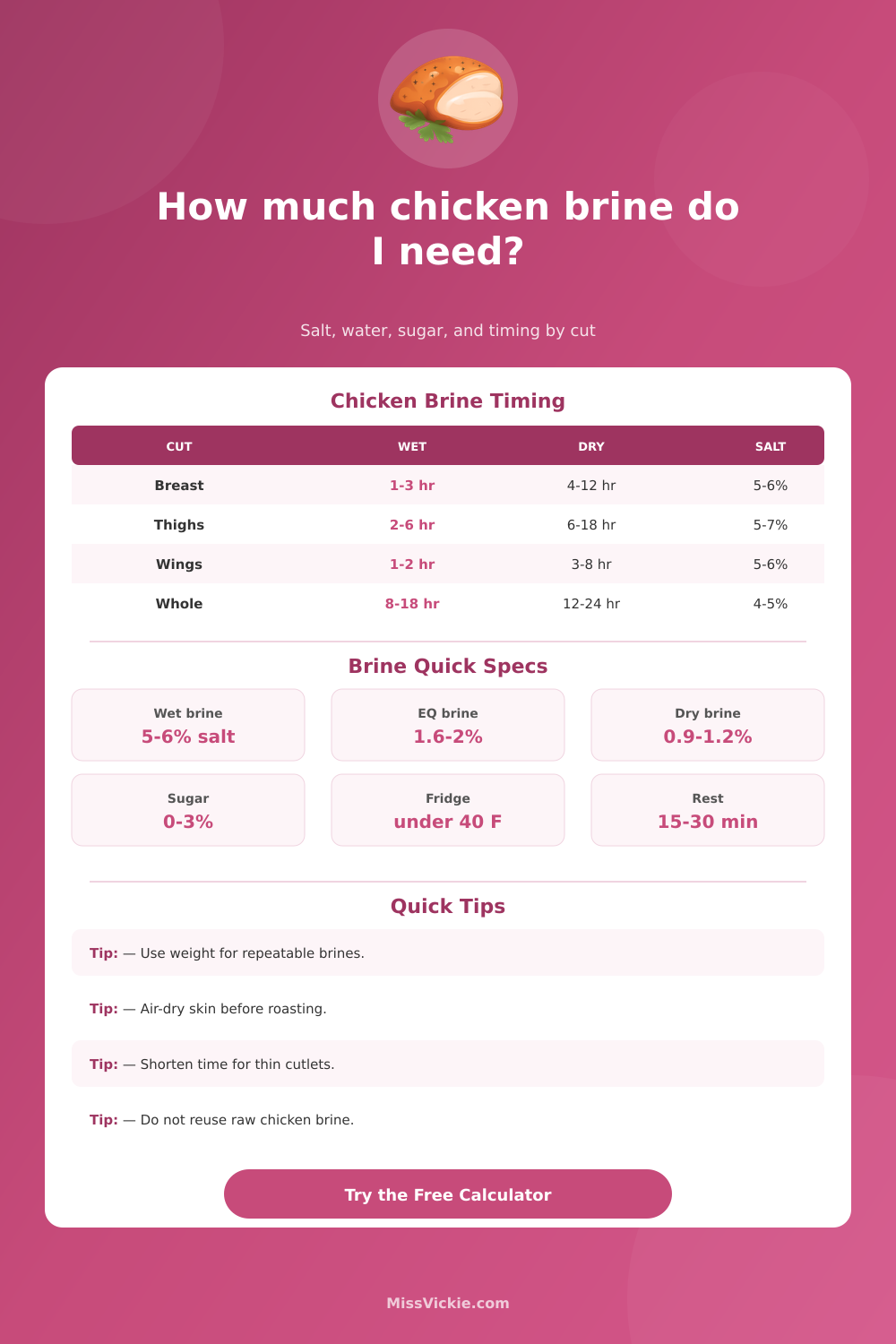
Classic wet brines taste stronger because salt is measured against liquid only. Equilibrium and dry brines measure salt against the chicken mass, so their percentages look lower.
| Chicken cut | Typical weight | Wet brine window | Dry brine window | Best use |
|---|---|---|---|---|
| Thin cutlets or tenders | 3 to 6 oz each | 20 to 60 minutes | 1 to 4 hours | Quick skillet, grill, or breaded cutlets |
| Boneless breasts | 6 to 12 oz each | 1 to 3 hours | 4 to 12 hours | Grill, roast, meal prep, or poaching |
| Bone-in breasts | 12 to 20 oz each | 2 to 6 hours | 6 to 18 hours | Roasting, smoking, or split-breast dinners |
| Thighs and drumsticks | 3 to 6 oz each | 2 to 6 hours | 6 to 18 hours | Tray bakes, frying, grilling, and braises |
| Wings | 2 to 3 oz each | 45 minutes to 2 hours | 3 to 8 hours | Crispy baked, fried, grilled, or smoked wings |
| Whole chicken | 3 to 6 lb | 8 to 18 hours | 12 to 24 hours | Holiday roast, rotisserie style, or smoked bird |
| Spatchcock chicken | 3 to 5 lb | 4 to 10 hours | 8 to 20 hours | Even roasting with better skin exposure |
| Salt type | Approx grams per tablespoon | 1/4 cup estimate | How it affects brine |
|---|---|---|---|
| Fine table salt | 18 g | 72 g | Dense crystals; spoon measures taste much saltier if substituted cup for cup |
| Morton kosher salt | 15 g | 60 g | Common brining salt with moderate spoon density |
| Diamond Crystal kosher | 9 g | 36 g | Large flakes; needs more volume for the same weight |
| Fine sea salt | 17 g | 68 g | Close to table salt by volume; best weighed for brining |
| Coarse sea salt | 13 g | 52 g | Variable crystal size; dissolve fully before adding chicken |
Weights are practical kitchen approximations. A gram scale is the cleanest way to keep chicken brines consistent across brands.
Salt is calculated from water or dairy weight, so the liquid tastes assertively salty and works quickly.
Salt is calculated from chicken plus liquid, giving a gentler target when brine time runs long.
Salt is applied to chicken weight only, then uncovered rest dries the surface for browning.
Dairy brines carry salt and acidity, useful for fried chicken and tender roasted pieces.
| Scenario | Chicken | Suggested liquid | Classic salt range | Timing target |
|---|---|---|---|---|
| Dinner for 2 | 1 to 1.5 lb breasts | 3 to 5 cups | 34 to 68 g | 1 to 2 hours |
| Family tray bake | 3 lb thighs | 2 to 2.5 qt | 104 to 156 g | 3 to 5 hours |
| Wing night | 4 lb wings | 2.5 to 3 qt | 130 to 196 g | 1 to 2 hours |
| Whole roaster | 4.5 lb bird | 3 to 4 qt | 156 to 238 g | 10 to 16 hours |
| Smoked chicken | 5 lb bird | 4 to 5 qt | 208 to 298 g | 10 to 18 hours |
| Buttermilk fry | 3 lb pieces | 1.5 to 2 qt dairy | 78 to 118 g | 4 to 12 hours |
| Formula | Best for | Calculator basis | Practical note |
|---|---|---|---|
| Water salt = liquid grams x salt percent | Classic wet brine | Water, ice, or dairy only | Fast and traditional, but timing matters more |
| EQ salt = chicken plus liquid grams x salt percent | Longer wet brines | Total food-contact mass | Lower percent because the chicken is included |
| Dry salt = chicken grams x salt percent | Crisp skin and roasting | Chicken only | Apply evenly and air-dry uncovered |
| Injected salt = pickup grams x brine percent | Large birds or smoking | Retained brine estimate | Use gentle percentages and even distribution |
Chicken is a type of meat that can easly be overcook. If chicken is cooked for too long, the meat will become dry. Brining is a process that add moisture to the chicken, and brining is a process that adds seasoning to the chicken.
You use a brine so that the chicken remains juicy. To use a brine correctly, you have to understand the amount of salt that you use, the amount of liquid that you use, and the amount of time that you allow the chicken to sit in the brine. A calculator is provided that will help you to determine the measurements for the brining of the chicken.
How to Brine Chicken
The calculator take into account the weight of the chicken, the thickness of the chicken, and the style of brine that you will use. Different cut of chicken require different lengths of time in the brine. For example, chicken breasts will require a different amount of time than chicken thighs.
Chicken wings will require a different amount of time because they are a small piece of chicken. If you are using a whole chicken or a spatchcocked chicken, you will have to consider the thickness of the chicken and the strength of the salt so that the skin doesnt become mushy. The style of the brine will determine the amount of salt that is use in the brine and the length of time that the chicken will be in the brine.
If you use a standard wet brine, the salt will only be measured against the amount of liquid in the brine. In this case, the brine will be very salty and will work quick. For an equilibrium brine, the salt will be measured against the weight of the chicken and the weight of the liquid in the brine.
This brine allow for long brining times without over-salting the chicken. For a dry brine, no liquid is used and you apply the salt direct to the chicken. This method is useful for roasting the chicken as it will produce better skin.
For a buttermilk brine, acid will be added to the brine. The acid will tenderize the chicken and the salt will season the chicken. These different styles of brine require different length of time to prepare the chicken, and the calculator will allow you to adjust for these variations.
The thickness of the chicken will determine the length of time that the salt has to travel to the center of the chicken. Thin chicken cut will reach equilibrium quickly while bone-in chicken breasts or whole chickens will require many hour of brining. The calculator will allow you to adjust the time according to the thickness of the chicken that you will use.
Different cuts of chicken will require different amounts of time to reach the same salt percentage. For example, you will not use the same two-hour time window for chicken tenders as you would for a five-pound chicken. The type of salt that is used will change the number of spoon of salt that will be needed.
However, the type of salt will not change the chemical reaction of the salt with the chicken. Table salt is more denser than other salts. One tablespoon of table salt will contain more sodium than one tablespoon of kosher salt.
This calculator will convert the salt percentage to grams and spoons of salt. Reference tables will allow you to change brands of salt without changing the percentage of salt that is used. For example, if you use sea salt, the reference tables will allow you to change brands without changing the salt percentage.
Sugar and acid are optional ingredient that can be used in the brine. However, the addition of sugar will change the way that the brine works. Sugar will allow for better browning of the chicken and will balance the saltiness of the brine.
If you use acid, such as citrus or vinegar, the length of time that the chicken will be in the brine will have to be shorten. The type and amount of acid used in the marinade will determine the length of time that the chicken will be in the brine. The calculator will determine the length of time with the inclusion of these option for users to select the type and amount of acid to be used in the brine.
The temperature at which the chicken will be brined should be below 40 degrees Fahrenheit. If the chicken will be in the brine for a long period of time, the importance of maintaining that temperature is even more important. An ice-filled cooler will be used to keep the chicken cold while it is brined.
Brined chicken that is left on a countertop will not last thirty minute. The calculator will determine the length of time based on the type of chilling method that will be used to keep the chicken cold. Wet-brined chickens should be patted dry or rinsed and dried.
Dry-brined chickens should be left uncovered in the refrigerator so that the skin can tighten and the moisture can evaporate from the chicken. This process allow for the skin of the chicken to become crisp. These reference grids will provide information to assist with cooking task that require different amounts of salt and time.
For example, you may want to make a fast brine with two pound of chicken breasts or you may want to brine a whole chicken for smoking. These reference tables will show the various percentages and times needed for these tasks so that you dont have to memorize the information. Many people make mistake when preparing the chicken prior to brining.
Some people use the same percentage of salt for dry and wet brines. Others use the same length of time to brine thin chicken cutlets as whole chickens. Some people use reused brine which is a food safety problem.
Others leave out the step of drying the chicken which is necessary to achieve crisp skin. The calculator will help to remove the guesswork regarding the amount of salt and the time that the chicken should sit in the brine. To use the calculator, you will have to determine the weight and thickness of the chicken that you will use.
You will also have to determine the type of brine that you will use and the type of salt that will be used in the brine. With these selection, the calculator will provide you with result. These results will tell you the amount of salt and liquid to use, the length of time that the chicken should sit in the brine, and the amount of sugar and acid to be used in the brine.
You will have to keep the chicken below 40 degrees Fahrenheit and ensure that the surface of the chicken is dry before cooking. Brining will make the chicken more juicy and more seasoned; however, brining does not replace the need to cook the chicken to a safe internal temperature.