Curing Salt Calculator
Estimate Cure #1 or Cure #2 by meat weight, curing method, nitrite target, brine weight, salt percent, sugar percent, pump pickup, finished yield, and serving size. Built for precise kitchen-scale planning before you follow a tested curing process.
🧂Choose a curing scenario
Each preset fills a realistic starting point. Edit the weights, ppm, cure type, salt, sugar, and yield for your own tested recipe.
⚖Batch and cure inputs
Metric inputs use kilograms, liters, and centimeters.
Changes the weight basis and reference limit.
Use #2 only for long dry-cured products.
Calculated as ingoing sodium nitrite.
Green meat weight in kg.
Water weight in liters; use 0 for dry cures.
Percent retained brine for injection methods.
Centimeters at the thickest point.
Total salt percent, including carrier salt in cure.
Percent sugar by curing weight basis.
Used for sodium per serving estimate.
Serving grams after cooking or drying.
Cure #1 and #2 are usually 6.25%.
Cure #2 is commonly about 4% nitrate.
Use a scale accurate enough for the batch.
Changes the note shown with results.
Your curing salt estimate
Enter your batch details, then calculate the cure, salt, sugar, brine concentration, and serving sodium.
Full calculation breakdown
Brine and timing notes
📏Quick cure math grid
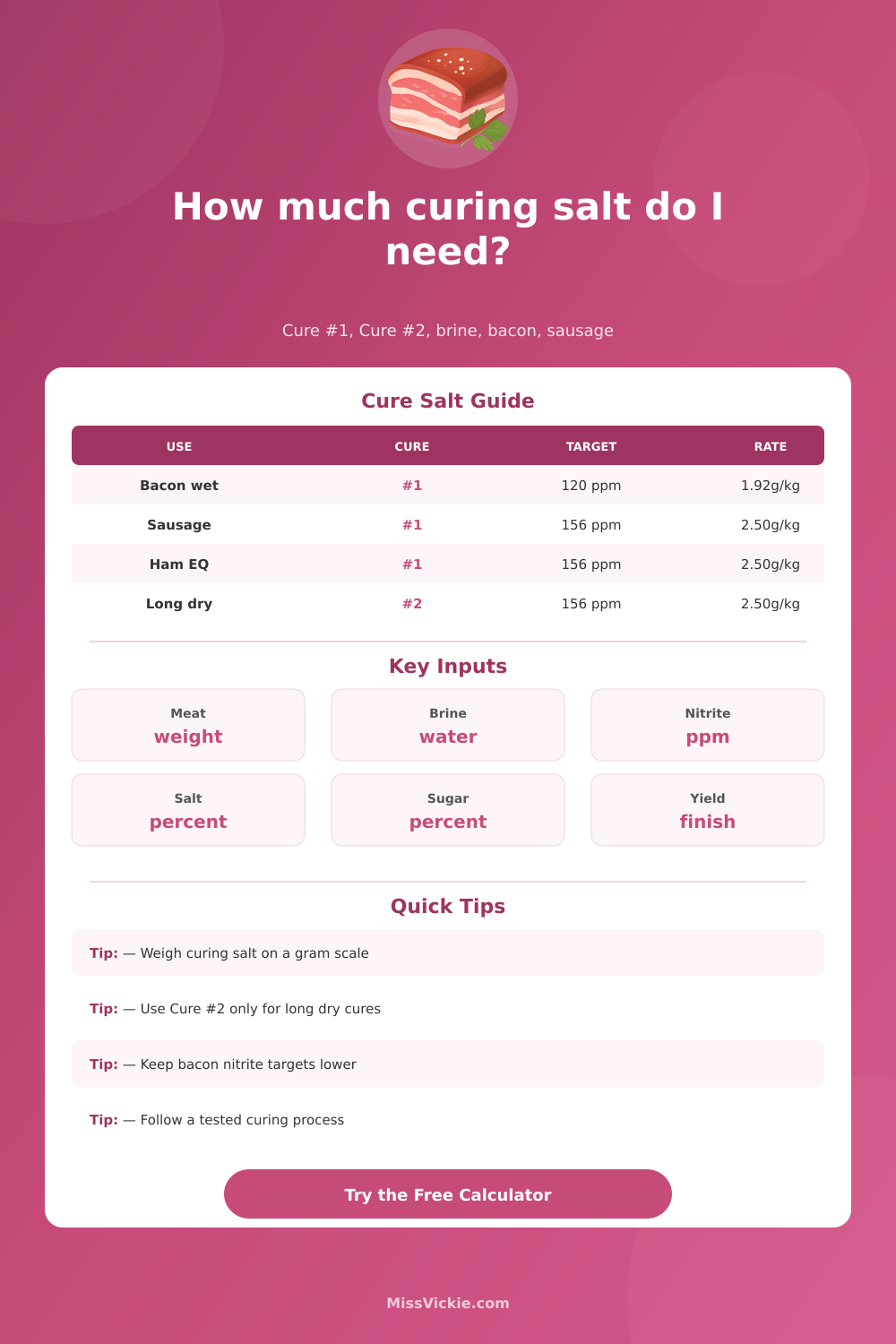
These quick rates assume a 6.25% sodium nitrite cure mix and an equilibrium weight basis. Always calculate by actual weight, not spoon measure, when possible.
🧪Comparison grid by curing style
📚Reference tables
Cure type reference
Cure #1 is the usual short-cure nitrite mix for bacon, ham, corned beef, poultry, and smoked sausage. Cure #2 adds nitrate for long dry-cured products that age long enough for nitrate reduction.
Weight basis reference
Dry equilibrium math uses meat weight. Wet equilibrium math uses meat plus water. Pumped products also need pickup percent because the retained brine carries the curing agents into the meat.
| Product or Method | Common Planning Target | Reference Maximum | Calculator Note |
|---|---|---|---|
| Bacon, pumped or immersion cured | 120 ppm nitrite | 120 ppm sodium nitrite | Lower target because bacon is often fried at high heat. |
| Bacon, dry cured | 120 to 156 ppm nitrite | 200 ppm sodium nitrite | Use dry bacon method if comparing to this reference. |
| Comminuted sausage | 120 to 156 ppm nitrite | 156 ppm sodium nitrite | Meat block weight is the usual basis. |
| Immersion or pumped meats | 120 to 200 ppm nitrite | 200 ppm sodium nitrite | Commercial calculations may use pickle formulas and pickup. |
| Dry-cured non-bacon items | 120 to 200 ppm nitrite | Varies by product and rule | Long cures may use Cure #2 and validated drying controls. |
🍽Conversion, sodium, and serving data
| Kitchen Measure | Approx Weight | Use In Calculator | Important Caution |
|---|---|---|---|
| 1 level teaspoon Cure #1 | About 5.67 g | Roughly 2.27 kg meat at 156 ppm | Brands vary; weighing is better than spoons. |
| 1 g salt | 1000 mg salt | About 393 mg sodium | Sodium estimate excludes meat's natural sodium. |
| 56 g cooked bacon serving | About 2 oz | Common serving estimate | Finished yield changes sodium density. |
| 100 g finished meat | Nutrition label base | Useful for sodium comparison | Drying concentrates salt per serving. |
🔢Formula reference
| Formula | What It Means | Example | Why It Matters |
|---|---|---|---|
| Cure g = ppm x kg / (% nitrite x 1000) | Solves curing salt from desired nitrite. | 156 ppm x 1 kg / 0.0625 / 1000 = 2.50 g | Core Cure #1 and Cure #2 dosage math. |
| Plain salt g = target salt g - cure carrier salt | Subtracts salt already present in the cure mix. | 22.5 g target - 2.34 g carrier = 20.16 g | Keeps total salt closer to your target. |
| Brine strength = dissolved solids / water | Compares cure, salt, and sugar to brine water. | 80 g solids in 1 L water = 8% | Useful for wet brines and pump brines. |
| Sodium serving = sodium total / finished servings | Estimates sodium from added salt and cure. | Salt sodium divided by 56 g servings | Shows how drying or cooking yield changes sodium. |
💡Practical curing tips
Curing salts is one of the central components of many home curing projects. The curing salt that is used must be measured carefuly because the curing salt has an impact upon the safety and the flavor of the cured meats. The amount of curing salt that are required to be used in the curing process is dependent upon the weight of the meat that is to be cured and the type of cures that is to be used upon the meat.
If the amount of curing salt is not balanced correctly, then the cured meat may pose a safety risk to the individuals that consumes the meat, or the meat may contain too much salt to be considered a desirable flavor. The type of curing method that is used will impact the weight of the meat that is to be cured. For instance, dry equilibrium rubs requires only the weight of the meat to be weighed, while wet brines require the weight of the water to also be weighed.
How to measure curing salt for safe meat
Injection methods requires the amount of liquid that the meat will retain to be factored into the calculations of the weight of the meat. As a result of these different methods, the cook has to calculate the weight of the meat prior to any other calculations are perform for the cure. Nitrite levels is critical to the curing process.
Short cures require a nitrite level of 120 to 156 parts per million. Depending upon the type of meat that is cured, the nitrite level may be lessened or increased. For instance, bacon contains enough sodium to cure with less nitrite than thick ham and sausages.
The nitrite level will impact the color and the safety of the cured meats. A nitrite level calculator can be used to ensure that the nitrite level is within the range that is required of the type of meat that is being cured. Salt and sugar are two component of the cure that serve different purposes.
Salt will impact the flavor and texture of the cured meat, while sugar will work to even out the saltiness of the cured meat. When calculating the amount of salt and sugar that is to be used, the cook has to subtract the salt that is already contained within the curing salt from the total amount of curing salt that is to be used. This ensures that the amount of curing salt that is added to the meats will not be too high.
Another factor that impact the amount of salt that is tasted by the diner is the yield of the meat. As the meat dries or is cooked, it will shrink. The amount of salt that remains in the shrinking meat will become more concentrate.
As a result, meats with low yield will taste stronger in their salt content than meats with high yields. Calculators can be used to track the yield of the meats that is cured, which will allow adjustments to be made to the amount of salt and the portion size of the meats. The type of curing salt that is used will also impact the timeline of the cure.
Cure number one is used for meats that are cooked or smoked, as it contains nitrites that will act quick upon the meat. Cure number two is used in long dry cures, as it contains ingredients that will convert the nitrate to nitrite over a period of several week. The type of curing salt has to be matched to the timeline of the cure; otherwise, the results will pose a risk to the safety of the meats.
The thickness of the meats that is cured will impact the length of the cure; however, it will not impact the dosage of the curing salt that is used. Thin meats will reach equilibrium with the curing salt more quickly than thick meats; thinner meats will require less time to cure. A cure calculator may be used to determine the length of the cure process, as well as to ensure that the refrigeration of the meats during the cure process; refrigeration is required for safety.
A gram scale should be used instead of using the teaspoon measurement for the curing salt. Cure number one salt in a level teaspoon will weigh 5.5 grams. However, using a gram scale will allow for accuracy in small curing projects.
Even small error in the amount of curing salt may impact the nitrite levels of the cured meats; too much nitrite will lead to undesirable outcomes for the cured meats. When converting pounds and quarts to kilograms and liters, or any other metric to imperial units, the numbers must be converted careful. Maintaining consistency in measurements will ensure accuracy in the curing process.
The safety of the cured meats relies upon more than the math behind the curing process. Sanitation, refrigeration levels, and pH levels of the meats are also critical components of the safety of the cured meats. As long as the nitrite, salt, and sugar levels are as calculated by the curing calculator, then management of the time and temperature of the meats can be attended to.
Finally, the cured meats should be tasted. If the meats are too salty, the yield of the meats during the drying or cooking process may have been too low. Any adjustments can be made to the next batch of cured meats according to the measurements and calculations.
Using a curing calculator will not only allow for management of the salt, sugar, and curing salt, but also allow for improvements to be made in the curing process.