MissVickie kitchen calculator
Sea Salt to Table Salt Conversion Calculator
Convert fine, coarse, flaky, gray, and finishing sea salt into table salt by matching salt weight or sodium, then round the result for baking, brines, sauces, and table seasoning.
Presets fill in real sea salt styles, recipe uses, serving counts, and rounding choices. Edit any field after choosing one.
Full breakdown
Kitchen interpretation
Choose a preset or enter your salt amount to see conversion guidance.
Fine cubic crystals pack tightly, so a teaspoon is usually heavier than most sea salts.
Close to table salt, but still often a little lighter by spoon volume.
Larger crystals leave more air in the spoon, lowering the mass per teaspoon.
Light flakes occupy space quickly; teaspoon swaps need the biggest reduction.
| Original sea salt | Approx dry weight | Table salt equivalent | Best kitchen use |
|---|---|---|---|
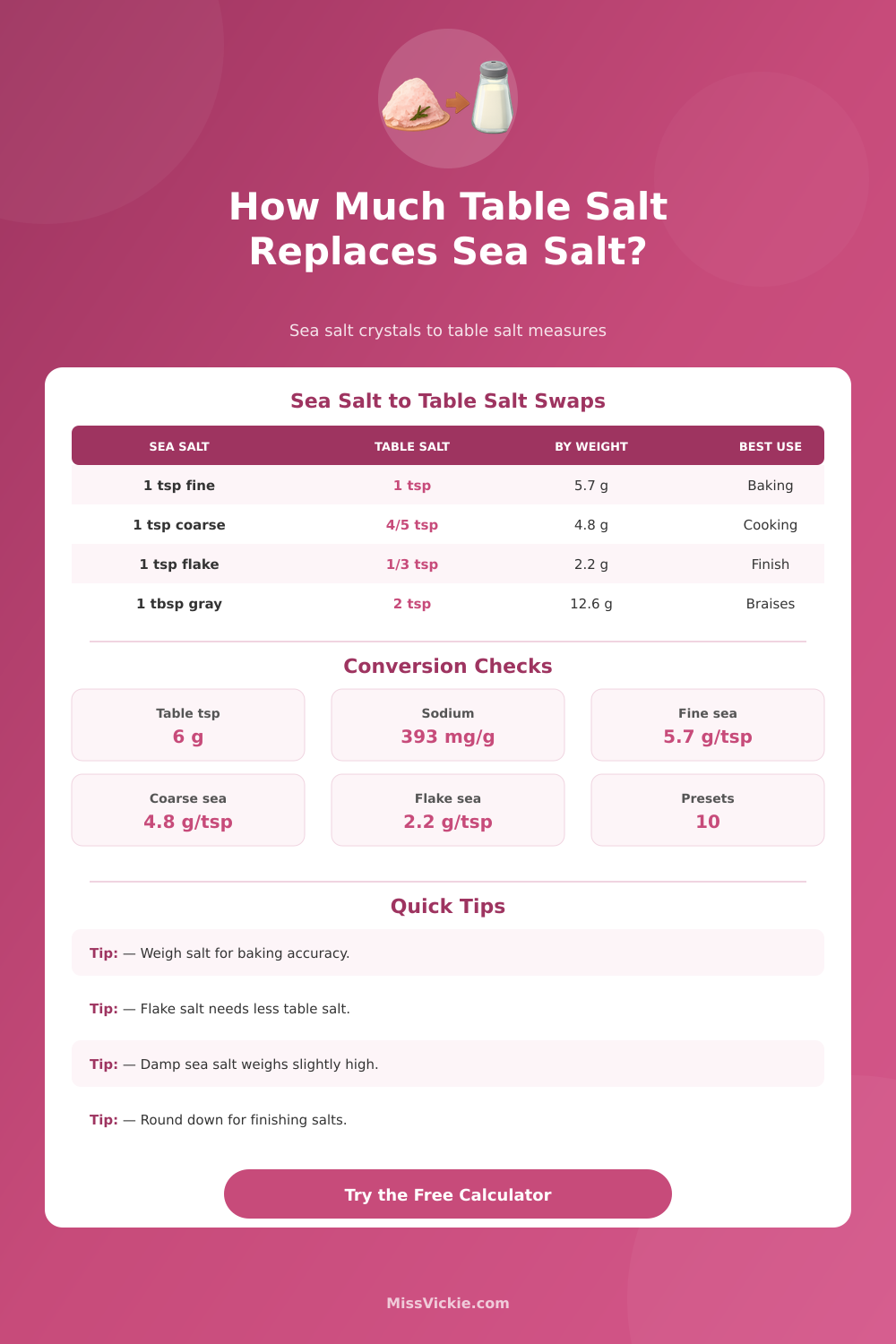
| 1 tsp fine sea salt | 5.7 g | 0.95 tsp table salt | Baking, sauces, dressings |
| 1 tsp coarse sea salt | 4.8 g | 0.8 tsp table salt | Soups, stews, pasta dough |
| 1 tsp flake sea salt | 2.2 g | 0.37 tsp table salt | Finishing, steak tops, salads |
| 1 tbsp gray sea salt | 12.6 g before moisture | about 2 tsp table salt | Braises, rustic cooking, roasts |
| 1/4 cup coarse sea salt | 57.6 g | 9.6 tsp table salt | Brines when a scale is unavailable |
| Recipe use | Best target | Rounding advice | Why it matters |
|---|---|---|---|
| Baking dough or batter | Match weight | Round to grams | Small salt changes are noticeable in cookies, cakes, and bread. |
| Soup, stew, or sauce | Match sodium | Round to nearest 1/8 tsp | Liquid recipes can be tasted and corrected near the end. |
| Brine or cure | Match weight | Use a scale | Brine strength depends on salt mass, water amount, and time. |
| Finishing sprinkle | Use less table salt | Round down | Table salt tastes sharper because it dissolves fast on the tongue. |
| Pickling liquid | Match weight | Use additive-free salt | Some cooks avoid iodine or anti-caking agents in clear brines. |
Typical sodium in 1 gram of sodium chloride salt.
Approximate sodium in 1 level teaspoon of fine table salt.
Useful quick check for small seasoning changes.
Salt contributes sodium and chloride, not calories, fat, protein, or carbs.
For bread, brines, pickles, curing mixes, and repeatable baking, grams are safer than spoon measures because crystal size can nearly triple the apparent volume difference.
Flaky sea salt gives bursts of crunch. Fine table salt dissolves quickly and tastes more immediate, so start with the calculator result and hold back a small pinch for tasting.
Sea salt and table salt is two different types of salt, and each of these salts have different physical properties. The physical properties of sea salt and table salt includes the crystal size of the salt, the moisture content in the salt, and the density of the salt. Because sea salt and table salt contain different density, a person cannot use the same volume of sea salt as they do table salt if they want to use the same weight of salt.
Using a teaspoon of sea salt will weigh less than a teaspoon of table salt due to the larger crystals in sea salt that allow for more air to become trap within teh teaspoon of sea salt. Crystal size are one of the main factors that determines how much sea salt will weigh. The size of the crystals direct affects the density of the salt.
How to Use Sea Salt and Table Salt in Recipes
Coarse sea salt contains large crystals and, therefore, has less density than fine table salt. Fine sea salt crystals are smaller and contain more density than coarse sea salt. Flake salt crystals are very thin and contain alot of air within the crystals, so flake salt has less density than table salt.
If you substitute flake salt for table salt in a recipe, less table salt should be used in the recipe than flake salt to avoid using too much salt in the food. Moisture in sea salt can also affect the weight of sea salt. The moisture content in sea salt can come from the humidity in the air.
Sea salt absorbs this moisture, which increase its weight. Without moisture, sea salt will weigh less than damp sea salt. In recipes, if the weight of the moisture in sea salt is ignored, too much table salt could be used in the recipe.
By calculating the weight of the moisture in sea salt, you can accurately convert the weight of table salt to the weight of sea salt. The type of food being prepared will determine the level of precision required to convert sea salt to table salt. Baking requires high precision when converting sea salt to table salt because once the baking dough is baked, there is no way to adjust the amount of salt in the dough.
If there is too much or too little salt in the dough, the texture of the baked good will not be correctly. For soups or sauce, high precision is not required because these foods can be tasted before serving to determine if more salt needs to be added. For brines and pickling liquids, precise measurements is required because the salt and water ratio is essential to the food safety and texture of the food.
In these cases, you should match the dry weight of the salt with the dry weight of sea salt. There are two main methods to converting sea salt to table salt: match the sodium content or match the weight of the salt. Matching the sodium level ensures that the food will taste the same if sea salt is replaced with table salt.
Matching the weight ensures that the amount of salt use in the recipe will remain the same. Matching the weight of the salt is more important for the preservation of food and for the structure of baked goods. The number of serving also affects the salt to table salt conversion.
If a recipe is to be doubled, the amount of salt will have to be doubled. If the recipe is to be halved, the amount of salt will have to be halved as well. Many people makes mistakes when using different salts but treating all type of salt as if they were interchangeable in their use of volume measurements for salt.
One mistake is using one teaspoon of flake salt as if it were the same as one teaspoon of table salt. Another mistake is to ignore the moisture content of sea salt, which cause the food to contain too much salt. Using a scale to measure the salt will help to avoid these mistake.
Using a scale allows you to measure the weight of the salt instead of the volume of the salt. Volume measurements are not as precise as weight measurements because volume hide the difference in the crystal sizes of the sea and table salt. Using a calculator or reference table will allow for the conversion of the volume of a salt to the weight of table salt.
Using reference tables allows for the determination of the weight in gram of each type of salt per teaspoon. These reference tables are a good start for converting salt types, but you should also consider the taste of the food when making the conversion.