Kosher Salt to Table Salt Conversion Calculator
Convert kosher salt to table salt by brand, spoon size, weight, sodium, servings, and recipe purpose so a light flake salt does not accidentally become a very salty dish.
Kosher salt is not one fixed volume weight. Diamond Crystal, Morton, and generic coarse kosher salts can give very different teaspoon conversions.
Table Salt Needed
0 tsp
rounded kitchen measure
Salt Weight
0 g
0 oz table salt
Sodium Estimate
0 mg
0 mg per serving
Volume Ratio
0%
table salt vs kosher volume
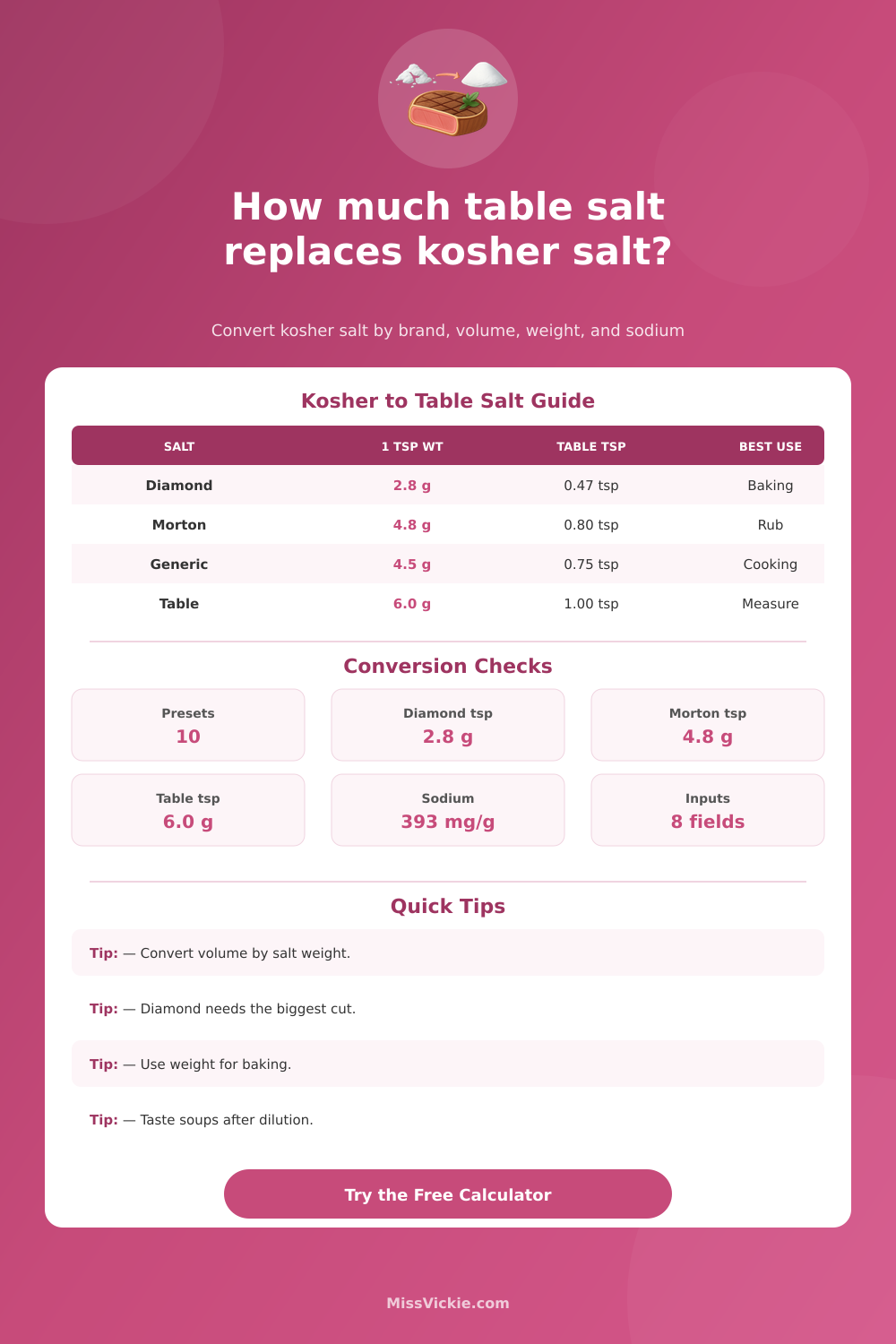
2.8 g
Diamond Crystal tsp
4.8 g
Morton kosher tsp
6.0 g
Table salt tsp
393 mg
Sodium per g salt
Weights are practical kitchen averages for level measures. Use a scale for baking, curing-style formulas, or any recipe where small salt changes matter.
| Kosher salt source | Approx. g per tsp | Table salt for 1 tsp kosher | Why it changes |
|---|---|---|---|
| Diamond Crystal kosher salt | 2.8 g | 0.47 tsp table salt | Large hollow flakes fill a spoon lightly. |
| Morton coarse kosher salt | 4.8 g | 0.80 tsp table salt | Denser crystals pack closer together. |
| Generic coarse kosher salt | 4.5 g | 0.75 tsp table salt | Typical coarse flakes sit between the two major styles. |
| Generic flake kosher salt | 3.2 g | 0.53 tsp table salt | Broader flakes weigh less by the spoonful. |
| Fine kosher-style salt | 5.4 g | 0.90 tsp table salt | Fine grains behave closer to table salt by volume. |
| Original kosher salt | Diamond to table | Morton to table | Generic coarse to table |
|---|---|---|---|
| 1/4 teaspoon kosher | scant 1/8 teaspoon | about 1/5 teaspoon | about 3/16 teaspoon |
| 1/2 teaspoon kosher | about 1/4 teaspoon | about 2/5 teaspoon | about 3/8 teaspoon |
| 1 teaspoon kosher | about 1/2 teaspoon | about 4/5 teaspoon | about 3/4 teaspoon |
| 1 tablespoon kosher | about 1 1/2 teaspoons | about 2 2/5 teaspoons | about 2 1/4 teaspoons |
| 1/4 cup kosher | about 2 tablespoons | about 3 tablespoons plus 1 teaspoon | about 3 tablespoons |
| Measure | Table salt weight | Estimated sodium | Per 4 servings |
|---|---|---|---|
| 1/8 teaspoon table salt | 0.75 g | 295 mg sodium | 74 mg each |
| 1/4 teaspoon table salt | 1.5 g | 590 mg sodium | 148 mg each |
| 1/2 teaspoon table salt | 3.0 g | 1,180 mg sodium | 295 mg each |
| 1 teaspoon table salt | 6.0 g | 2,360 mg sodium | 590 mg each |
| 1 tablespoon table salt | 18.0 g | 7,080 mg sodium | 1,770 mg each |
Volume Match
Fast for soups and weeknight cooking, but risky when switching between Diamond Crystal and table salt because the spoon weight changes sharply.
Weight Match
Best for baking, dough, spice blends, and brines. Matching grams keeps saltiness and sodium closest to the original recipe.
Taste Adjustment
Best for sauces, stews, and dressings. Convert low, dissolve fully, then taste after liquid, acid, and fat are balanced.
Dry Rubs
Use weight when possible because table salt has smaller grains and distributes more intensely across the same surface area.
Brines
Use grams per liter or grams per quart. Volume conversions can push brines far above or below the planned salinity.
Finishing Salt
Table salt is not a true finishing salt substitute. The calculator can reduce volume, but the texture will still taste sharper.
When using a recipe that calls for kosher salts but only has table salt available, it is important to understand that kosher salt and table salt are not the same. The difference between kosher salt and table salt is that each type of salt have a different weight per spoonful of the salt. Because the weights of each type of salt are not the same, it is impossible to assume that using kosher salt for a recipe will have the same amount of salt as if the recipe had called for table salt.
A calculator is provided that will allow a cook to perform the calculations necesary to ensure that both types of salt are used in equivalent amount. The difference in the two types of salt is due to the physical structure of the salt crystals. Kosher salt crystals is large and leave extra air within the measuring spoon.
Convert Kosher Salt to Table Salt
Table salt crystals are fine and small, and pack tightly within the measuring spoon. Because of these different structures, a teaspoon of table salt will weigh more than kosher salt. As a result, if the measurements are not adjusted for this difference, the cook may add too much salt to the foods being prepared.
In addition to the salt brand used in the recipe, the different brands of kosher salt have vary amounts of density of the crystals. For example, Diamond Crystal kosher salt is much more lighter and fluffy in composition compared to brands like Morton kosher salt. For these reasons, the cook must select the brand of kosher salt that will be used in the recipe in the calculator.
In addition to the brand of kosher salt that is to be used in the recipe, the type of table salt will also change the weight of the salt that should be used. For example, iodized table salt has a different density than plain table salt, fine sea salt, or pickling salt. Each of these salt will impact the weight of the salt that should be measured for the recipe.
The type of table salt that will be used in the recipe can also have an impact upon the salt concentration in the recipe, especially if it is a brine or baking recipe. Depending upon the purpose of the salt that is to be used in the recipe, the amount of salt that is added to the recipe should be varied. For baking recipes, salt impacts the development of gluten in the bake goods.
In the case of brines, the concentration of the salt will determine the amount of moisture that the meat will hold. Finally, in dry rubs and seasoning soups, the texture of the salt crystals are important. However, when using salt to season a soup, the level of salt that is used in the recipe is the most important factor.
Salt is a source of sodium. Salt contains approximately forty percent sodium by weight. Because all brands of salt have the same percentage of sodium, the total amount of salt that is used will impact the total amount of sodium in the recipe.
The calculator will estimate the amount of sodium that will be present in the recipe if the amount of salt that is indicated in the recipe is use. Additionally, the recipe will divide the total amount of sodium by the number of servings that will result from the recipe. This allows cooks to understand how much sodium each person who eats the recipe should consume.
Depending upon the type of recipe that is to be prepared, different types of rounding may be preferred in relation to the amount of salt that is to be used in the recipe. For example, some cooks prefer to round the amount of salt indicated in the recipe down to allow for the addition of more salt after the recipe is cooked. Others may prefer to use the exact amount of salt indicated by the recipe.
For example, if the recipe is a soup, it may be easy to add more salt once the soup is cooked. However, if it is a baked good, it may be impossible to fix the amount of salt that is contained in the recipe. When using salt in dry rubs and seasoning recipes, the texture of the salt is one of the factors that will impact the even distribution of salt upon the food that will be cooked.
Because table salt crystals are smaller than those in kosher salt, table salt will coat the foods more complete. For these reasons, a recipe that uses table salt may require more precise measurement of the amount of salt to ensure that the foods are evenly salted, but will result in the same level of saltiness in the food. Finally, while the salt conversion calculator will provide a start to the amount of salt that should be used in the recipe, the salt will interact with the other ingredients in the recipe.
The total amount of salt will be adjusted to provide an accurate measurement of salt to use in the recipe, but additional salt may need to be added once the recipe is cooked to adjust for these interactions between the salt and the other ingredients. Thus, it is necessary to measure the amount of salt that the calculator indicated, but to taste the food to determine if additional salt should be added to enhance the flavor of the food.