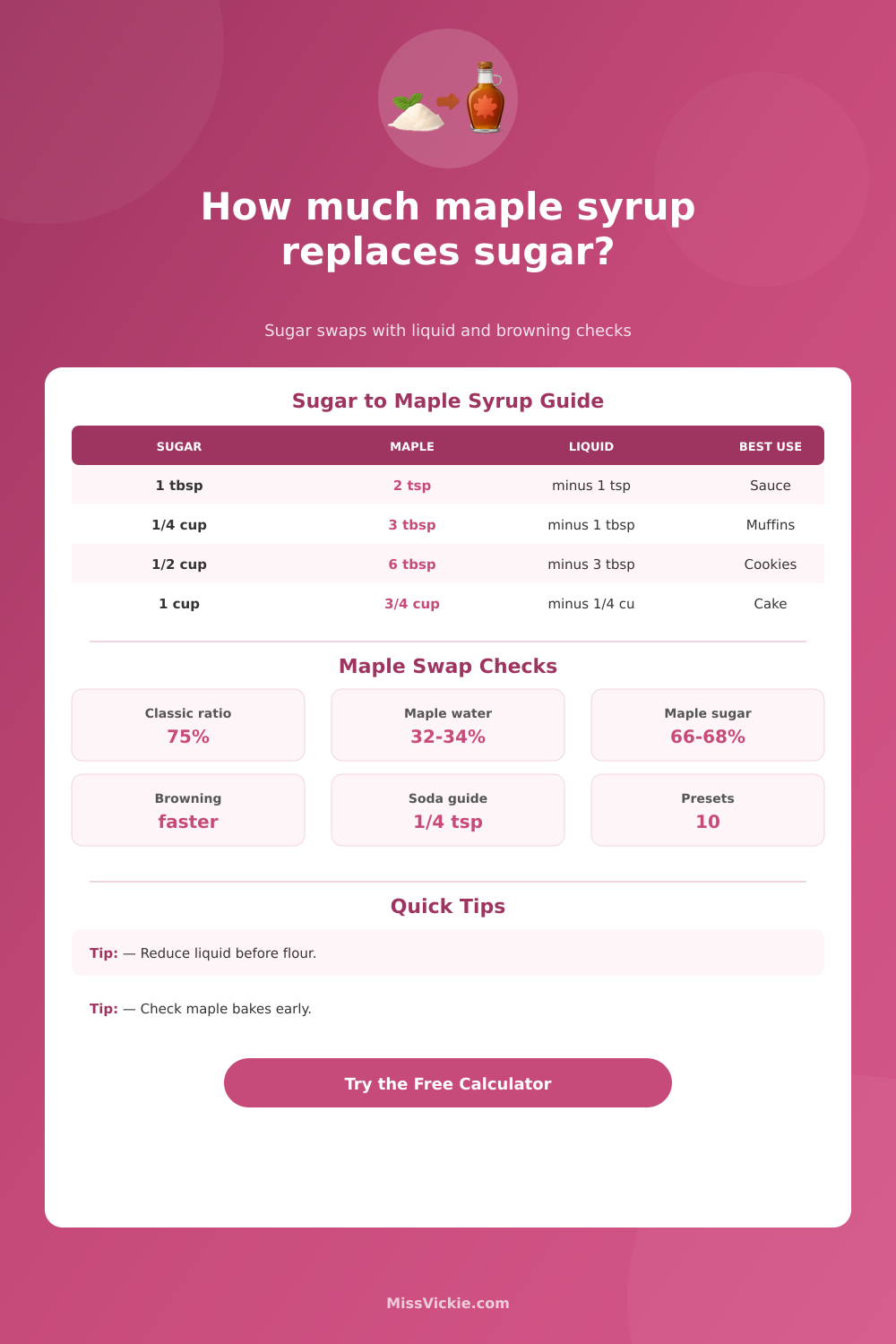
MissVickie maple swap math
Sugar to Maple Syrup Conversion Calculator
Convert granulated sugar, brown sugar, powdered sugar, coconut sugar, raw sugar, and more into maple syrup with sweetness matching, liquid reduction, acidity balance, browning risk, and recipe-type guidance.
Presets fill the sugar amount, sugar type, maple grade, target sweetness, recipe type, oven heat, and liquid controls. Use one as a shortcut, then fine-tune the fields for your recipe.
Full breakdown
Recipe readout
Run the calculator to see liquid, sweetness, acidity, browning, and recipe-type advice.
Classic white sugar swap
Brown sugar swap
Powdered sugar swap
Coconut or raw sugar swap
When the recipe has plenty of liquid
When the recipe has little liquid
When reducing liquid is not possible
Baking soda support
Browning speed
Maple grade choice
Muffins, cakes, and quick breads
Cookies, bars, and brownies
Sauces, glazes, oatmeal, and drinks
Reduce liquid before adding extra flour
Liquid reduction keeps the recipe closer to the original formula. Add flour, cocoa, oats, or starch only when there is not enough liquid to remove or the batter still looks loose after resting.
Control browning early
Maple syrup can make edges darken before centers set. If color matters, use amber maple, lower the oven slightly, line the pan, and start checking doneness a few minutes sooner.
This calculator gives practical kitchen estimates for recipe testing. Maple syrup brands, sugar moisture, flour absorption, pan color, oven calibration, and mixing method can change the final result, so use the readout as a strong starting point and note your best batch adjustments.
Enter the original sugar amount and choose the sugar type. The calculator converts that sugar to grams, estimates its sweetness contribution, and then calculates a maple syrup amount using maple solids, grade strength, and your chosen sweetness factor.
The liquid reduction is just as important as the syrup amount. Since pure maple syrup contains water, the tool estimates how much milk, water, juice, or other liquid to remove so the batter or dough does not become too thin.
The browning and acidity notes help you decide whether to lower heat, check earlier, or add a small amount of baking soda in recipes where maple acidity and fast browning can change the crumb.
When you replace granulated sugar with maple syrup in a recipe, you are changing more than just the sweetness of the foods. In addition to the water, acidity, and color that is contained within maple syrup is a distinct flavor of maple syrup that will behave differntly in the oven than granulated sugar. Additionally, because maple syrup contain water, you cant simply replace granulated sugar with maple syrup in a recipe.
You must also consider the effect that the moisture and acidity in maple syrup will have upon the final flavor and texture of the food. Many people attempt to use a simple three-quarter ratio to replace granulated sugar with maple syrup. However, a simple ratio is typically insufficient for achieve the best results with maple syrup.
How to Replace Sugar with Maple Syrup
For example, each type of sugar have a different density allowing some to replace more granulated sugar than others. Additionally, each grade of maple syrup contains a different amount of sweetness than another grade of maple syrup. Finally, each recipe has a different ability to handle the extra moisture introduced by maple syrup.
The maple syrup conversion calculator will ask for the original amount of granulated sugar in the recipe. The calculator will also ask for the type of sugar that you would like to use as a replacement for granulated sugar. The conversion calculator will also ask of the grade of maple syrup.
This particular variable is necessary as darker, more robust grades of maple syrup contains more dissolved solids than the golden, delicate grades of maple syrup. Consequently, food with darker maple syrup will brown more quickly than food with golden, delicate maple syrup. Finally, the conversion calculator will also ask of the amount of liquid in the recipe as maple syrup contains water, and darker maple syrup contains even more water than lighter grade of maple syrup.
If you intend upon baking in a high oven temperature, the browning from maple syrup may be noticeable very quickly. Liquid reduction is one of the reasons why many home bakers fails when attempting to use maple syrup instead of granulated sugar. Maple syrup contains approximately one-third water.
Thus, when using maple syrup in place of granulated sugar you must reduce the amount of liquids in the other ingredients of the recipe. For instance, if you are baking a dry dessert like shortbread cookies, the addition of maple syrup may lead to the addition of extra flour or extra oats to the recipe to neutralize the effect of the extra moisture of the maple syrup. The acidity of maple syrup is another reason why you must consider the use of maple syrup in place of granulated sugar.
Maple syrup is mildly acidic. This acidity can play a role in the baking process with recipes that contain baking powder, baking soda, buttermilk or cocoa powder. Recipes that contain buttermilk or cocoa powder will typically handle the acidity of maple syrup.
Recipes that contain only baking powder may create a flatter texture when using maple syrup instead of granulated sugar. The maple syrup conversion calculator will let you know if the acidity of maple syrup will play a role in your recipe and the flavor of the finished product. Another factor to consider when replacing granulated sugar with maple syrup is the risk of browning.
Maple syrup contains invert sugars that will caramelize at a faster rate than the granulated sugar used in the original recipe. For instance, if the oven is set to 350 degrees the edges of the food may brown too fast when using maple syrup. One way to avoid this is to reduce the oven temperature 15 or 20 degrees.
The alternative is to cook the food five minutes earlier then the recipe suggests. The type of recipe you are attempting to bake will also play a role in how maple syrup will react to the food. For instance, muffins and quick bread typically have a loose batter that can absorb the extra moisture from maple syrup.
However, cookies and pie fillings will have a much tighter structure to them and may be more sensitive to the extra moisture from maple syrup. Thus, the maple syrup calculator will provide different suggestions for cookies and pie fillings compared to muffins and quick breads. Finally, there are other variables in the kitchen that the maple syrup conversion calculator does not account for.
For instance, the calculator will not account for the humidity in the kitchen where the recipe is being baked or the specific brand of maple syrup. Thus, your first attempt at using maple syrup may be your test run with maple syrup. Pay close attention to the consistency of the batter mixture and the color of the food while it is baking.
By paying attention to the color and consistency of the food while baking, you can adjust the recipe to better account for maple syrup for the next batch of the same food being prepared.