MissVickie kitchen calculator
Sugar to Agave Conversion Calculator
Replace granulated, brown, powdered, raw, or coconut sugar with agave while adjusting sweetness, liquid reduction, browning, recipe style, and hydration so the swap behaves better in real recipes.
Each preset fills the calculator with a realistic sugar-to-agave swap. You can still adjust sugar type, agave style, liquid reduction, browning control, hydration, and recipe scale.
Calculation breakdown
Hydration readout
Run the calculator to see sweetness, liquid, browning, and recipe texture guidance.
Total sugar mass after recipe scaling and sugar-type density.
Calculated syrup amount based on sweetness and recipe behavior.
Estimated water already entering the recipe through the syrup.
Agave water left after reducing recipe liquid.
Protect the recipe structure
Sugar does more than sweeten. It adds dry bulk, traps air with fat, helps cookies crisp, and controls water. Agave is a liquid sweetener, so structural recipes need smaller test batches.
Reduce liquid in stages
Use the calculator's liquid reduction as a target, but hold back only part of the recipe liquid at first. Flour brand, cocoa, fruit puree, eggs, and pan size can change the final hydration.
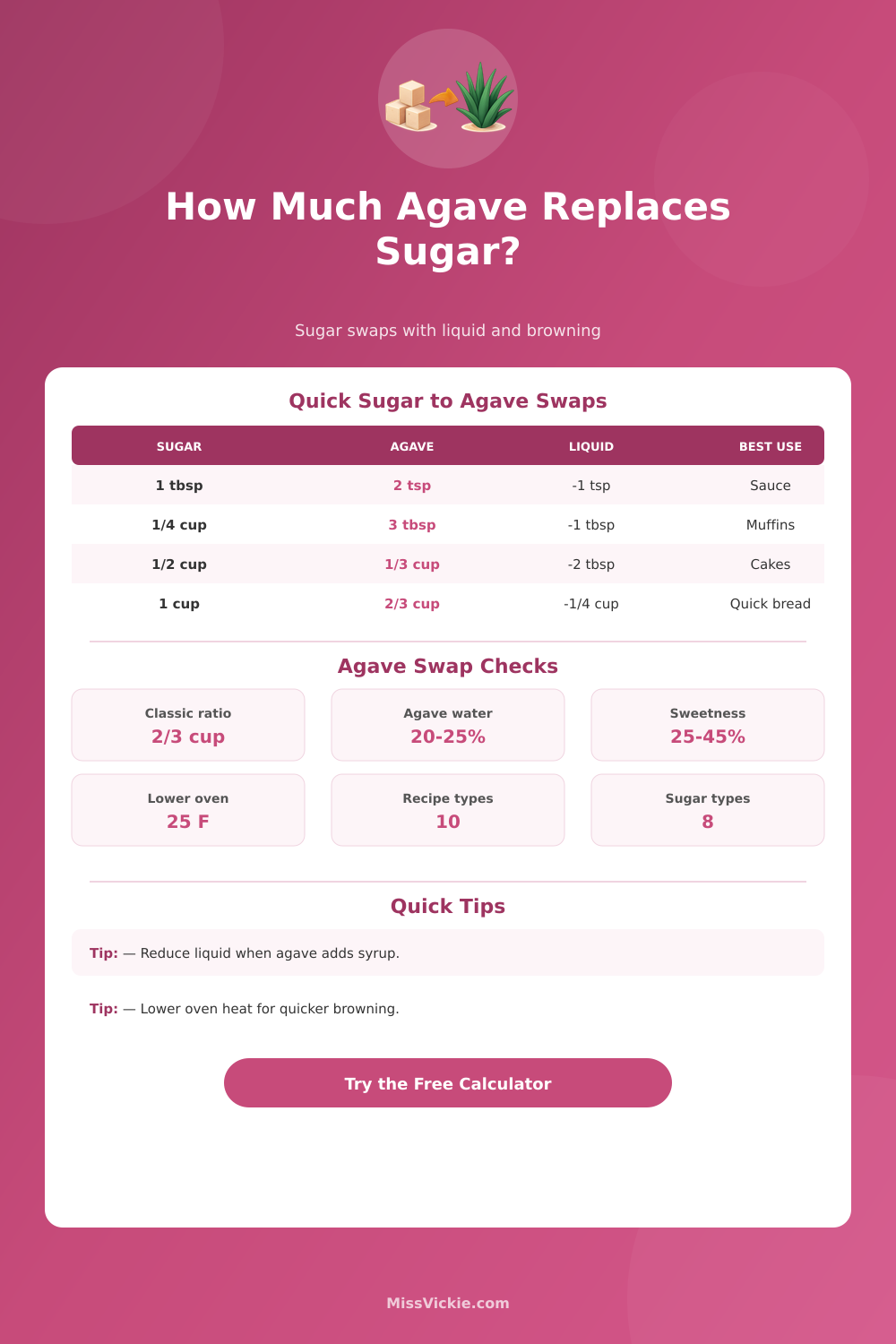
This sugar to agave conversion calculator treats the swap as a sweetness, syrup, liquid, browning, and recipe-structure problem. The common rule is to use about two-thirds as much agave as sugar, but cakes, cookies, drinks, sauces, yeast doughs, and granola do not all need the same adjustment.
Use the agave amount as the sweetener replacement, then use the liquid reduction to keep the batter or dough from becoming too wet. For drinks, sauces, and glazes, reduction may be optional. For cookies and yeast dough, hydration and browning deserve extra attention.
When you replace granulated sugar with an agave syrup in a recipe, the texture and the appearance of the resulting baked goods may change. The texture may spreads too much or the surface may brown too quick compared to the recipe’s expectations. Granulated sugar do more than provide sweetness to a recipe; it also provides dry bulk, moisture control, and even influence the way the recipe browns.
Agave syrup, by contrast, only provides sweetness but in a liquid form that introduces moisture to the recipe. Because of this introduction of liquid to the recipe, it is necessary to adjust the amount of liquid and the baking temperatures of the recipe. The calculator will help you to determine the amount of agave syrup you should use by asking you to enter information about the type of sugar you are using, the amount of sugar you are using, and the type of recipe you are creating.
How to Use Agave Syrup Instead of Granulated Sugar in Baking
The calculator will weigh the sweetness of the sugar you are replacing with agave syrup relative to the weight of the sugar itself. The calculator will calculate the amount of agave syrup needed to achieve the same level of sweetness as the sugar that is being replaced. Agave syrup is significantly sweeter than granulated sugar so this must be accounted for in the recipe.
Agave syrup contain water, which will change the consistency of the batter or dough. The calculator will calculate the amount of water contained in the agave syrup being used and suggest how much of the other liquid in the recipe should be removed. For instance, if you are using agave syrup in place of granulated sugar in a batch of muffins, the batter will be able to absorb some of that extra moisture.
However, if you are using agave syrup in place of granulated sugar in a batch of cookies, the cookie dough will not be able to absorb that moisture. If you add too much moisture to cookie dough, the cookies will spread too far on the baking sheet. Thus, depending upon the type of baked good being made, the setting for the type of recipes will have to be changed.
Another factor that must be considered is the browning of the foods. Because agave syrup contains elements that allow for browning at a faster rate then granulated sugar, the calculator will also ask for the type of agave syrup being used, the type of sugar that is being used in the recipe, and the category of the recipe being made. Based upon these answers, the calculator will suggest whether you should lower the baking temperature or whether the baked goods should be checked for doneness at an earlier period than suggested for most recipes.
The type of sugar being used will also influence the requirements of the agave syrups. For instance, if the sugar that is being used is brown sugar, the chewiness and flavor of the recipe will change with the use of agave syrup. Powdered sugar contain elements like starch that agave syrup does not contain.
Lastly, coconut sugar has a different texture and flavor than granulated sugar. The recipe will adjust the ratio of agave syrup to sugar substitutes according to the type of sugar that is being replaced. In some cases, it may also be necessary to add ingredients like molasses to compensate for flavor change.
There is a variety of factors in the kitchen that the calculator cannot account for. For instance, the protein content of the flour may vary between batches of flour. The amount of liquid that different brands of cocoa powder absorb may vary.
Both eggs and fruit puree contain liquid ingredients. The type of pan in which the recipe is cooked will also impact the amount of time it takes for the edges of the food to cook. While the amount of liquid indicated by the calculator is a good starting point for measuring the liquids for the recipe, it is likely that some of the liquid will have to be held back until baking time in order to account for these variable in the kitchen.
The rows indicated under the “Reference Rows” indicate the amount of agave syrup to use in recipes that use various amounts of sugar, from a tablespoon to a cup. Both the amount of agave syrup and the amount of liquid that needs to be removed scales according to the amount of sugar that is being used in the recipe. The amount of liquid that must be removed from recipes that use agave syrup do not increase in a linear fashion due to the interaction of the water in the agave syrup with the rest of the recipe.
Many people finds that using agave syrup in place of granulated sugar in their baking is difficult. If people understand that the use of agave syrup will impact both the sweetness and the liquid of the recipe, however, they will experience more predictable result with their baked goods. For instance, because cookies require dry bulk, it is possible to use agave syrup in place of granulated sugar but also must adjust the baking of the cookie dough by chilling it or reducing the amount of fat in the recipe.
Cakes tend to be able to tolerate extra moisture so agave syrup can be used in place of granulated sugar but the baking temperature may need to be reduced so the surface of the cake sets before the interior is fully cooked. The same principles can be applied to recipes that are not baked. For instance, using agave syrup in place of granulated sugar in recipes like glazes or lemonade will rarely pose a problem due to the liquids already contained in these recipes.
However, in recipes like salad dressings or barbecue sauce, the same amount of liquid can simply be tasted as it is being prepared since the difference in the amount of liquid will not impact the outcome of the recipe. In sauces, there is no need to protect the crumb of a cookie or the structure of a cake structure. Thus, understanding the impact of agave syrup on baking allows for individuals to understand in what ways the recipe can be changed.