MissVickie baking swap math
Shortening to Butter Conversion Calculator
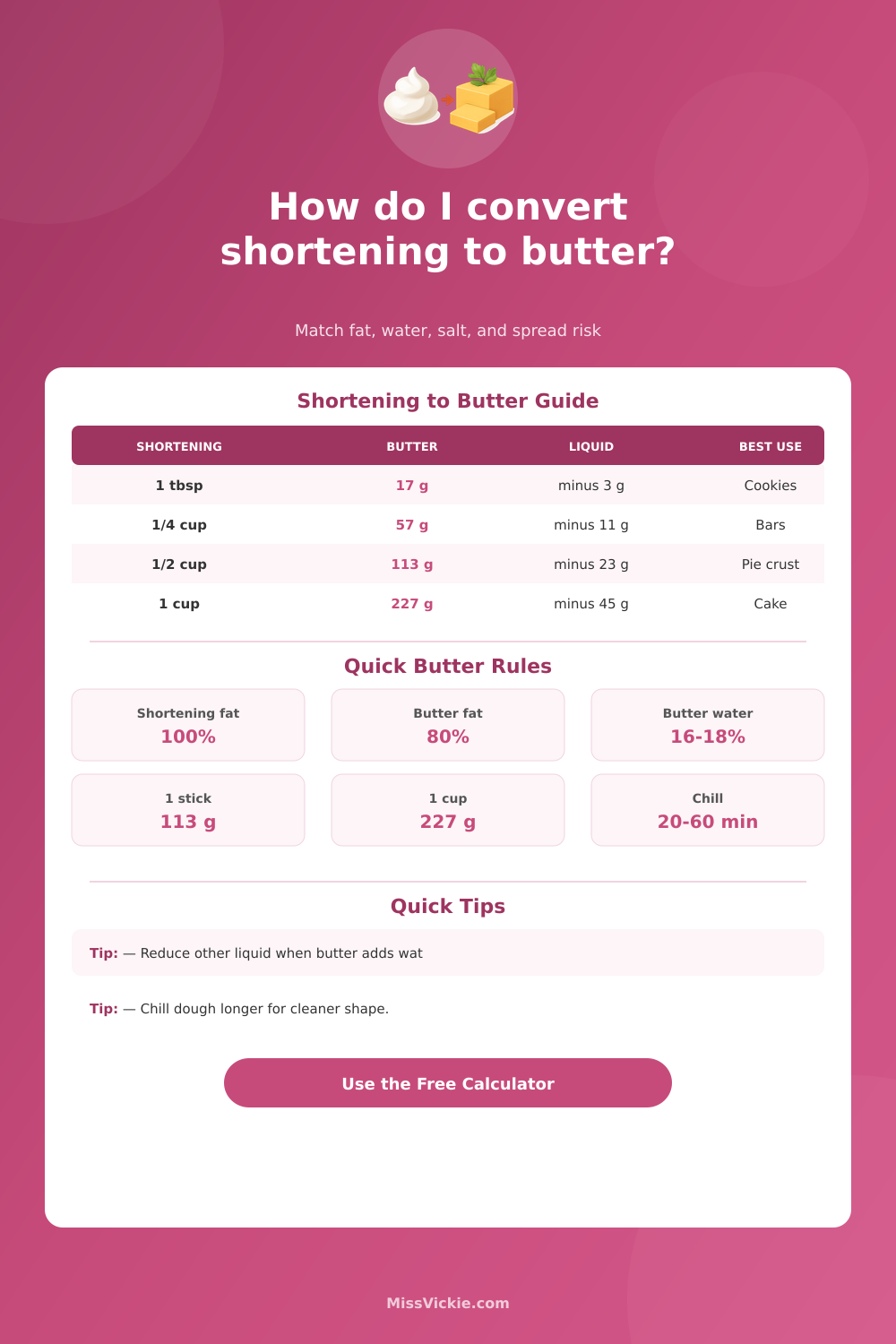
Convert shortening into butter with more than a one-for-one guess. This calculator estimates butter needed for fat equivalence, added water, liquid reduction, salt adjustment, chilling time, and spread risk by recipe type.
Pick a common baking use, then adjust any field. Presets change the shortening amount, butter water content, recipe style, salt option, and handling controls.
Full breakdown
Handling readout
Run the calculator to see water, fat, chill time, salt, and recipe-type advice.
Small cookie batch
Classic half cup swap
One cup shortening
Metric recipe
Cookies
Pie crust
Cake and muffins
Frosting
Unsalted butter
Salted butter
High-water butter
European-style butter
Use grams for the cleanest swap
Shortening is lighter per cup than butter, so cup-for-cup swaps can feel easy but may not match fat. Weighing lets you control fat equivalence and water reduction instead of guessing.
Chill for shape, reduce liquid for texture
Chilling firms the butterfat and slows spread. Reducing milk, water, or juice offsets the extra water that butter brings into the dough or batter.
This calculator is a practical baking-planning tool. Butter brands, shortening formulas, flour absorption, oven temperature, and mixing style can change the final texture, so use the result as a strong test-batch starting point.
When you replace shortening with butter in a recipes, you are altering the fat content and the moisture content of the dough that will be baked. Shortening, a 100% fat ingredient, will keep your cookies tall and your pie crusts flaky. Butter contribute flavor and color to baked goods, but also contains water and milk solids that shortening do not contain.
Because of the water content of butter, it is necesary to adjust the recipe to compensate for the difference in moisture content between the two ingredient. The calculator perform the mathematical calculations necesary to determine the amount of butter and liquid to remove from a recipe in order to use butter instead of shortening. The calculator can determine the correct amount of butter if you use the fat content of the ingredients as the measuring variable, the total volume of ingredients as the measuring variable, or a combination of the two variables.
How to Use Butter Instead of Shortening
Each of these variables will impact the amount of butter that the calculator recommend, as well as the amount of liquid to remove from the recipe. If the recipe to be altered also contains liquids such as milk, juice, or water, you can reduce those liquids to compensate for the water content of the butter. If the recipe does not contain liquids other than water, however, it will be necesary to use chilling time and a dry buffer to accommodate for the softer texture that butter will provide to the dough.
The fat percentage of the ingredients is the first variable that will impact the outcome of the baked goods. Shortening is almost 100% fat, but most American butter contains approximately 80% fat. European butters, however, contain a higher percentage of fat than American butter.
Thus, you will need less of the European butter than American butter to provide the same fat content to the recipe. The calculator allow for adjustments to the fat content and water content percentages of the butter. The amount of butter needed will change according to the adjusted percentages of the fat content of the butter.
Water is another ingredient that many people does not consider until the dough is too soft for comfort. Butter contains 16-18% water, by weight, and some European butters and baking spreads may contain even more water than American butter. The additional water to the dough will loosen the texture of cookies and pie crusts, and cause cake batter to spread too far in the baking pan.
The calculator will estimate the amount of water that the butter will add to the recipe, and will compare that to the amount of liquids that are already contained in the recipe. If there is enough liquid in the recipe to account for the water in the butter, the calculator will provide the amount of liquid to remove to the baker. If the recipe does not contain enough liquid to account for the water in the butter, however, the spread risk will be more higher on the recipe with butter than with shortening.
Not all recipes will behave the same when butter is used in place of shortening. Drop cookies will spread more when shortening is replaced with butter. Thus, the calculator will adjust the recommended chilling time for drop cookies.
For pie crusts, the butter must be cold and the dough rested. Cake and quick breads can handle more moisture, but the crumb of the cake may become denser with more water if the milk is not reduced. Frosting will also be impacted by the presence of butter rather than shortening, as the butter will melt more quickly on a warm day.
Thus, the risk score for frosting will be higher, and the recommendation will be for chilling the frosting prior to pipe it onto the cake. The last ingredient to consider when using butter in place of shortening is salt. Salted butter will contain 1/4 of a teaspoon of salt per stick of butter.
If the recipe to which the butter is to be added also contains salt, this additional salt may become very noticeable in the finished baked goods. The calculator will alert the baker to this additional salt in the butter, and allow the baker to decide whether or not to reduce the amount of added salt to the recipe. For casual cookies and bars, the extra salt is acceptable.
For items like biscuits or cakes, however, it is best to use unsalted butter. Another way to adjust for the softer texture of butter is to use chilling time for the dough. The more chilled the butter is, the less the dough will spread on the baking baking sheet.
Thus, the calculator will indicate the amount of chilling time require for each type of recipe. If the dough feels too loose after substituting butter for shortening, the baker can fix the dough by chilling for an additional twenty or thirty minutes. Pie dough, however, will require more resting time for the butter to remain in distinct pieces within the dough.
The spread risk meter on the calculator will include considerations of recipe type, butter temperature, water content, and chilling time. A medium risk score indicates that the baked goods will be acceptable as they are, but a higher risk score will indicate steps to take with the recipe to ensure the best outcome. The value of the calculator is that it allows bakers to consider the trade-offs of using butter instead of shortening.
Using butter improves the flavor and browning of baked goods, but may cause issues with the texture of items such as cookies and pie crusts. Thus, the calculator allows bakers to consider these different trade-offs, and to decide whether flavor is more important than the shape and repeatability of the baked goods. After the calculator provides the baker with the amounts of butter and other ingredients to use in the recipe, it is recommended that the baker use the recipe to prepare and bake a small batch of the goods.
Within the small batch, write down the amount of butter to be used, the amount of liquid to be removed, and the amount of chilling time to be used. Bake a small portion of the recipe, and note the spread and texture of the baked goods. Use this information to adjust the chilling time or the amount of buffer (flour) to be used in the next batch of baked goods.
Bake the recipe several times with this new ingredient substitution. Over time, the baker will be able to remember which setting works best with which type of recipe. While the calculator provides the baker with the figures necessary to prepare the recipe, the texture of the baked goods will still depend upon the baker’s experience and the way in which the dough feel when squeezed in the hands.