Dough Volume Calculator
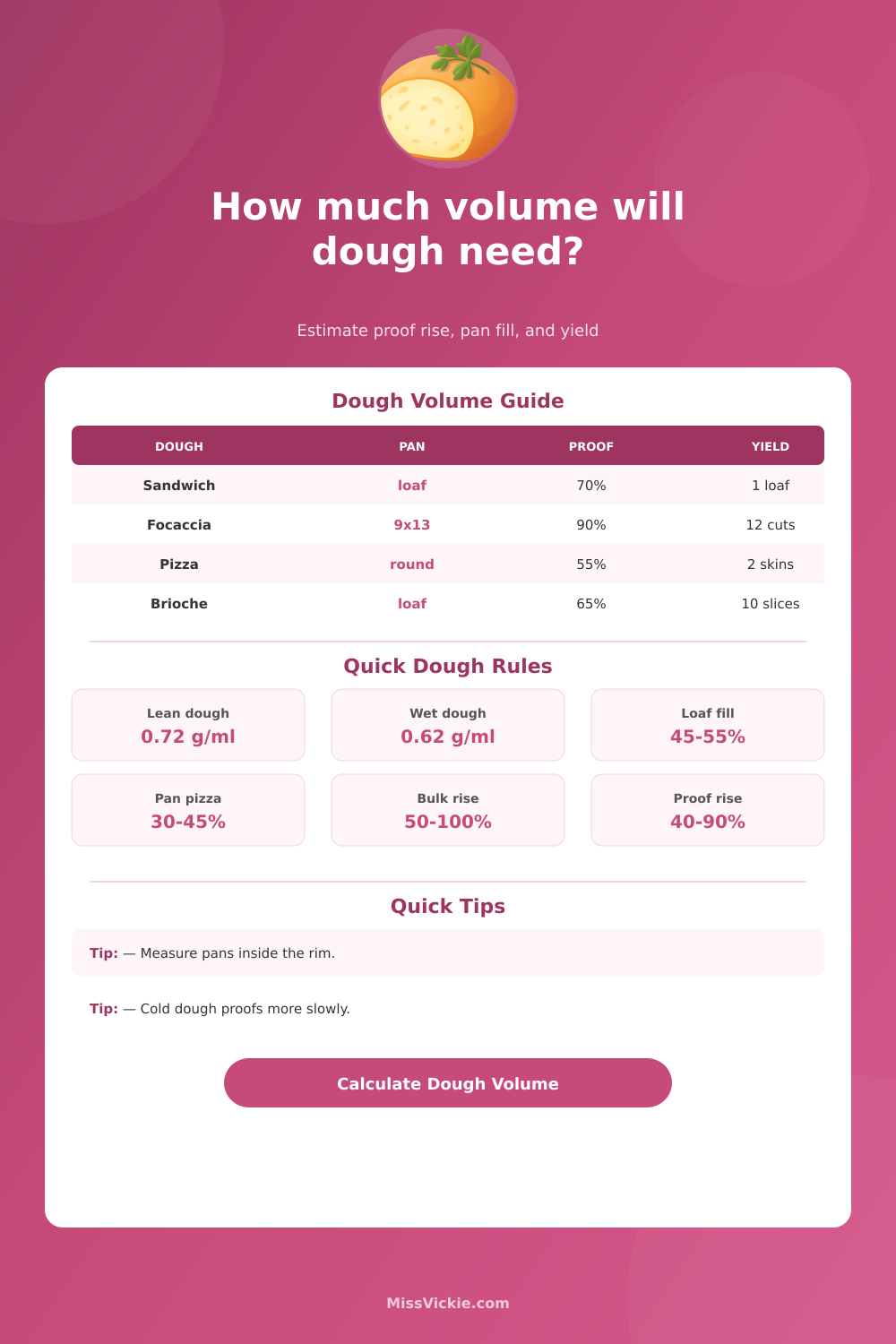
Estimate how much space dough needs from mixing through bulk fermentation, final proof, pan fill, and portion yield. Use it for sandwich loaves, enriched dough, focaccia, pizza, rolls, buns, and shaped breads.
Dough and pan presets
Choose a starter profile, then adjust the dough weight, density, hydration, rise, proof expansion, pan dimensions, and target fill height.
Calculator inputs
Detailed dough volume breakdown
Volume and proof tables
Dough density reference
| Dough style | Typical density | Hydration | How it behaves |
|---|---|---|---|
| Stiff bagel or pretzel dough | 0.78 to 0.86 g/ml | 50 to 58% | Compact, slow expansion, strong shape retention. |
| Lean sandwich bread | 0.68 to 0.76 g/ml | 60 to 68% | Moderate volume, predictable loaf pan rise. |
| Pizza and flatbread dough | 0.66 to 0.74 g/ml | 58 to 72% | Spreads wider when warm, needs room for gas. |
| High hydration focaccia | 0.58 to 0.66 g/ml | 75 to 95% | Loose, airy, large bubbles, fast pan coverage. |
| Enriched brioche or roll dough | 0.70 to 0.80 g/ml | 50 to 65% | Butter and sugar slow proof but support oven spring. |
Density changes after mixing, folds, fermentation, degassing, and shaping. Use the table as a starting point, not a fixed rule.
Pan fill height guide
| Pan or item | Raw fill | Proof target | Reason |
|---|---|---|---|
| Pullman loaf | 45 to 55% | 75 to 85% | Leaves controlled room for squared sides and lid movement. |
| Open sandwich loaf | 40 to 50% | 70 to 85% | Lets the crown rise above the rim without spilling. |
| Focaccia tray | 20 to 35% | 45 to 65% | Low dough spreads across the pan before dimpling. |
| Cinnamon rolls | 30 to 45% | 65 to 85% | Space between rolls closes during final proof. |
| Deep dish pizza | 25 to 40% | 45 to 70% | Needs room for sauce, cheese, and oven spring. |
The calculator compares your target fill height with the actual dough volume so you can scale before the pan is crowded.
Proof expansion timing
| Proof look | Volume change | Use for | Watch point |
|---|---|---|---|
| Slightly puffy | 25 to 40% | Pizza, pretzels, bagels | Dough should spring back quickly when poked. |
| Noticeably expanded | 50 to 70% | Lean loaves, buns, rolls | Poke mark slowly fills but does not collapse. |
| Nearly doubled | 80 to 100% | Focaccia, soft dinner rolls | Surface feels airy and gently wobbly. |
| Very airy | 110% or more | High hydration doughs only | Risk of weak gluten, overproofing, or overflow. |
Temperature, yeast amount, sourdough strength, sugar, fat, and salt can all shift proof timing even when the volume target is the same.
Yield planning shortcuts
| Item | Common dough per piece | Pan note | Serving cue |
|---|---|---|---|
| Dinner rolls | 55 to 75 g | Space with small gaps before proof. | 1 to 2 rolls per person. |
| Burger buns | 85 to 110 g | Use rings or a sheet pan. | 1 bun per sandwich. |
| Cinnamon rolls | 75 to 110 g | Arrange cut sides up with room to swell. | 1 roll per serving. |
| Bagels | 105 to 130 g | Proof on sheet, not a deep pan. | 1 bagel per serving. |
| Sandwich loaf | 650 to 950 g | Scale to pan size and desired crown. | 10 to 16 slices per loaf. |
For equal baking, portion dough by weight first, then use volume as the second check for pan crowding and proof height.
Dough type comparison grid
Good all-purpose profile for sandwich loaves, rolls, and basic yeasted breads. It usually doubles cleanly without turning slack.
Needs wider pans and gentle handling. Volume can climb quickly during bulk, but the dough may spread instead of rising tall.
Butter, eggs, milk, and sugar add tenderness but slow yeast activity. Expect a softer rise curve and longer proof window.
Bagel, pretzel, and low hydration doughs take less space per gram. They need less pan depth but more mixing strength.
Two practical proofing tips
How the calculator thinks
- Dough volume starts with weight divided by density. A 900 g dough at 0.72 g/ml starts near 1,250 ml before fermentation expansion.
- Bulk fermentation rise is applied before the final proof. If a dough rises 75%, its volume is multiplied by 1.75.
- Proof expansion is applied after bulk volume. That final number is compared with pan capacity and target headroom.
- Pan fill height is area times height. Rectangle pans use length times width; round pans use pi times radius squared.
- Yield divides the dough weight and estimated finished weight by the number of pieces so rolls, buns, bagels, and slices are easier to plan.
Dough weights and dough volume are two different measurement of dough. To understand how dough expand during the fermentation process, it is important to understand the relationship between dough weight and dough volume. Dough weight is a measurement of mass of the dough.
Dough volume is a measurement of the amount of space that the dough occupy. During the fermentation process, dough expands, which increase the volume of dough without increasing the weight of the dough. Several factors affect the relationship between dough volume and dough weight that must be considered to ensure that the volume of dough will fit into the pan in which it will be baked.
Dough Weight and Volume
Density is a measurement of dough weight in terms of dough volume. The density of the dough determines the relationship between dough weight and dough volume. Lighter, lower density dough will occupy more space then heavier, high-density dough.
Because low-density dough contains more air bubble, it will expand more quickly during the fermentation process than high-density dough. A calculator that take into account the weight of the dough and the density of the dough can convert dough weights into dough volumes. High-hydration dough contains more water than low-hydration dough.
High-hydration dough has a lower density than low-hydration dough because the water in the dough allow the bubbles of gas that are create during fermentation to expand. The higher the hydration level of the dough, the lower the density of the dough and the higher the volume of the dough. Low-hydration dough might also expand during fermentation because the gluten in the dough can trap the gas bubbles.
However, because the low-hydration dough is firmer, it have a higher density. It is important to consider both the hydration and the density of the dough because each of these factor impacts the volume of dough. Bulk fermentation and final proof are two separate stage of the fermentation process.
During bulk fermentation, the dough is left alone before it is shaped. During final proofing, which occur after the dough has been shaped, the dough is placed into the pan. The volume of the dough increase during both bulk fermentation and final proofing.
It is essential to plan for the volume of dough during these two stages of fermentation. Pan geometry refer to the shape of the baking pan. Different pan shapes will produce different sized loaves of bread.
A narrow pan will force the dough to expand in only one direction, causing the loaf to be taller. A round pan will distribute the expansion of the dough differently than a narrow pan because the rounded sides of the pan will allow the center of the loaf to expand. The inside dimension of the pan are essential to consider when determining the volume of dough that will be baked in the pan.
These inside dimensions represent the amount of space that the dough will occupy. These inside dimensions are more important than the outside dimensions of the pan. Headroom is the amount of empty space between the top of the dough and the top of the pan.
Some type of dough require more headroom than other types of dough because they will expand more quickly during the fermentation process. The amount of headroom will inform bakers about any adjustments that must be made in the recipe for that type of dough. For instance, bakers may need to change the dough weight or change the type of pan in which the dough is baked.
If there isnt much headroom in the pan, it is possible that the dough will overflow the pan. Yield planning is the process of dividing the total weight of the dough into individual piece. When dividing the dough into individual pieces, the volume of each individual piece of dough is also divide.
Small pieces of dough may occupy the same pan as other small pieces of dough and may actualy crowd them. A large piece of dough will have more room to expand than a small piece of dough. A calculator can divide dough into individual weights and volumes.
With this information, bakers can make a decision about if the individual pieces will fit into the pan. The effect that temperature and timing has upon the rate at which the dough increases in volume is important to consider when planning a recipe. However, temperature and time are not variables that is included in the calculation of dough volume.
Dough that is colder will expand at a slower rate than dough that is warmer. Cold dough can be used in recipes if a baker desires to slow the expansion of the dough. Dough that contain ingredients like sugar and fat is called enriched dough.
Enriched dough tends to take longer to reach the desired volume than lean dough. It is also important to use the poke test to determine the consistency of the dough. This test allow a baker to physically assess the dough, regardless of the calculation made to determine the proper volume of dough.
By calculating the weight and volume of the dough, a baker can make a comparison between that dough and the baking pan. Based on these calculations, a baker can determine whether the weight of the dough is correct for the baking pan, as well as whether there is enough headroom for the dough to rise. These calculation will reduce the number of surprises that a baker encounters during the baking process.
By performing these calculations in advance, bakers can have a better idea of the volume of dough that will expand and the weight of that dough prior to beginning the recipe.