🍕 Pizza Calorie Calculator
Estimate pizza calories from diameter, shape, crust style, sauce level, cheese amount, topping choice, oil, number of pizzas, slices, and serving size.
Pick a real pizza situation, then adjust size, crust, cheese, toppings, and serving slices to match the pie on your table.
Pizza Inputs
Live Pizza Data
Formula: crust calories by area + sauce by area + cheese weight + topping weight + oil, multiplied by the number of pizzas and adjusted for uneaten edge.
Pizza Calorie Results
Full Calorie Breakdown
Personal round pizza, often 4 slices.
Medium round pizza, often 6 slices.
Large round pizza, often 8 slices.
Extra-large round pizza, often 8 to 12 slices.
| Crust style | Calories per sq in | Typical finished weight | Best use |
|---|---|---|---|
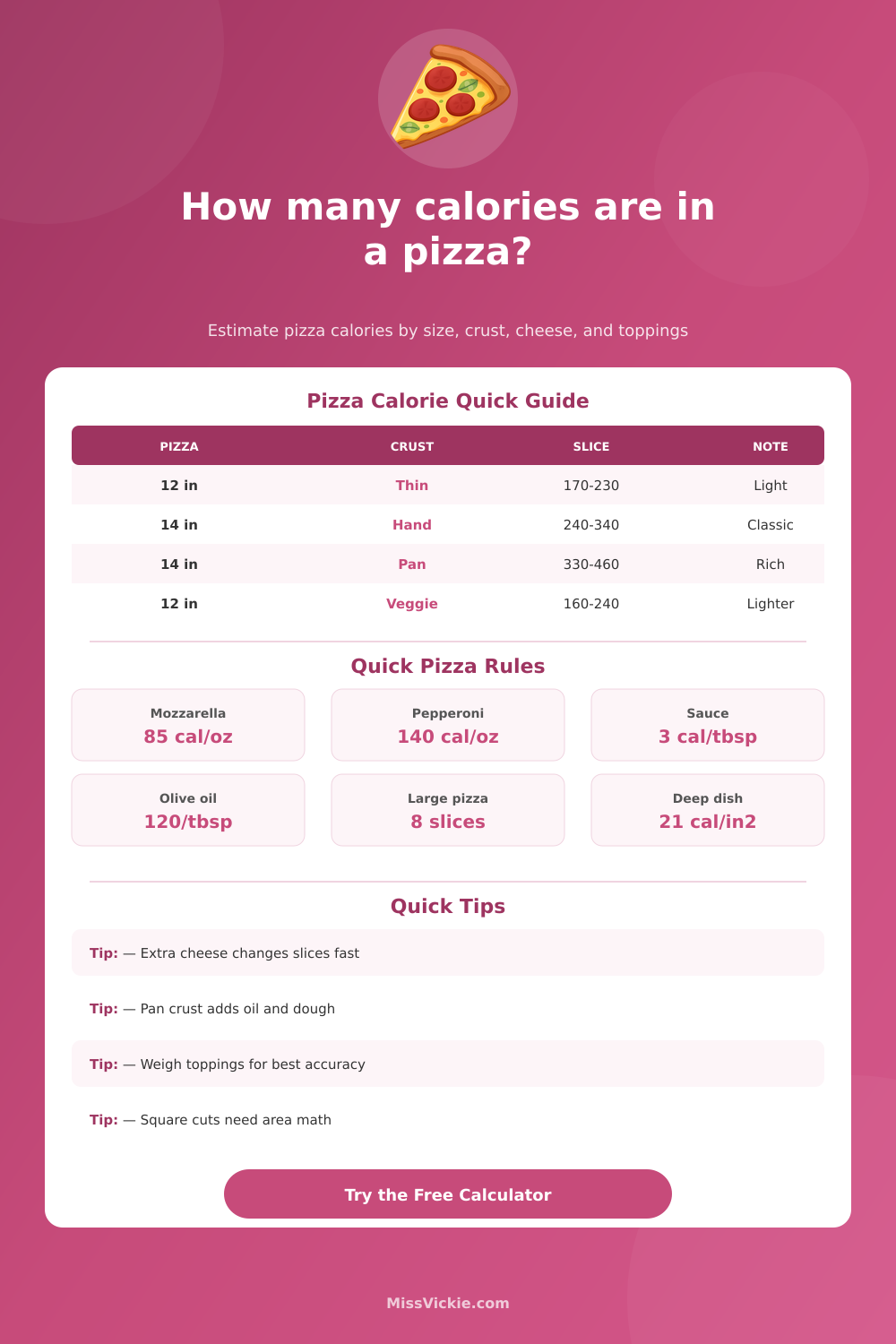
| Thin crust | 9 kcal | About 1.0 g per sq in | Crisp pizzeria pies and lighter slices |
| Hand tossed | 12 kcal | About 1.45 g per sq in | Classic delivery-style round pizzas |
| Neapolitan-style | 11 kcal | About 1.35 g per sq in | Soft center with puffed rim |
| Pan pizza | 17 kcal | About 1.9 g per sq in | Thicker dough with oil in the pan |
| Deep dish | 21 kcal | About 2.4 g per sq in | Very thick crust and tall sides |
| Stuffed crust | 20 kcal | About 2.2 g per sq in | Cheese-filled rim and richer edge |
| Cauliflower crust | 7 kcal | About 1.1 g per sq in | Lower-dough alternative crust |
| Gluten-free crust | 13 kcal | About 1.5 g per sq in | Rice, starch, or blend-based crusts |
| Item | Calories | Calculator rate | Planning note |
|---|---|---|---|
| Part-skim mozzarella | 85 kcal per oz | 0.035 to 0.105 oz per sq in | Most common shredded pizza cheese |
| Fresh mozzarella | 70 kcal per oz | 0.055 oz per sq in | Higher moisture, slightly lower calorie density |
| Vegan cheese shreds | 80 kcal per oz | 0.06 oz per sq in | Often oil and starch based |
| Tomato pizza sauce | 3 kcal per tbsp | 0.035 to 0.09 tbsp per sq in | Low calorie compared with cheese and crust |
| Pesto base | 80 kcal per tbsp | 0.035 tbsp per sq in | Very calorie dense because of oil and nuts |
| Alfredo or white sauce | 45 kcal per tbsp | 0.055 tbsp per sq in | Creamy sauce raises slices quickly |
| Olive oil drizzle | 120 kcal per tbsp | Manual input | Count pan oil, crust oil, and finishing oil |
| Topping | Calories per oz | Typical large pizza amount | Calorie effect |
|---|---|---|---|
| Pepperoni | 140 kcal | 3 to 5 oz | High fat cured meat, one of the biggest movers |
| Italian sausage | 95 kcal | 3 to 5 oz cooked | Dense meat topping; drain well before adding |
| Bacon | 150 kcal | 2 to 4 oz cooked | Small amounts add many calories |
| Ham | 45 kcal | 3 to 5 oz | Leaner meat topping than pepperoni or bacon |
| Grilled chicken | 47 kcal | 3 to 6 oz | Higher protein with moderate calories |
| Mushrooms | 6 kcal | 2 to 4 oz | Very low calorie but adds moisture |
| Peppers and onions | 10 kcal | 3 to 6 oz | Good volume with low calorie impact |
| Black olives | 45 kcal | 2 to 4 oz | Higher fat vegetable topping |
| Pineapple | 14 kcal | 3 to 5 oz | Adds sweetness with modest calories |
| Scenario | Pizza setup | Cut | Typical per-slice range | Why it lands there |
|---|---|---|---|---|
| Personal lunch pizza | 10 inch flatbread, light cheese | 4 slices | 230 to 330 kcal | Small pizza, but each slice is a quarter pie |
| Medium cheese pizza | 12 inch hand tossed, standard cheese | 8 slices | 190 to 270 kcal | Moderate area and no meat toppings |
| Large pepperoni pizza | 14 inch hand tossed, pepperoni | 8 slices | 280 to 390 kcal | Pepperoni and cheese share much of the total |
| Thin veggie pizza | 14 inch thin crust, light cheese | 8 slices | 170 to 250 kcal | Lower crust density and low-calorie toppings |
| Pan sausage pizza | 14 inch pan crust, sausage, extra cheese | 8 slices | 360 to 510 kcal | More dough, pan oil, meat, and cheese |
| Deep dish pizza | 10 inch deep dish, heavy sauce and cheese | 6 slices | 420 to 620 kcal | Small top area but very dense crust and filling |
| Sheet pizza square | 18 x 13 inch tray, 24 squares | 24 squares | 120 to 220 kcal | Smaller pieces make each serving easier to scale |
Counting pepperoni slices is less reliable than weighing the topping pile. A few extra ounces of pepperoni, bacon, or sausage can add hundreds of calories to one pizza.
Square slices, corner pieces, and party cuts are easier to estimate from total pizza calories divided by piece count, then multiplied by how many pieces are actually eaten.
Pizza contain many different variables that can change the total amount of energy contained within the meal. Many people tries to estimate the calories that are contained within a pizza. However, it is difficult to estimate the calories within a pizza due to the different variables of crust, cheese, and toppings.
In order to understand the total calories within a pizza, an individual must examine the specific details of the pizza. One of the first variables to consider are the type of crust for the pizza. Thin crust pizzas will contain more fewer calories than thick crust pizzas.
How to Calculate Pizza Calories
This is due to the fact that thin crust contain less dough than thick crust does. Hand tossed crust will contain more calories than thin crust due to the extra dough within the crust. Pan pizzas and deep-dish crust pizzas will contain extra calories because these crusts contains oil within the pan in which the cook prepares the pizza.
Thus, the type of crust for the pizza is one of the primary factor that will impact the total calories that are prepared for the pizza. Another factor that can impact the calories within a pizza is the amount of cheese that is included within the pizza. A pizza with a double layer of cheese will contain more calories than a pizza that contains a light layer of cheese.
A pizza prepared with fresh mozzarella will contain fewer calories than a pizza prepared with shredded part-skim cheese. In the case of vegan shreds, the calories will differ from dairy cheese. In order to calculate the calories of a pizza, an individual should utilize the calculator to select the type of cheese and the level of cheese within the pizza because the cheese contain a major amount of the calories of the prepared pie.
The toppings that is included on the pizza will also contain calories and will alter the nutritional value of the pizza. Toppings like pepperoni and bacon contain high amount of fat, which will increase the number of calories very quick to the pizza. Vegetables and mushrooms will increase the volume of the pizza but will contain fewer calories.
In order to calculate the calories from the toppings for the pizza, you must enter the weight of the toppings in ounces because this is the most accurate way of measuring the amount of calories that the toppings will contain. The type of sauce and oil that is used on the pizza will also contain variables that impact the total calories within the pizza. Most tomato sauce has fewer calories than sauce like pesto or alfredo sauce because of the oil and nuts that is contained in those sauces.
Any oil that is added to the pizza will also contain additional calories for the pizza. The oil is also an additional input that can be entered into the calculator to allow for the calories from the crust and oil to be separate from one another. These additional calories from the sauce and oil are an impact on the total calories of the pizza because these ingredients will contribute to the total calories of the pizza if many portion of the pizza are consumed.
The shape of the pizza and the way in which it is cut will impact the amount of energy of each portion of the pizza. A round pizza that is cut into eight portions will contain more calories in each portion of the pizza than a round pizza that is cut into twelve portions. Rectangular pizzas that are cut into portions will contain more calories in the corner portion of the pizza than in the center portions of the pizza.
The calculator will ask for the total area of the pizza and the number of portions into which the pizza is divided so that the energy count per portion is calculated in a uniform way. Another factor to consider is the amount of crust of the pizza that is not eaten. Most individual will leave the crust of the pizza on the plate.
Thus, the amount of calories from the crust that is not eaten should be accounted for in the total calories of the pizza. The calculator will account for the uneaten crust of the pizza so that the total number of calories is only for the portion of the pizza that is eaten. This factor is specifically mentioned in the calculator because it is important to ensure that individuals does not count the calories of the crust that they did not eat.
The calculator will allow individuals to input the diameter (or length and width) of the pizza. The type of crust, the amount of cheese, and the toppings can be selected. Once these variables are entered, the calculator will provide the total amount of energy of the pizza and the energy in each slice of the pizza.
This information allow individuals to understand the energy content of the pizza. Through understanding the energy content of the pizza, individuals can make better decisions when choosing among the various types of pizza.