Pizza Calculator
Plan complete pizza batches by count, diameter, dough ball weight, hydration, sauce, cheese, topping load, bake loss, slices, and hungry guests.
Choose a pizza style to load realistic starting values, then adjust every gram. The calculator is built for batch planning rather than only comparing diameters.
Pizza Batch Breakdown
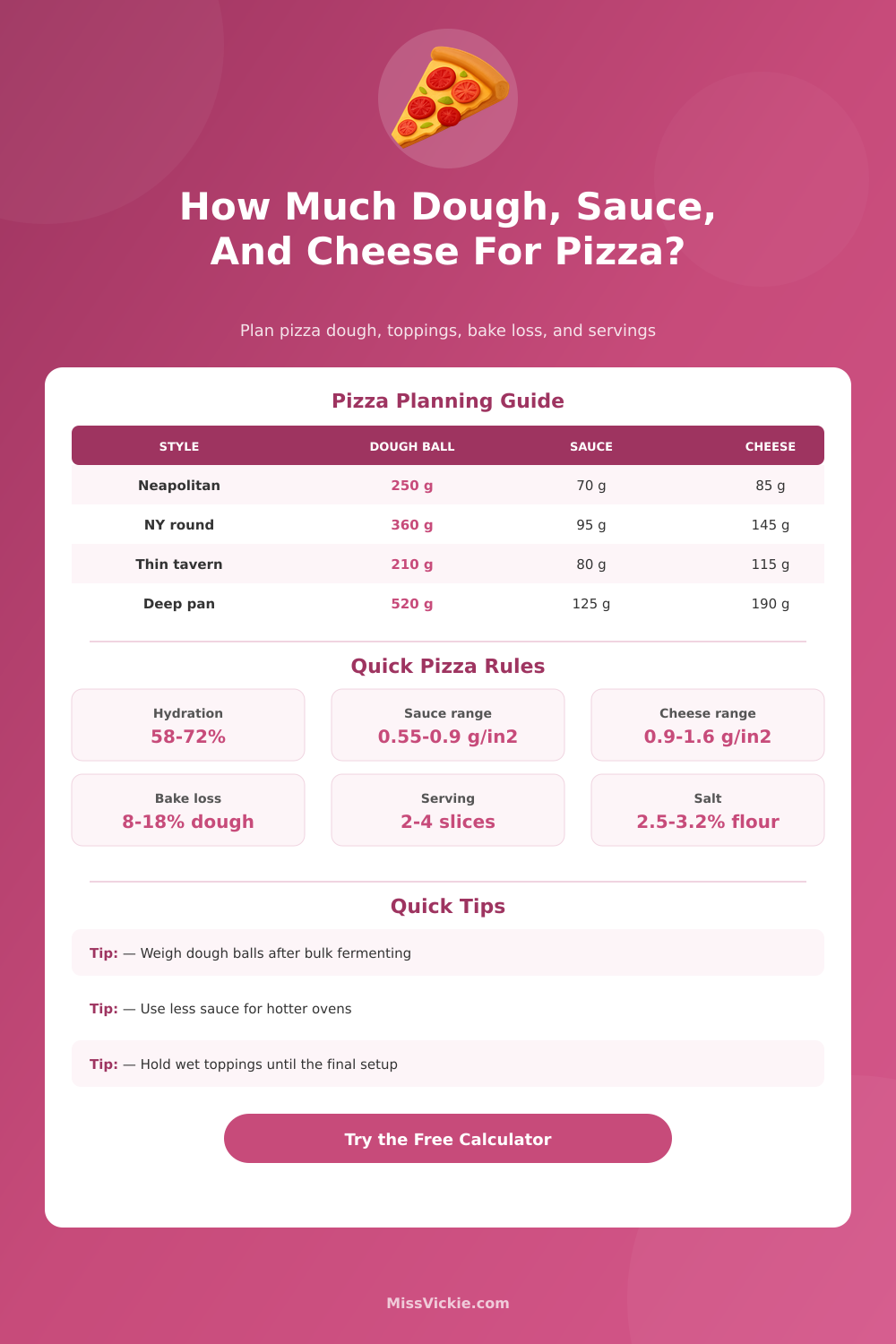
| Pizza style | Common diameter | Dough ball | Hydration | Texture goal |
|---|---|---|---|---|
| Neapolitan round | 10 to 12 in | 230 to 270 g | 60 to 66% | Puffy rim, tender center, fast hot bake. |
| New York round | 14 to 18 in | 400 to 650 g | 58 to 65% | Foldable slice with chew and crisp bottom. |
| Chicago tavern thin | 12 to 16 in | 200 to 330 g | 48 to 56% | Cracker-thin base that cuts into squares. |
| Detroit pan | 8x10 to 10x14 in | 420 to 700 g | 68 to 75% | Airy pan crumb with fried cheese edges. |
| Sicilian tray | 13x18 in | 900 to 1200 g | 65 to 78% | Thick focaccia-like base for party pieces. |
| Layer | Light coverage | Balanced coverage | Heavy coverage | Use when |
|---|---|---|---|---|
| Sauce | 0.45 g per sq in | 0.65 g per sq in | 0.90 g per sq in | Go lighter for wet tomatoes, hot ovens, and thin crust. |
| Low-moisture mozzarella | 0.85 g per sq in | 1.15 g per sq in | 1.55 g per sq in | Good for NY, pan pizza, and family cheese pizzas. |
| Fresh mozzarella | 0.55 g per sq in | 0.80 g per sq in | 1.05 g per sq in | Drain first so the center does not turn soupy. |
| Vegetables | 0.35 g per sq in | 0.60 g per sq in | 0.85 g per sq in | Roast or squeeze watery vegetables before loading. |
| Meat toppings | 0.45 g per sq in | 0.75 g per sq in | 1.05 g per sq in | Pre-cook fatty meats if the bake is short. |
| Oven or pan | Typical bake loss | What evaporates | Planning note |
|---|---|---|---|
| Wood or gas pizza oven | 7 to 11% | Surface moisture from dough and sauce | Short bake means toppings stay juicy, so use restrained sauce. |
| Home oven on steel | 10 to 15% | Dough moisture and cheese steam | Great default for NY and weeknight pizzas. |
| Deep pan pizza | 12 to 18% | Dough water plus sauce concentration | Longer bake browns the edges and reduces final tray weight. |
| Very thin crust | 14 to 22% | More moisture from a shallow dough layer | Expect a snappier crust and a lighter finished pizza. |
| Event | Suggested slices | Pizza style fit | How to adjust |
|---|---|---|---|
| Light lunch | 2 slices per person | NY, tavern, veggie | Add salad or sides if toppings are light. |
| Regular dinner | 3 slices per person | Most round pizzas | Plan one extra pizza for mixed appetites. |
| Game night | 4 slices per person | Pan, Sicilian, stuffed | Use heavier cheese and toppings for staying power. |
| Kids party | 1 to 2 slices per child | Cheese, thin, square-cut | Cut smaller squares to reduce waste. |
Moderate dough ball, lower topping load, wet center, and a soft leopard-spotted rim.
Larger round, medium hydration, generous cheese, and enough dough strength for big slices.
Small dough ball for the diameter, light sauce, edge-to-edge toppings, and square cuts.
High hydration, a thick dough bed, cheese to the edge, and a longer bake for crisp walls.
Moderate pan dough, gentle proof, scattered cheese, and sauce dollops after stretching.
Heaviest batch dough, high water, rectangular serving math, and a sturdy crumb.
Needs extra dough and cheese because the rim is filled before the center is topped.
Uses pizza dough math but treats the filling as enclosed weight with more bake loss risk.
Planning a pizza night means determining the correct amount of dough and the correct amount of toppings. You have to balance the dough with the toppings so that the pizza ends up with the right consistency and the right amount of toppings. The math for one pizza is simple and straightforward.
However, math become difficult if you have to make many pizzas, or if the pizzas require different weights of dough and toppings. Different styles of pizza require different weights of dough and have different hydration levels. Additionally, the amount of sauce and cheese required vary with the size of the pizza.
How to Calculate Pizza Dough, Toppings, and Servings
Making these incorrect calculations can lead to dough that is difficult to work with, or pizza slices that is unbalanced. The calculator makes it easy to compute all of the necessary ingredient for pizza by simply entering the specific numbers for the pizza you wish to prepare. You enter the number of pizzas you want to make, the diameter of the pizzas or the size of the pan in which the pizzas will be baked, the weight of the dough balls, the hydration level for the dough, and the amount of toppings you will use.
Based on these inputs, the calculator will provide the total amount of flour, water, salt, oil, and yeast necessary to prepare the pizzas, the total finished weight of the pizzas after baking, and how many slices will be create from each batch of pizzas. Knowing the number of slices is essential to ensuring that each guest gets enough food to eat. Dough weight is essential to the creation of a pizza.
For instance, Neapolitan pizzas use dough balls that fall within a narrow range of weights. Detroit and Sicilian pizzas, however, have dough balls that contain more water than other types of pizza. The calculator allows you to test the difference between these various type of pizza by altering the weight of the dough ball and the hydration level of the dough.
Altering these two variables will allow you to see the effect upon the total amount of flour and water that is required. Hydration levels affect the texture of the pizza and how the dough is handled. High hydration levels allow the dough to become more extensible and enables the recipe to include more thin New York style pizzas.
However, the higher the hydration levels, the more stickier the dough will be when prepared on a table. Low hydration levels will produce stiffer dough that holds its shape better for thin tavern style pizzas. However, low hydration levels will create dough with tight crumb patterns if the dough is baked for too long.
Lastly, salt, oil, and yeast are measured in percentages of the weight of the flour. Though these ingredients are minimal in quantity, they are still important to the flavor and rise time of the pizza. Should you change any of these values, the calculator will show you the new total amount of each ingredient.
Sauce and cheese ingredients are not the same as the weight of the dough, but the amount of sauce and cheese required vary with the size of the pizza. For instance, two pizzas may have the same weight of sauce. However, the taste of each sauce will vary if one pizza has a 12-inch round diameter and the other is a 10-by-14-inch pan.
The calculator determines the amount of sauce or cheese that will be coated in each unit of area of the pizza. This is helpful if you prepare different types of pizza; thin tavern style crust pizzas can hold more weight of sauce than suggest by the thin tavern style crust. Additionally, a Neapolitan pizza will have less sauce so that the center of the pizza does not become soupy during the baking process.
Toppings follow the same calculations as the sauce and cheese ingredients. Additionally, water content of the toppings should be considered. For instance, vegetables will release some of their water when cooked on the pizza.
Salting or roasting the vegetables prior to placing them on the pizza will balance the water content within the toppings. Additionally, meats with high amounts of fat should not be placed raw on the pizza; they will unbalance the toppings when cooked. Bake loss is a component that is often overlooked when preparing pizza.
Moisture will leave the pizza during the baking process. Wood-fired ovens will lose less of the moisture than home ovens. The calculator will account for the loss of both the dough and wet toppings in the recipe.
The finished weight of the pizza will assist in determining if enough pizzas will be made for the number of guest who will attend the dinner. Slice count determines the number of servings of pizza will be available. For instance, a pizza with eight slices can feed four people for dinner, but a pizza with eight slices can feed six people if the guests also eat the salad.
Additionally, parties may require that each guest is served four slices of pizza to keep the guests full for many hours. The calculator will divide the total number of slices of pizza by the total number of servings to display the result before the pizza cook starts to make the dough. Common mistakes in making pizzas include using too much dough for the toppings, and adding toppings without considering their water content.
These types of mistakes can easily be avoided by using the pizza recipe and batch calculator. One of the benefits of using the calculator is that each variable can be altered and the other variables will change accordingly. For instance, increasing the number of pizzas will also increase the amount of flour and water needed to prepare the pizzas.
Additionally, changing the shape of the pizza from a round to a rectangular pan will change the calculation of how much sauce and cheese is needed to coat the entire pizza. Additionally, increasing the bake loss will decrease the total amount of pizza that will be baked; thus, more pizzas have to be prepared to feed the same number of guest. The cook can make all of these changes quickly without having to calculate the changes by hand.
Pizza preparation requires that the cook find a balance between the weight of the dough, the toppings, and the number of guests that will eat the pizzas. The calculator eliminates the difficulty that is associated with the math for preparing pizzas. For instance, the cook can choose the thickness of the rim of the pizza, how much cheese each guest should have, and how many slices of pizza each guest should eat.
Once the cook makes these choices, the other components of the pizza will follow those selections for the batch of pizzas being prepared.