Baker percentage planner
Ingredient Percentage Calculator
Turn any recipe into baker percentages, compare hydration, fat, sugar, and salt, then scale the formula by flour weight, total dough, batch count, or production loss.
Start with a preset
Presets load practical working formulas. You can edit every number after choosing one.
Enter formula weights
Formula note appears here.
Formula comparison grid
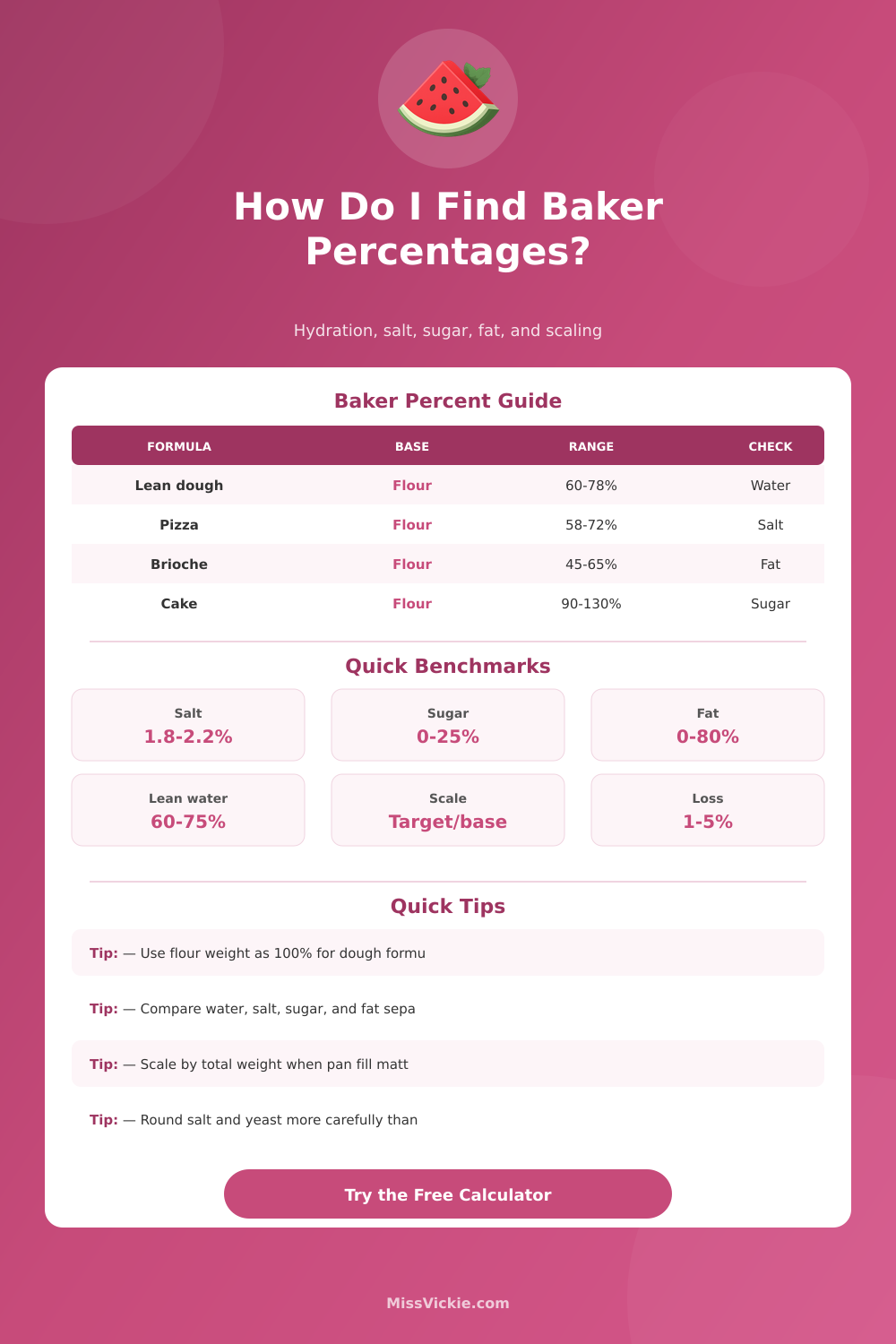
Use these ranges to understand whether your recipe behaves like a lean dough, enriched dough, sweet dough, or batter.
| Formula family | Hydration | Fat | Sugar | Salt | Typical adjustment |
|---|---|---|---|---|---|
| Lean hearth bread | 60% to 78% | 0% to 5% | 0% to 4% | 1.8% to 2.2% | Raise hydration for open crumb; lower for shaping control. |
| Pan or sandwich bread | 58% to 68% | 2% to 10% | 3% to 12% | 1.8% to 2.2% | Fat and sugar soften crumb, so hydration can stay moderate. |
| Pizza and flatbread | 58% to 72% | 0% to 6% | 0% to 4% | 2.0% to 3.0% | Higher salt can slow fermentation and sharpen flavor. |
| Bagels and pretzels | 50% to 58% | 0% to 4% | 2% to 8% | 1.8% to 2.5% | Low water creates chew and keeps pieces compact. |
| Brioche and rich dough | 45% to 65% | 20% to 90% | 8% to 25% | 1.5% to 2.2% | Count butter and eggs carefully because they change mixing strength. |
| Cake style batter | 75% to 130% | 20% to 100% | 70% to 140% | 0.8% to 1.8% | Sugar and fat may exceed flour, so compare structure separately. |
Base percentage table
| Ingredient | What the calculator does | Percent formula | Why it matters |
|---|---|---|---|
| Base ingredient | Sets the recipe anchor at 100%. | Base divided by base times 100 | Every other ingredient becomes easier to compare, scale, and troubleshoot. |
| Water or liquid | Calculates hydration against the base. | Water divided by base times 100 | Hydration affects stickiness, crumb, spread, and cooking loss. |
| Fat | Shows shortening or enrichment level. | Fat divided by base times 100 | Fat tenderizes, slows gluten strength, and changes mouthfeel. |
| Sugar | Shows sweetness and fermentation pressure. | Sugar divided by base times 100 | Sugar browns crust, feeds yeast at low levels, and slows yeast at high levels. |
| Salt | Shows seasoning strength. | Salt divided by base times 100 | Small changes can shift flavor, gluten tightening, and fermentation speed. |
| Focus ingredient | Audits one custom ingredient. | Ingredient divided by base times 100 | Great for comparing oil, seeds, cocoa, cheese, spice, or preferment additions. |
Scaling methods
| Scale mode | Best for | Scale factor | Example use |
|---|---|---|---|
| Target base mass | Classic baker percentage work. | Target base divided by current base | Change 1000 g flour dough to 1500 g flour. |
| Target total formula | Pan fill, order yield, or dough divider planning. | Target total divided by current total | Make exactly 2400 g dough before dividing. |
| Manual factor | Quick doubling, halving, or production multiples. | Entered factor | Use 0.5x for a test batch or 3x for service. |
| Batch multiplier | Repeating the same scaled formula. | Scaled weight times batches | Prepare four identical tubs of focaccia dough. |
| Loss buffer | Real kitchen recovery. | Total times one plus loss percent | Add 2% to cover bowl residue or bench flour. |
Troubleshooting guide
| Result | Likely percentage issue | What to try next | Calculator check |
|---|---|---|---|
| Dough feels slack | Hydration is high for the flour or mixing method. | Hold back 2% to 5% water, then add only if dough can handle it. | Compare hydration card with formula family row. |
| Crumb is tight | Hydration may be low, fat may be low, or salt may be high. | Increase water by 2%, add fat for softness, or verify salt weight. | Review water, fat, and salt breakdown lines together. |
| Fermentation is slow | Salt, sugar, fat, or cold dough may be restraining yeast. | Reduce enrichments for lean dough or extend time and temperature control. | Check sugar, fat, salt, and leavening percentages. |
| Recipe scales poorly | Small ingredients were rounded too aggressively. | Round flour broadly, but keep salt, yeast, and leavening precise. | Switch rounding to nearest 0.5 for sensitive ingredients. |
Tip: treat flour as the anchor
For most bread, pizza, pasta, pastry, and batter work, the base ingredient is flour at 100%. Once the base is fixed, every ingredient becomes a ratio instead of a guess.
Tip: scale total formula when yield matters
If your pan, mold, order sheet, or dough divider needs a precise total weight, scale by total formula first, then var the calculator return the new base and ingredient weights.
Baking require you to understand the relationships between the ingredients in the dough. A change in the amount of any ingredient within the dough can change the type of crumb that will form from the baked bread. The different ingredients relative to the flour influence the type of crumb that forms from the dough, not how much of each ingredient that you scooped from the bag.
Thus, if you think about each ingredient in relation to the others in the dough, you will understand the role that each ingredient play in the dough. The ingredient percentage calculator make it easy for you to do the math for your recipe. However, you have to understand the role of each ingredient before you can use the calculator to determine the weight of each ingredient.
How to Use an Ingredient Percentage Calculator
Flour is the ingredient that will serve as a base of the recipe. All other ingredients will be measured in relation to the weight of the flour. Water will influence the structure of the dough, fat will influence the texture of the baked bread, sugar will influence the browning of the bread and the rate of the fermentation process, and salt will both strengthen the structure of the baked bread and enhance its flavor.
Thus, if flour is considered to be 100% of the recipe, all other ingredients will be expressed as a percentage of that 100%. Many people finds their need for the ingredient percentage calculator when they find that their recipe does not cleanly scale to the amount of dough that they need. For instance, if an individual simply doubles the amount of each ingredient within the recipe, there may be rounding errors that occur in the scaling process.
Additionally, ingredients like salt and yeast has relatively narrow ranges of effectiveness within the recipe. Thus, the calculator allows for the individual to select the method by which the recipe should be scaled to meet either a specific weight of flour or a target weight of total dough. Each day, a baker may have different needs for the dough, some days it is necessary that the recipe is scaled to ensure that each baking pan is filled with dough of the appropriate weight, while other days the baker may simply need to know how much more flour is required to make the dough.
One of the percentages that will be most noticeable to a baker is the hydration percentage. Dough that contains lean country flour and contains 70% of its weight in water will spread under its own weight when baked. Dough that contains 70% of its weight in water will develop large irregular holes when it is baked.
If the hydration percentage is changed to 55%, the dough will be stiff enough to hold sharp edges if the dough is being baked as bagels or pretzels. The ingredient percentage calculator will display the hydration percentage of the recipe, which is one of the elements that will allow bakers to ensure that the dough has the characteristic that they desire for their baked bread. Additionally, the calculator will display the percentages of the fat, sugar, and salt ingredients relative to the weight of the flour in the recipe.
These percentages will be of use to those looking to modify the recipe to transform it from one type of bread to another. The tables included in the recipe provide information about the typical percentage of each ingredient within various categories of bread recipes. For instance, brioche contains 40% fat, while sandwich loaves contains only 5% fat.
Each type of bread uses the same amount of flour, yet the percentage of fat influences the texture of the baked bread. Additionally, cake batters contain a significant amount of sugar and liquid relative to the weight of the flour within the recipe. These percentages help to indicate the balance of ingredients in the recipe, though the egg within the recipe provides the structural element of cake recipes.
It is helpful to place salt and yeast to a greater degree of precision than the other ingredients within the recipe. The ingredient percentage calculator provides a variety of rounding options for each ingredient, the degree of precision for salt and yeast is important, because adding half a gram of salt to the dough will have a different effect on the bread than the addition of five grams of flour. Thus, if an individual is working from an old recipe that does not use precise measurements of each ingredient, the individual can first enter the recipe into the calculator as written, followed by a decision of which ingredient should be rounded to a higher degree of precision before the recipe is prepared.
In the kitchen, there are variables to each recipe that are outside of the ingredient percentage calculator. For instance, the protein content of the flour may change within a growing season, the weight of the eggs may vary, and the amount of water that is contained within the air in the kitchen may affect how much water the dough absorb. Thus, the ingredient percentage calculator provides a stable starting point for the baker to make adjustments to a recipe that is being prepared.
If the dough is found to be too slack when using the calculated percentage of hydration, the amount of water can be reduced for the next batch of dough to be prepared. The same logic that applies to adjusting recipes for baking within the same kitchen can also be applied to adjusting recipes for dietary considerations. For instance, if flour is replaced with whole grain flour, the amount of hydration may have to be increased to account for the difference in absorption of water between flours.
The ingredient percentage calculator will automatically recompute the percentages of each ingredient if any of the base or liquid ingredient are changed. Thus, it is helpful to compare the new recipe to the old recipe that is to be replaced. Many bakers will maintain a notebook of percentages of ingredients that is associated with successful baked bread recipes.
These percentages can then be entered into the ingredient percentage calculator, which will output the weight of each ingredient needed to prepare the bread based on the batch size of the bread that is to be baked. These numbers can be used whenever and wherever dough is to be prepared for baking. The value of the ingredient percentage calculator becomes apparent over time.
A baker will eventually become familiar with the type of hydration that is required to produce different types of bread. The amount of fat in the dough will be recognized as an influence on the rate of proofing of the dough. The amount of sugar in the recipe will be recognized as an influence on the competition for water between the sugar and the yeast within the dough.
These recognitions will develop because of the use of percentages within the recipe. Additionally, the ingredient percentage calculator removes the need to perform the calculations within the recipe, allowing the baker to focus on recognizing these patterns within the dough recipes.