MissVickie Fiber Tool
Fiber Food Calculator
Estimate fiber by food group, portion weight or kitchen volume, serving count, soluble and insoluble split, and progress toward a daily fiber target.
1. Pick a fiber food preset
Values are practical estimates for common cooked or ready-to-eat portions.
2. Enter portion and target details
Use grams for best accuracy, or choose cups, tablespoons, pieces, or label servings.
Example: 1 cup, 2 tbsp, 100 g, or 1 serving.
Use this for meal prep or multiple portions.
Used only when custom target is selected.
Adjust from a nutrition label for custom foods.
The rest is estimated as insoluble fiber. Exact split varies by variety, ripeness, and processing.
Use a label such as bran cereal, pear with skin, psyllium mix, or homemade bean salad.
Cooked lentils fiber estimate
Beans and lentilsFull calculation breakdown
- Food labelCooked lentils
- Food groupBeans and lentils
- Entered portion1 preset serving
- Estimated portion weight198 g
- Serving multiplier1 serving
- Fiber density used7.9 g per 100 g
- Fiber per serving15.6 g
- Remaining fiber to target9.4 g
Soluble vs insoluble split
This serving gives a strong fiber contribution, with most of the fiber estimated as insoluble bulk and a smaller soluble portion.
This calculator is for kitchen planning and nutrition education. Food databases, labels, cooking water, peel, ripeness, and grind size can all change actual fiber values.
Food category comparison grid
A fast way to compare how fiber usually behaves by group.
Beans and lentils
Often the best full-meal fiber builders. Cooked cups commonly land around 12-16 g total fiber.
Whole grains
Oats, barley, bran cereal, and intact grains add steady fiber and can include useful soluble fiber.
Seeds
Chia and flax are dense, so small spoon portions can contribute more fiber than expected.
Fruit
Berries, pears, apples with skin, oranges, and avocado are strong choices for snacks and breakfast.
Vegetables
Vegetables may be moderate per 100 g but become meaningful when portions are generous.
Nuts
Almonds and pistachios add fiber with fat and calories, so portion size matters.
Mixed meals
Bowls, soups, tacos, and salads can combine several fiber sources in one realistic serving.
Label foods
Cereal, wraps, bars, and supplements should use the package label whenever possible.
Fiber reference tables
Use these as planning references when you do not have a nutrition label.
| Food | Typical portion | Total fiber | Group |
|---|---|---|---|
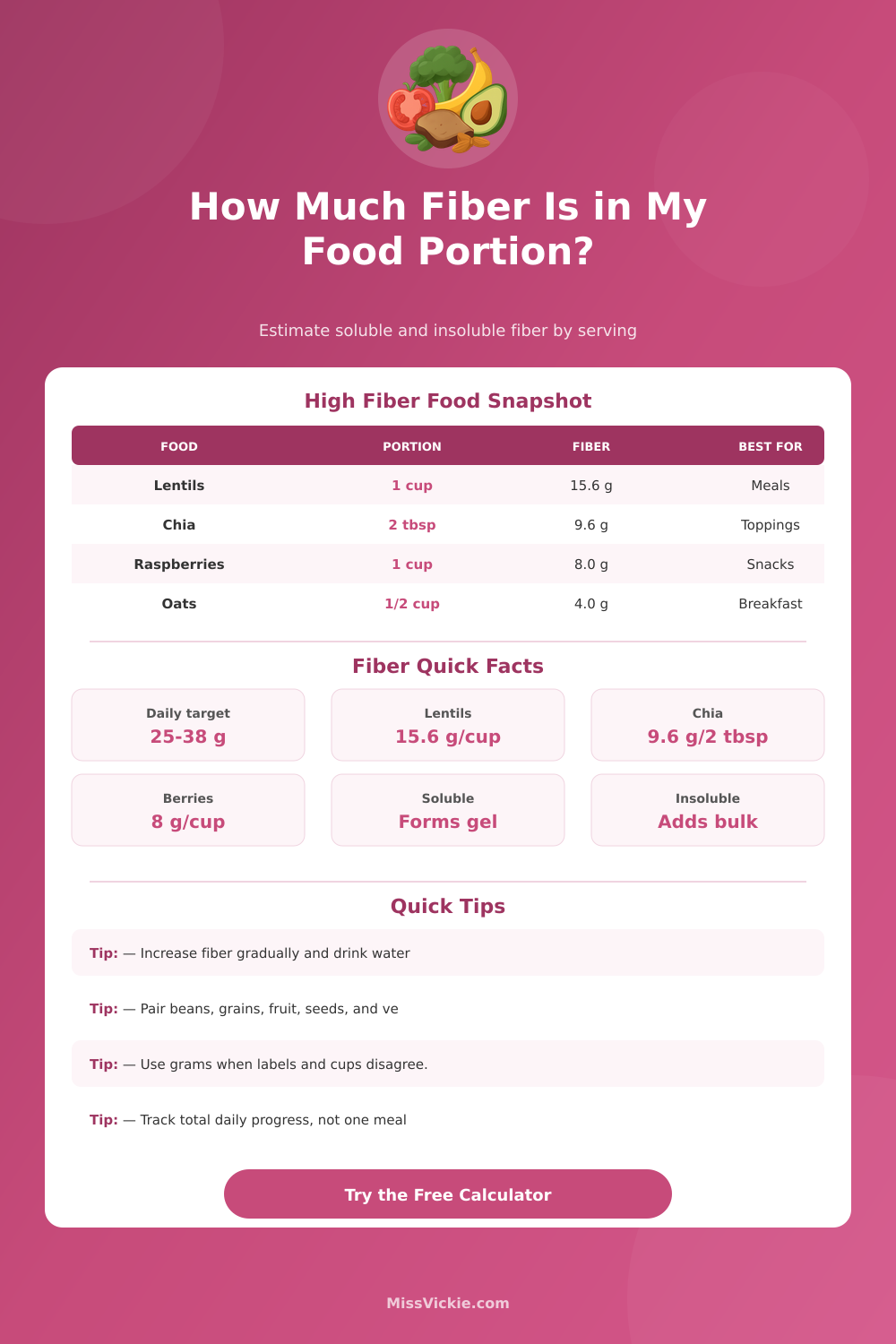
| Lentils, cooked | 1 cup, 198 g | 15.6 g | Legume |
| Black beans, cooked | 1 cup, 172 g | 15.0 g | Legume |
| Chia seeds | 2 tbsp, 28 g | 9.6 g | Seed |
| Raspberries | 1 cup, 123 g | 8.0 g | Fruit |
| Broccoli, cooked | 1 cup, 156 g | 5.1 g | Vegetable |
| Food family | Soluble tendency | Insoluble tendency | Practical note |
|---|---|---|---|
| Oats and barley | Moderate to high | Moderate | Often used when soluble fiber is the goal. |
| Beans and lentils | Moderate | High | Excellent total fiber for soups, bowls, and salads. |
| Seeds | Moderate | High | Grinding or soaking can change texture and serving use. |
| Wheat bran | Lower | Very high | Dense insoluble source, best increased gradually. |
| Fruit with skin | Moderate | Moderate | Peels can add meaningful insoluble fiber. |
| Measure | Food example | Approx weight | Why it matters |
|---|---|---|---|
| 1 cup cooked | Lentils | 198 g | Cooked legumes are heavy and fiber-rich. |
| 1/2 cup dry | Rolled oats | 40 g | Dry grain cups weigh less than cooked cups. |
| 2 tbsp | Chia seeds | 28 g | Small spoon measures can be dense. |
| 1 oz | Almonds | 28.35 g | Useful for snack labels. |
| 1 medium piece | Avocado half | 100 g | Piece size can vary widely. |
| Food move | Estimated fiber | Progress to 25 g | Planning idea |
|---|---|---|---|
| Add 1 cup lentils | 15.6 g | 62% | Build a soup, dal, or grain bowl. |
| Add 2 tbsp chia | 9.6 g | 38% | Use in oats, yogurt, or pudding. |
| Add 1 cup berries | 8.0 g | 32% | Pair with breakfast or dessert. |
| Add 1 oz almonds | 3.5 g | 14% | Use as a snack or salad crunch. |
| Add 1 cup broccoli | 5.1 g | 20% | Round out a lunch or dinner plate. |
Two quick fiber planning tips
Small habits make the calculator results easier to use.
The fiber calculator are a tool that allow a person to determine the amount of fiber that is contained within an specific food. A person can use the fiber calculator to input information regarding the specific food that is being eaten, the portion size of that food, and the daily fiber target of that individual. Based on these inputs, the fiber calculator can calculate the total fiber, the soluble fiber, and the insoluble fiber that is contained within that food.
These calculation help a person to understand the amount of fiber that they are consuming from that food. The information that a person inputs into the fiber calculator is important in determining the amount of fiber in the food that is being evaluate. For instance, different food items has different weights.
How to Use a Fiber Calculator
For instance, a cup of cooked lentils will weigh a different amount than a cup of dry oats, and a cup of cooked lentils will have a different amount of fiber than a cup of dry oats. The fiber calculator allow for different units of measurement to be inputted (such as grams, cups or tablespoons). Grams is often the best unit of measurement to use for these calculation, as the fiber count for each food item can be easily locate on the foods label.
The fiber calculator use these units to ensure the calculations of fiber are accurate. The fiber calculator can provide information regarding soluble fiber and insoluble fiber. Soluble fiber is the type of fiber that can bind to water to form a gel, which can help to slow the rate at which an individual’s blood sugar level increase.
Insoluble fiber is the type of fiber that does not dissolve in water, but which can help to move the food through an individual’s digestive system. Each of these type of fiber can be adjusted using a sliding scale on the fiber calculator. The percentage of soluble versus insoluble fiber for each food item may change based upon the food’s preparation method (such as how it was cooked).
The fiber calculator allows a person to set a daily fiber target. Common targets may be 25 grams of fiber per day, 30 grams of fiber per day, 38 grams of fiber per day, or any number that a person set for themself. Based upon the food that is entered into the calculator, the fiber calculator can display the percentage of a person’s daily target that they have already met, as well as the number of gram of fiber that the person still need to consume to reach their daily target.
This information help to prevent an individual from overestimating the amount of fiber that they are consuming each day. The fiber calculator also include information regarding different food group. For instance, legumes generally contain a high amount of fiber per cooked cup of the food, while seeds tend to contain a high amount of fiber in small spoonful quantity.
Vegetables also contain fiber, but the fiber content may differ according to the volume of the vegetables. The category comparison grid include information about each of these food groups. This grid allows a person to easily compare the fiber content of foods from each group, which helps the individual to make choice that will maximize their fiber intake.
The portion weight and unit conversion are included in the fiber calculator to account for the fact that a cup of food items does not always weigh the same as another cup of food items. For instance, 1 cup of cooked lentils weighs approximately 198 grams, but 1 cup of dry rolled oats weighs only approximately 81 grams. Additionally, a tablespoon of a food item may weigh different than a cup of the same food item.
These conversions are included to ensure that the individual does not have to calculate these weights themself. Reference tables are included for foods that do not have a label. The reference tables include information about foods that contain soluble and insoluble fiber.
While the information on the reference tables will not be as accurate as the food label for that specific food, these table may help a person who is attempting to plan their meal. Finally, the fiber calculator allow for a person to plan their meal to increase their fiber intake. For instance, ground flax can be added to a meal of lentils, or berries can be added to any meal to increase the fiber content of that meal.
The fiber calculator can calculate the fiber content of more than one food item. However, it is important to gradually increase a person’s fiber intake. If the fiber intake increase rapidly, it may lead to discomfort in the body.
In these case, it is recommended that a person also increases their water intake. While the fiber calculator can calculate the fiber content of many foods, the real fiber content of meals may differ from these calculation. For instance, many fruit contain fiber only if their skin is consumed.
Additionally, cooking foods such as vegetables in water will alter the density of those cooked foods. Thus, the fiber calculator cannot account for all of the way in which foods can be prepared. However, the fiber calculator can provide a baseline of fiber content for an individual; this baseline can then be adjusted based upon the fiber content of each food item’s label.
Finally, if a person use the fiber calculator regularly, it is possible that the individual will develop an instinct as to which foods contain the most fiber relative to others. For instance, each person may find that beans and lentils contain more fiber than vegetables of similar volume. Similarly, people may find that seeds contain a high amount of fiber in small amount.
Additionally, individuals may find that fruits that contain skins also contain both soluble and insoluble fiber. Eventually, individuals may no longer need to use the fiber calculator to determine the fiber content of their meal. Instead, they may be able to use their new knowledge to make informed decision about the foods that they eat.